
⚠ Critical Compliance Notice
This document provides operational guidance on peptide vendor vetting procedures and quality verification methodologies. It is NOT an endorsement of any specific vendor, compounding pharmacy, or peptide supplier.
HolistiCare.io does not approve, certify, or guarantee the quality, potency, or safety of any peptide products or suppliers. All vendor selection, quality verification, and procurement decisions remain the sole responsibility of the purchasing practice and must be conducted in accordance with institutional procurement policies, legal counsel guidance, and applicable FDA regulations.
Practices are strongly advised to consult with qualified legal counsel, compliance officers, and institutional procurement specialists before establishing vendor relationships or implementing the vetting procedures described in this document.
Abstract
Peptide therapy has become a high-volume offering in functional medicine, but the supply chain remains one of the least regulated and most quality-variable segments of the pharmaceutical landscape. Compounding pharmacies operate under Section 503A and 503B frameworks with significant variation in quality control rigor. Third-party peptide suppliers range from legitimate research-grade manufacturers to entities with minimal quality assurance infrastructure.
The clinical risk is direct: impure peptides, misdosed formulations, contaminated batches, and products with degraded potency create patient safety incidents that expose practices to both medical liability and regulatory enforcement. The operational challenge is that traditional manual vendor vetting — reviewing certificates, validating lot numbers, tracking cold chain compliance — is time-intensive, error-prone, and does not scale.
This operational guide presents a systematic framework for peptide vendor vetting using AI-assisted quality verification tools. We specify what documentation to require, how to verify it independently, where AI can accelerate and improve accuracy, and how to maintain ongoing surveillance of vendor quality performance. This is not a vendor recommendation list — it is a due diligence process specification.
I. The Peptide Supply Chain Quality Problem
The fundamental issue is not that bad actors exist in the peptide supply chain — though they do. The fundamental issue is that even well-intentioned vendors operate in a regulatory environment with minimal mandatory quality standards, inconsistent enforcement, and no centralized quality database that purchasers can consult.
1.1 Why Traditional Pharmaceutical Supply Chain Standards Do Not Apply
When a hospital pharmacy orders FDA-approved pharmaceuticals, the supply chain quality assurance is largely externalized. The FDA has already inspected the manufacturing facility, validated the production process, and certified that the product meets identity, strength, quality, and purity standards. The hospital’s procurement process verifies licensure and DEA registration, but does not independently verify product quality — because the FDA has already done so.
Peptides do not operate in this framework. The majority of peptides prescribed in functional medicine are:
- Compounded under Section 503A or 503B, meaning they are not FDA-approved drugs
- Sourced from API (Active Pharmaceutical Ingredient) suppliers who may not be FDA-registered
- Manufactured without batch-level FDA inspection or pre-market approval
- Distributed without post-market surveillance equivalent to FDA adverse event reporting
This does not make peptides categorically unsafe — it makes them categorically unverified by the infrastructure that purchasers of traditional pharmaceuticals rely upon. The due diligence burden shifts entirely to the purchasing practice.
1.2 The Four Categories of Quality Failure
Peptide supply chain quality failures manifest in four distinct categories, each with different clinical and regulatory implications:
Each of these failures is preventable through adequate vendor vetting and ongoing quality verification. The question is how to operationalize that verification at scale.
II. The Core Vendor Vetting Checklist: What to Require Before First Purchase
The following checklist specifies the minimum documentation and verification steps required before establishing a vendor relationship for peptide procurement. This is a gating process — vendors who cannot provide these items should not be approved.
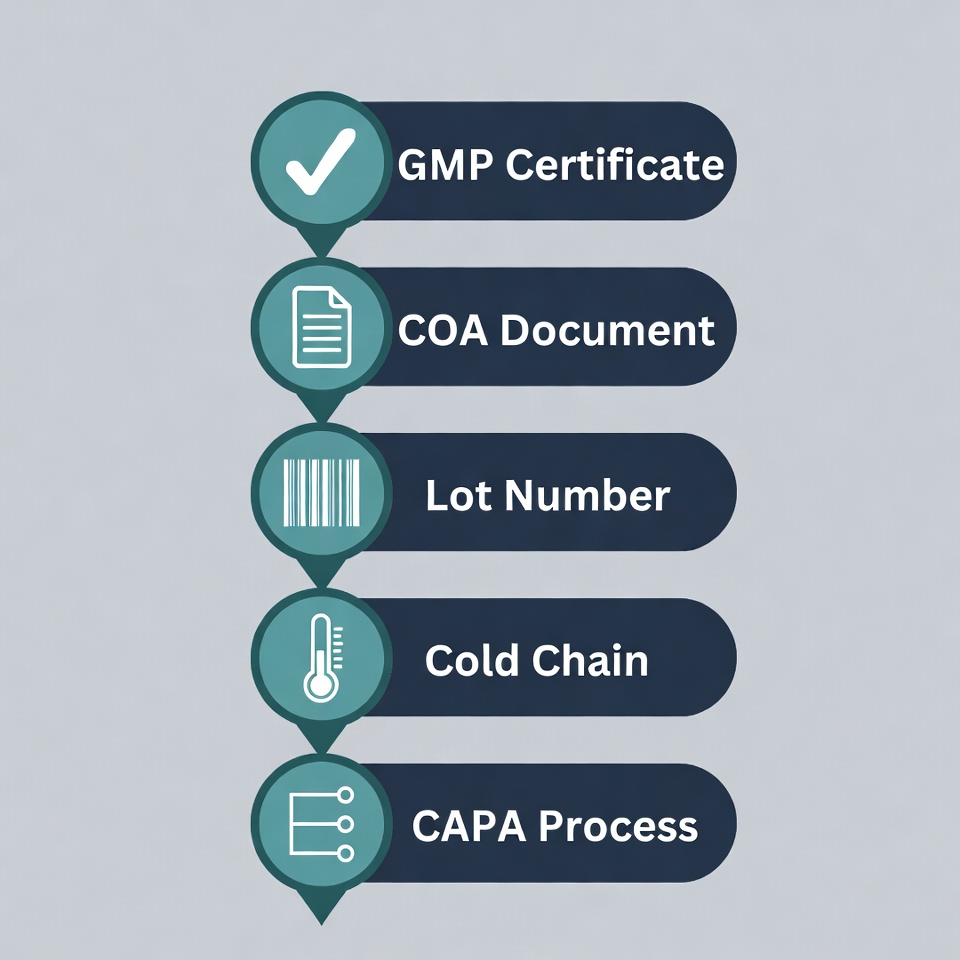
Checklist Item 1: Current GMP Certification or Accreditation
What to Request:
Certificate of GMP (Good Manufacturing Practice) compliance from an accredited certifying body
OR PCAB (Pharmacy Compounding Accreditation Board) accreditation certificate for 503B compounders
OR FDA registration number for 503B outsourcing facilities
How to Verify:
Cross-reference PCAB accreditation via public database: https://www.pcab.org/accredited-entities/
For FDA-registered 503B facilities, verify via FDA Outsourcing Facility database
For international suppliers claiming GMP, verify certifying body is recognized (e.g., ISO 9001, EudraGMDP for EU suppliers)
Red Flags:
Certificate is expired or dated >2 years ago without renewal documentation
Certifying body is not independently verifiable or is not recognized by FDA/international regulatory bodies
Vendor claims GMP compliance but cannot produce certificate (‘in process’ is not compliant)
✓ AI-Assisted Verification Opportunity (OCR-based certificate parsing: Upload GMP certificate → AI extracts facility name, certifying body, expiration date, scope of certification → Cross-references against public databases → Flags discrepancies or expired certifications automatically. HolistiCare's vendor verification module performs this check in ~30 seconds per vendor, vs. 15-20 minutes of manual lookup and documentation.
Checklist Item 2: Certificates of Analysis (COAs) for Each Lot
What to Request:
Batch-specific COA for every lot number purchased, dated within 90 days of purchase
COA must include: identity testing (HPLC or MS), potency assay (% purity), microbial testing, endotoxin testing, heavy metals screening
COA must identify the testing laboratory (in-house or third-party)
How to Verify:
If COA references third-party lab, independently contact lab to verify COA authenticity (vendors have been known to fabricate COAs)
For in-house testing, request evidence of lab accreditation (ISO 17025 or equivalent)
Compare COA values against USP monograph standards where available (many peptides do not have USP standards — flag this limitation)
Red Flags:
COA is undated or predates product manufacturing date (impossible)
COA shows 100% purity (unrealistic for most peptides — typical pharma-grade is 95-98%)
COA does not specify testing methodology (e.g., ‘identity confirmed’ without stating HPLC/MS)
Vendor cannot or will not provide batch-specific COAs (‘representative sample’ COAs are insufficient)
Checklist Item 3: Lot Number Traceability and Chain-of-Custody Documentation
What to Request:
Unique lot number on every vial/package that links to manufacturing batch records
Chain-of-custody documentation showing: raw material source → manufacturing facility → distribution → delivery
API (Active Pharmaceutical Ingredient) source documentation: Where did the raw peptide come from? What is that supplier’s quality certification?
How to Verify:
Request upstream supplier documentation: If vendor is a compounder, who supplied the raw peptide? Can that supplier’s GMP certification be verified?
Cross-reference lot numbers across multiple purchases to ensure uniqueness and non-reuse
For 503B compounders, verify lot number format complies with FDA guidance (NDC-like structure)
Red Flags:
Lot numbers are generic or sequential without date/facility codes (e.g., ‘001’, ‘002’, ‘003’)
Vendor cannot or will not disclose API source (‘proprietary’ is not an acceptable answer for clinical products)
Multiple products from different claimed manufacturers share identical lot number patterns (suggests relabeling)
✓ AI-Assisted Verification Opportunity Lot number pattern analysis: AI ingests all lot numbers from vendor purchases → Identifies non-unique or suspiciously patterned lot numbers → Flags for manual review. COA cross-validation: AI compares lot number on product packaging to lot number on COA → Flags mismatches automatically.
Checklist Item 4: Cold Chain Compliance and Stability Data
What to Request:
Storage and handling requirements: temperature range, light sensitivity, reconstitution stability
Cold chain documentation: temperature monitoring during shipping (data loggers or validated cold packs)
Stability testing data: How long does the peptide remain potent under specified storage conditions?
How to Verify:
For temperature-sensitive peptides, request data logger readouts from shipment (many vendors use single-use temperature monitors)
Compare vendor-stated stability to published literature where available (some peptides have published stability profiles in pharmaceutical journals)
If stability data is proprietary/unpublished, request summary of testing methodology at minimum
Red Flags:
Peptides shipped without cold packs or temperature monitoring for products requiring refrigeration
Vendor claims ‘room temperature stable’ for peptides known to degrade rapidly (e.g., GHK-Cu, some growth factors)
Stability data is absent or vague (‘stable for extended periods’)
Checklist Item 5: CAPA (Corrective and Preventive Action) System Evidence
What to Request:
Documentation that vendor has a formal CAPA system for handling quality complaints, failed batches, and adverse event reports
Example CAPA report (de-identified) showing how a previous quality issue was investigated and corrected
Contact information for quality/regulatory officer who handles CAPA
How to Verify:
Ask for specific examples: ‘Describe a recent batch failure and what corrective action was taken’
Verify that CAPA system is documented (written SOPs, not informal processes)
For 503B facilities, CAPA is FDA-required — absence is a major red flag
Red Flags:
Vendor has no formal CAPA system (‘we handle issues as they arise’)
Vendor cannot provide any examples of past CAPA events (either they have no quality monitoring or they are concealing failures)
Quality/regulatory officer is the same person as sales rep (inadequate separation of functions)
III. Independent Third-Party Testing: When and How to Verify Vendor Claims
The following data fields must be captured, structured, and maintained to current standards:
Even with robust vendor documentation, independent verification through third-party testing is the only way to confirm that the product you received matches the quality claimed on the COA. This is not feasible for every batch, but should be conducted periodically as part of ongoing vendor surveillance.
3.1 When to Conduct Third-Party Testing
We recommend third-party testing in the following scenarios:
- Initial vendor qualification: Before approving a new vendor, send one batch for independent testing to establish baseline.
- High-volume or high-risk peptides: For peptides you prescribe to >50 patients/month or peptides with narrow therapeutic windows.
- Suspected quality issues: If patients report unexpected lack of efficacy or adverse reactions inconsistent with known peptide profile.
- Periodic surveillance: Randomly test 1-2 batches per quarter from each approved vendor to verify ongoing compliance.
- Post-FDA warning letters: If a vendor or their upstream supplier receives FDA warning letter or enforcement action, immediate testing required.
3.2 What to Test For
Third-party testing should focus on the parameters most likely to vary and most clinically consequential:
3.3 Accredited Testing Laboratories
The following laboratory accreditations indicate competence for peptide quality testing:
- ISO/IEC 17025 accreditation (international standard for testing laboratories)
- FDA-registered analytical testing lab (for labs serving pharmaceutical industry)
- USP verification or certification (for labs performing USP method validation)
Do NOT use vendor-recommended labs exclusively — this creates conflict of interest. Identify independent labs with no commercial relationship to vendor.
3.4 Cost and Turnaround Considerations
Third-party peptide testing typically costs $400-$1,200 per sample depending on test panel complexity, with 2-4 week turnaround. This is not negligible, but should be contextualized:
- Cost of testing one batch: ~$800
- Cost of patient adverse event from contaminated peptide: medical management + potential litigation = $50,000+
- Cost of FDA enforcement action for dispensing adulterated product: warning letter response + potential consent decree = $100,000+
The ROI on periodic third-party testing is unambiguous.
Related Resource: For comprehensive peptide safety and quality management infrastructure: HolistiCare Peptide Therapy Platform
IV. AI-Assisted Vendor Performance Monitoring and Alert Systems
The initial vetting process establishes that a vendor is qualified at a point in time. Ongoing performance monitoring establishes that quality is sustained over time. This is where AI-assisted surveillance provides the most operational value.
4.1 Automated COA Validation and Anomaly Detection
HolistiCare’s vendor surveillance module ingests COAs for every batch received and performs automated quality checks:
AI-Powered COA Analysis Potency trend monitoring: Tracks reported potency across batches from same vendor. Flags if potency drops >5% compared to historical average (potential degradation or quality drift). Statistical outlier detection: Compares COA values (purity, microbial counts, pH) against vendor's historical distribution. Flags batches that are statistical outliers. COA format validation: Detects missing fields, inconsistent units, or formatting anomalies that suggest manual alteration of COA. Cross-vendor comparison: Compares COA values for same peptide across multiple approved vendors. Flags if one vendor consistently reports lower purity or higher impurity levels. Expiration date logic check: Verifies that COA date + stated shelf life = expiration date on vial. Flags discrepancies (common when vendors relabel expired inventory).
4.2 Patient Outcome Correlation and Adverse Event Flagging
The most sensitive indicator of peptide quality problems is often patient-reported outcomes. If multiple patients report unexpected lack of efficacy or unusual side effects from the same batch, this is a quality signal that should trigger vendor investigation.
HolistiCare’s clinical intelligence layer can correlate patient outcomes to peptide lot numbers:
- Tracks lot number dispensed to each patient
- Monitors patient-reported outcomes and adverse events
- Flags if a specific lot number is associated with disproportionate adverse events or efficacy complaints
- Automatically generates vendor quality concern report for clinical review
This is not possible in traditional EHR systems where lot numbers are unstructured text in chart notes. It requires structured lot tracking integrated with outcome monitoring.
Related Resource: For automated risk detection and patient safety monitoring infrastructure: Peptide Patient Safety: Automated Risk Flags
4.3 Vendor Scorecard and Automatic De-Qualification Triggers
Based on the performance data collected, HolistiCare generates a quarterly vendor scorecard with automated alerts:
This automated governance layer ensures that vendor quality issues trigger institutional response rather than relying on individual clinician vigilance to notice patterns.
Related Resource: For AI governance frameworks and automated quality monitoring: Human-in-the-Loop: AI Governance for Peptide Therapy
V. Appendix: Vendor Qualification Questionnaire Template
The following template can be adapted for use in initial vendor qualification. Distribute to all prospective peptide suppliers and require completion before approval.
Vendor Qualification Questionnaire (De-Identified Template) Instructions: This questionnaire must be completed in full and submitted with supporting documentation. Incomplete submissions will not be reviewed.
Section A: Company and Facility Information
- Legal business name and DBA (if applicable)
- Physical facility address (P.O. boxes not acceptable)
- State pharmacy license number(s) and expiration date(s)
- DEA registration number (if handling controlled substances)
- 503A or 503B designation (if applicable)
- Years in operation under current ownership
- Primary contact for quality/regulatory inquiries (name, title, email, phone)
Section B: Quality and Compliance Documentation
- Attach current GMP certificate or PCAB accreditation certificate
- Attach most recent state board of pharmacy inspection report
- Attach FDA Form 483 and responses for past 3 years (if applicable)
- Describe your CAPA system: Is it documented? Who manages it? Provide example CAPA report (de-identified).
- List all third-party testing laboratories you use for COA generation (include lab names and accreditations)
Section C: Supply Chain and Traceability
- For each peptide you supply, provide: API source (manufacturer name and country), API lot number traceability process, typical lead time from API receipt to finished product
- Describe your lot numbering system: What information is encoded in your lot numbers?
- Do you conduct in-house stability testing? If yes, attach summary of methodology.
- Describe your cold chain management: How do you ensure temperature control during shipping?
Section D: Adverse Event and Quality Complaint Handling
- Describe your process for handling customer quality complaints.
- Describe your process for investigating and reporting adverse events.
- In the past 24 months, have you recalled any peptide products? If yes, provide details.
- In the past 24 months, have you received FDA warning letters, state board enforcement actions, or legal actions related to product quality? If yes, provide details and corrective actions taken.
Section E: References and Insurance
- Provide contact information for 3 current customers (functional medicine practices or compounding pharmacies) who can serve as references.
- Attach certificate of liability insurance showing product liability coverage (minimum $2M recommended).
Section F: Attestation
By signing below, I attest that the information provided in this questionnaire is accurate and complete to the best of my knowledge. I understand that any material misrepresentation may result in immediate disqualification as a vendor.
Authorized Signature: _________________________ Date: _________
Printed Name and Title: _________________________
VI. Conclusion: Due Diligence as Operational Standard, Not Aspiration
The peptide supply chain will not regulate itself. The FDA’s enforcement capacity is limited, and state boards of pharmacy vary widely in their oversight rigor. The burden of quality assurance falls on the purchasing practice — and that burden is not negotiable.
The vendor vetting framework presented in this guide is not maximal paranoia. It is minimum due diligence. Every item on the checklist addresses a documented quality failure mode that has occurred in real peptide supply chains. Every verification step serves a specific risk mitigation function.
Practices that implement systematic vendor vetting — with documented checklists, third-party testing, AI-assisted performance monitoring, and automatic de-qualification triggers — will not eliminate all supply chain risk. They will, however, demonstrate to regulators, insurers, and litigators that they exercised reasonable care commensurate with the known risks.
That standard — reasonable care commensurate with known risks — is the legal threshold for negligence. Meeting it requires systems, not heroic individual effort. HolistiCare exists to provide those systems.
Vet systematically. Document thoroughly. Monitor continuously. The alternative is to discover quality failures through patient harm rather than through surveillance — and that is not a risk position any serious practice should accept.
References
[1] FDA. (2013). Compounding Quality Act: Title I of the Drug Quality and Security Act of 2013. Public Law 113-54.
[2] FDA. (2016). Insanitary Conditions at Compounding Facilities: Guidance for Industry. FDA Guidance Documents.
[3] FDA. (2020). Section 503B Outsourcing Facilities: Registration and Reporting Requirements. 21 CFR Part 207.
[4] USP. (2023). General Chapter <797>: Pharmaceutical Compounding — Sterile Preparations. United States Pharmacopeia.
[5] USP. (2023). General Chapter <795>: Pharmaceutical Compounding — Nonsterile Preparations. United States Pharmacopeia.
[6] PCAB. (2023). Accreditation Standards for Compounding Pharmacies. Pharmacy Compounding Accreditation Board.
[7] FDA. (2002). Guidance for Industry: Quality Systems Approach to Pharmaceutical CGMP Regulations. FDA CDER.
[8] ISO. (2017). ISO/IEC 17025:2017 — General requirements for the competence of testing and calibration laboratories. International Organization for Standardization.
[9] FDA. (2023). List of Registered Outsourcing Facilities. FDA Database (publicly accessible).
[10] FDA. (2022). Warning Letters and Enforcement Actions Related to Compounding. FDA Inspections, Compliance, Enforcement, and Criminal Investigations.
Additional Regulatory Resources:
- FDA Human Drug Compounding Homepage: https://www.fda.gov/drugs/guidance-compliance-regulatory-information/human-drug-compounding
- PCAB Accredited Entities Database: https://www.pcab.org/accredited-entities/
- USP Compounding Standards: https://www.usp.org/compounding
- FDA 503B Outsourcing Facility List: https://www.fda.gov/drugs/human-drug-compounding/registered-outsourcing-facilities
Legal & Medical Disclaimer:
This document is produced for educational and informational purposes by HolistiCare.io and does not constitute legal advice, regulatory guidance, vendor endorsement, or certification of any peptide supplier, compounding pharmacy, or testing laboratory. The vendor vetting checklists, qualification questionnaires, and quality verification procedures presented are illustrative frameworks intended for educational discussion among healthcare professionals, procurement officers, and compliance specialists. HolistiCare.io does not approve, endorse, certify, or guarantee the quality, safety, potency, or regulatory compliance of any peptide products, vendors, or suppliers mentioned or referenced in this document. All vendor selection, quality verification, and procurement decisions remain the sole responsibility of the purchasing practice and must be conducted in accordance with institutional procurement policies, applicable FDA regulations (including Section 503A and 503B compounding frameworks, DQSA, and FDA guidance documents), state board of pharmacy requirements, DEA regulations where applicable, and in consultation with qualified legal counsel. The checklists and templates provided are not exhaustive and may not address all quality risks or regulatory requirements applicable to specific practices or jurisdictions. Practices are strongly advised to consult qualified legal counsel, compliance officers, institutional procurement specialists, and regulatory advisors before implementing vendor vetting procedures or establishing supplier relationships. Third-party testing laboratory recommendations are examples only and do not constitute endorsement. HolistiCare.io makes no representations regarding the accuracy, completeness, or reliability of any vendor-provided documentation, certificates, or test results. The use of AI-assisted quality monitoring tools does not eliminate the need for human oversight, clinical judgment, or independent verification. HolistiCare.io is a clinical intelligence software company and does not provide direct clinical services, legal advice, regulatory consulting, or vendor procurement services.



What do you think?
[…] Related Resource: For vendor quality verification and compliance documentation review: Vetting Peptide Vendors with AI: Quality & Traceability Checklist […]
Comments are closed.