Published: July 26, 2026
Last reviewed: July 26, 2026
Author: HolistiCare Editorial Team
Personalized longevity protocols drift when clinical methodology is held in individual memory, applied across fragmented workflows, or changed without explicit ownership, version history and exception documentation. Clinics can preserve clinician judgment by standardizing the process around the decision: define protocol ownership, distinguish required from adaptable elements, record the version applied, document deviations and their reasons, and review recurring variation.
Key takeaways
- Variation is not automatically failure. The governance task is to distinguish warranted from unwarranted variation.
- Complex protocols and unclear specification can make consistent implementation harder, but direct evidence from longevity clinics is limited.
- Ownership, versioning, sign-off and change control are evidence-informed governance practices, not independently proven outcome interventions.
- Technology can make protocol state, exceptions and audit trails visible, but it cannot prevent drift without clinical ownership and review.
Evidence scope: This article is an evidence review and operational analysis. Direct studies of protocol governance in independent longevity clinics are limited. Most evidence comes from implementation science, oncology pathways, pediatric cardiology and healthcare audit research. These settings provide useful governance principles but do not establish outcome effects for longevity clinics.
In this article
- What is protocol drift in a longevity clinic?
- Why personalized protocols drift as teams scale
- Why eliminating variation is the wrong goal
- What protocol governance should standardize
- A practical protocol lifecycle for longevity clinics
- How to tell a controlled exception from protocol drift
- What to measure without inventing benchmarks
- What technology can and cannot do
- Questions clinic leadership should ask
- Governance protects the clinical voice as clinics scale
What is protocol drift in a longevity clinic?
A protocol is the clinic’s defined clinical method for a recurring care situation, such as a baseline biomarker workup or follow-up cadence for a particular risk profile. A care plan is the individualized application of that method to one member. A deviation is a departure from a protocol element. An exception is a deviation that sits inside a defined governance process and has an identified clinical reason.
Not every deviation is drift. Drift occurs when departures accumulate outside a visible governance structure.
Protocol drift is the gradual, unmanaged divergence between an approved clinical protocol and the way care is actually delivered. It becomes a governance problem when variation is not linked to a known protocol version, a responsible clinician, a documented reason or a review process.
Carroll and colleagues’ conceptual framework for implementation fidelity provides useful grounding. It describes implementation fidelity as the degree to which an intervention is delivered as intended. Separately, Sutherland and Levesque’s framework for unwarranted clinical variation explains why variation itself is not the problem. Some variation reflects clinical need, evidence, judgment and preference. Other variation cannot be adequately explained by those factors.
The definition of protocol drift used here is an operational synthesis for longevity-clinic leadership. It has not been validated as a measurement instrument in this setting.
Why personalized protocols drift as teams scale
The methodology lives in individual memory
Founder-led clinics can operate through apprenticeship, habit and informal judgment while the clinical team is small. A clinician may hold the reasoning behind a protocol without documenting every decision rule because few other people need to apply it.
As more clinicians, health coaches and support staff use the method, tacit rules become harder to reproduce. This does not mean variation among clinicians is necessarily unsafe or inferior. It means the clinic may struggle to distinguish a sound clinical judgment from an undocumented difference in habit. This is closely related to why personalized longevity care becomes operationally unscalable.
Complex workflows create more points of variation
A protocol with more stages, branches and handoffs creates more opportunities for its content, sequence, timing or delivery to differ from what was intended. Carroll’s framework proposes intervention complexity as one moderator of implementation fidelity, alongside facilitation strategies such as training and supporting materials.
That framework is conceptual. It identified relationships that required empirical testing rather than measuring their effect in a longevity clinic. The practical implication is therefore an inference: longer and more branching protocols may require clearer specification and oversight if a clinic wants to understand how they are being applied.
Fragmented data and handoffs obscure protocol state
Labs, wearables, intake questionnaires, medications, supplements and coaching notes often sit in different systems. When the relevant clinical context and current protocol version are not visible together, clinicians may find it harder to identify the intended default and reviewers may find it harder to reconstruct what happened.
This is a structural limitation, not a claim that one platform can make all clinical data complete or error-free. The relationship between protocol delivery and fragmented data across labs, wearables and EHRs is explored separately.
Evidence changes faster than informal protocols
A clinician may reasonably respond to new evidence, a new risk factor or a member-specific contraindication before an official protocol has been updated. That response may be a legitimate clinical judgment.
The governance problem begins when a local adaptation repeats across visits or clinicians without being reviewed or incorporated into an approved update. Informal practice has then started to replace the protocol without an explicit decision to change it.
Why eliminating variation is the wrong goal
A governance program that aims for zero variation misunderstands the clinical problem. Warranted variation can reflect a member’s risk profile, contraindications, comorbidities, treatment history, new evidence or an informed preference. Unwarranted variation is not adequately explained by need, evidence or preference. A high adherence percentage does not distinguish between the two.
A useful adjacent illustration comes from a pediatric cardiology Standardized Clinical Assessment and Management Plan study. Its process included structured review of deviations. Among 216 reviewed deviations, 39.8% were classified as justified, 9.7% as possibly justified and 50.4% as not justified. When measured against all opportunities for deviation, deviations classified as not justified represented 4.1% of those opportunities.
These figures are not a benchmark for longevity clinics. The SCAMP program was a bundled quality-improvement methodology in pediatric cardiology, and the findings do not show that most recorded deviations were justified. They demonstrate a more useful principle: deviations can be classified and reviewed instead of being treated as a single undifferentiated failure rate.
What protocol governance should standardize
The following controls form an evidence-informed operating model. None has been independently tested as a stand-alone intervention that improves clinical outcomes. Each addresses a point where visibility can be lost as a clinic grows.
Named ownership
Every protocol needs a clinical owner, a defined approval authority, responsibility for evidence review and revision, and an escalation path for cases where the protocol does not fit the member. Without named ownership, there is no accountable party to decide whether repeated exceptions warrant a formal change.
Core and adaptable elements
For each protocol, a clinic can distinguish:
- required elements;
- default elements;
- clinician-adaptable elements;
- exclusion or escalation conditions;
- documentation requirements.
This is how governance protects personalization. A required element should not vary without a documented reason. An adaptable element is one clinicians are expected to tailor. Making the distinction explicit allows a clinic to standardize the process without dictating the decision.
Version identity and effective dates
An active protocol should identify:
- its name and version;
- its owner and approver;
- its approval and effective dates;
- the version it supersedes;
- a concise summary of changes;
- its next review date or review trigger.
Version control supports traceability and reduces ambiguity about what the protocol required at a particular time. It does not, by itself, improve clinical outcomes.
Clinician sign-off and exception reasons
At the point of use, the record should identify the protocol version, responsible clinician, whether the default was followed or varied, the reason for a material exception, and any required follow-up or escalation.
Structured reason categories can support later analysis. Clinicians still need space for concise narrative reasoning so that an exception is not reduced to a code.
Review and change control
Recurring deviations should prompt defined questions:
- Is the protocol incomplete or out of date?
- Does it fit the population to which it is being applied?
- Are the instructions clear?
- Is the workflow practical?
- Is the variation clinically justified?
- Should the exception be incorporated into the next version?
NICE clinical-audit principles and HQIP best-practice guidance provide a normative model based on explicit criteria, measurement, action and re-audit. They are governance guidance, not evidence that a specific control improves outcomes in longevity clinics.
Adjacent oncology studies also show why bundled evidence must be interpreted carefully. Colonna and colleagues reported more pathway-aligned decisions after combining pathway development, simulation-based measurement and provider feedback. The components were not tested separately, and the decisions were assessed in simulated oncology cases. A retrospective oncology-pathway analysis by Mullangi and colleagues found that pathway uptake varied with patient, physician and practice factors, but did not establish that pathway compliance caused better clinical outcomes.
A practical protocol lifecycle for longevity clinics
A protocol should move through a defined lifecycle rather than exist as a static document:
- Draft the protocol and define its scope.
- Review the relevant evidence and identify uncertainty.
- Approve the protocol and assign an accountable owner.
- Publish a controlled version with an effective date.
- Apply it to an individual member’s care plan.
- Follow the default or document a clinician-led exception.
- Monitor use, exceptions and relevant outcomes.
- Revise, republish or retire the protocol.
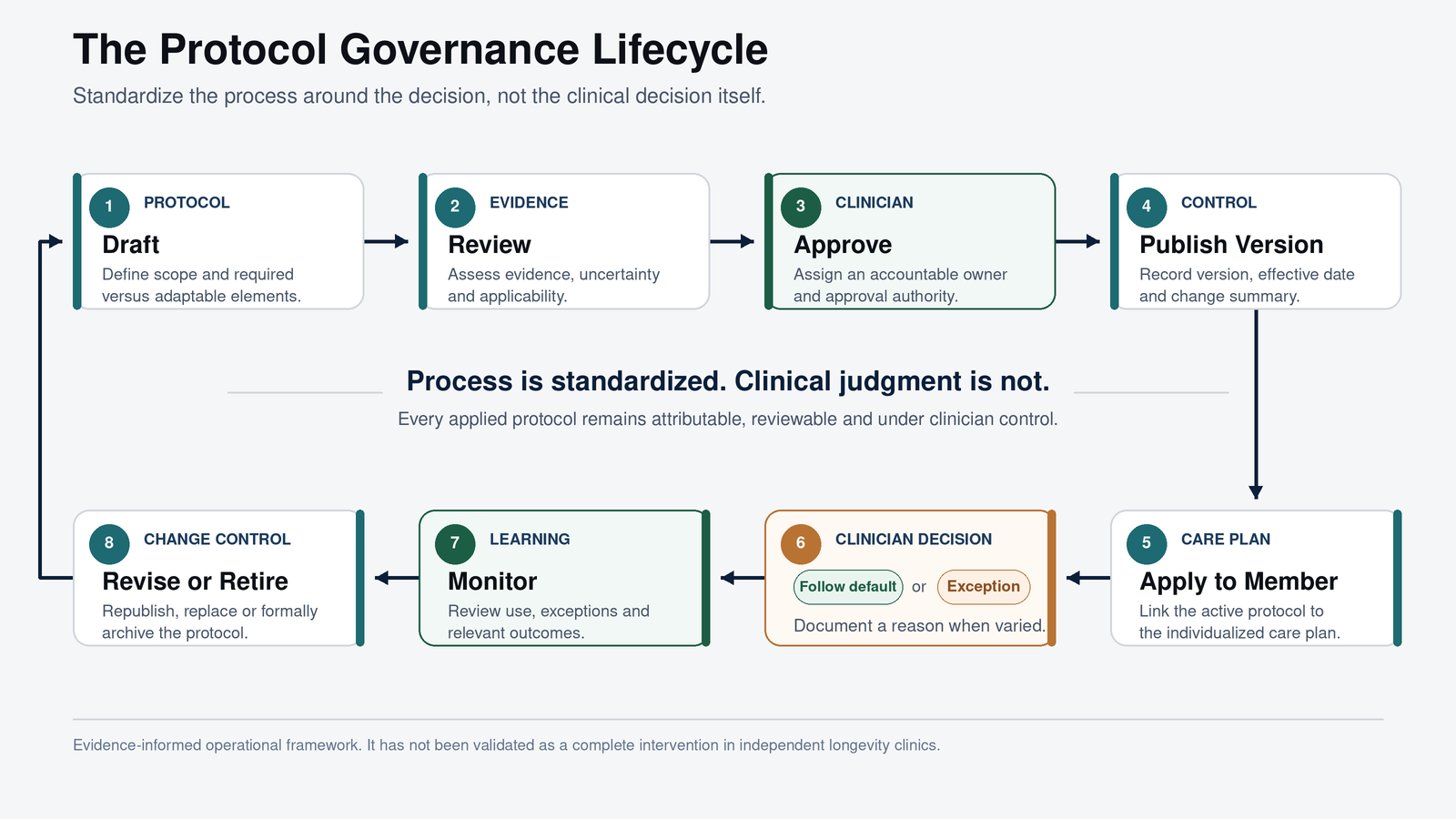
At the application stage, the clinician has two visible paths: follow the default or document a reasoned exception. Both paths return to monitoring and review. The clinical decision point remains inside the governed lifecycle.
How to tell a controlled exception from protocol drift
A controlled exception has:
- a known active protocol version;
- an identifiable responsible clinician;
- a documented reason;
- a member-specific departure that is time-bounded where appropriate;
- assigned follow-up;
- enough structure for recurring exceptions to be reviewed together.
Protocol drift has:
- an unknown or outdated version;
- a habitual change that was never approved;
- missing or unusable reasons;
- unclear responsibility;
- recurrence without review;
- a change in practice without publication of a new version.
The distinction is not whether variation occurred. It is whether that variation is visible, attributable and reviewable.
What to measure without inventing benchmarks
Useful diagnostic signals include:
- use of superseded versions;
- exceptions without a documented reason;
- recurring exception clusters by protocol element;
- clinician-level variation after considering case mix;
- changes or high-risk exceptions without required sign-off;
- overdue evidence or protocol reviews;
- repeated handoff failures around protocol tasks;
- completeness of protocol-linked documentation.
These are not league-table scores or universal thresholds. A raw exception count means little without the number of opportunities for an exception. Under-documentation can distort the result. Case mix and member preference can explain apparent variation between clinicians.
A rapid evidence synthesis by Harrison and colleagues found wide variation in feedback approaches used to address unwarranted clinical variation. It did not identify one model that worked consistently across settings. This evidence comes from healthcare settings outside independent longevity clinics and does not establish a universal feedback method or benchmark for them.
What technology can and cannot do
Technology can support a controlled protocol library, active-version visibility, role-based approval, protocol-linked care plans, clinician sign-off, structured exception capture, audit trails and review queues. These mechanics can make a governance model operable across a team.
Technology cannot decide whether every variation is clinically warranted. It cannot replace protocol ownership, keep evidence current without human review, guarantee adherence, prevent drift by itself or guarantee better outcomes.
Generic notes and audit logs can document an encounter, but they do not by themselves create a protocol-specific governance model. That model requires defined ownership, protocol states, version identity and structured exception handling. This is part of why an EMR alone does not manage protocol-driven care.
Questions clinic leadership should ask
- Who owns each protocol, and who can approve a change?
- Can the team identify the active version and effective date?
- Are required and adaptable elements explicit?
- Can a clinician document an exception without losing narrative context?
- Can recurring deviations be grouped and reviewed?
- Are member preferences and clinical contraindications represented?
- Does the workflow show who approved what and when?
- What triggers review, revision or retirement?
- Can the clinic distinguish missing documentation from actual protocol non-adherence?
- Does the system preserve clinician control wherever a clinical decision is made?
Governance protects the clinical voice as clinics scale
Protocol governance is not protocol rigidity. A governed method makes justified variation more visible and defensible. The objective is not compliance for its own sake. It is a learning lifecycle around clinical judgment in which ownership, versioning, documented exceptions and periodic review keep the clinic’s methodology coherent.
The evidence behind this operating logic comes mainly from adjacent settings. It supports the general shape of the model but does not establish that a specific control produces better clinical outcomes in a longevity, concierge, functional or executive-health clinic.
This lifecycle belongs within the operating infrastructure behind a longevity clinic. If your clinic is trying to standardize protocol delivery without standardizing clinical judgment, use the governance questions above when evaluating that operating layer.
HolistiCare provides clinical decision-support infrastructure; it is not a licensed medical provider or electronic health record. All diagnostics, care protocols and clinical decisions remain exclusively the responsibility of qualified healthcare professionals. Insights generated by HolistiCare’s AI engine are for clinical and informational use only and do not constitute medical advice, diagnosis or treatment.
References
- Carroll C, Patterson M, Wood S, Booth A, Rick J, Balain S. A conceptual framework for implementation fidelity. Implementation Science. 2007;2:40.
- Sutherland K, Levesque JF. Unwarranted clinical variation in health care: Definitions and proposal of an analytic framework. Journal of Evaluation in Clinical Practice. 2020;26(1):53-58.
- Farias M, et al. Dynamic evolution of practice guidelines: Analysis of deviations from assessment and management plans. Pediatrics. 2012;130(1):93-98.
- Harrison R, Hinchcliff R, Manias E, et al. Can feedback approaches reduce unwarranted clinical variation? A systematic rapid evidence synthesis. BMC Health Services Research. 2020;20:40.
- Colonna S, Sweetenham J, Burgon TB, et al. A better pathway? Building consensus and engaging providers with feedback to improve and standardize cancer care. Clinical Breast Cancer. 2019;19(2):e376-e384.
- Mullangi S, Chen X, Pham T, et al. Association of patient, physician, and practice-level factors with uptake of payer-led oncology clinical pathways. JAMA Network Open. 2023;6(5):e2312461.
- National Institute for Health and Care Excellence. Principles for best practice in clinical audit.
- Healthcare Quality Improvement Partnership. Best Practice in Clinical Audit. 2020.