
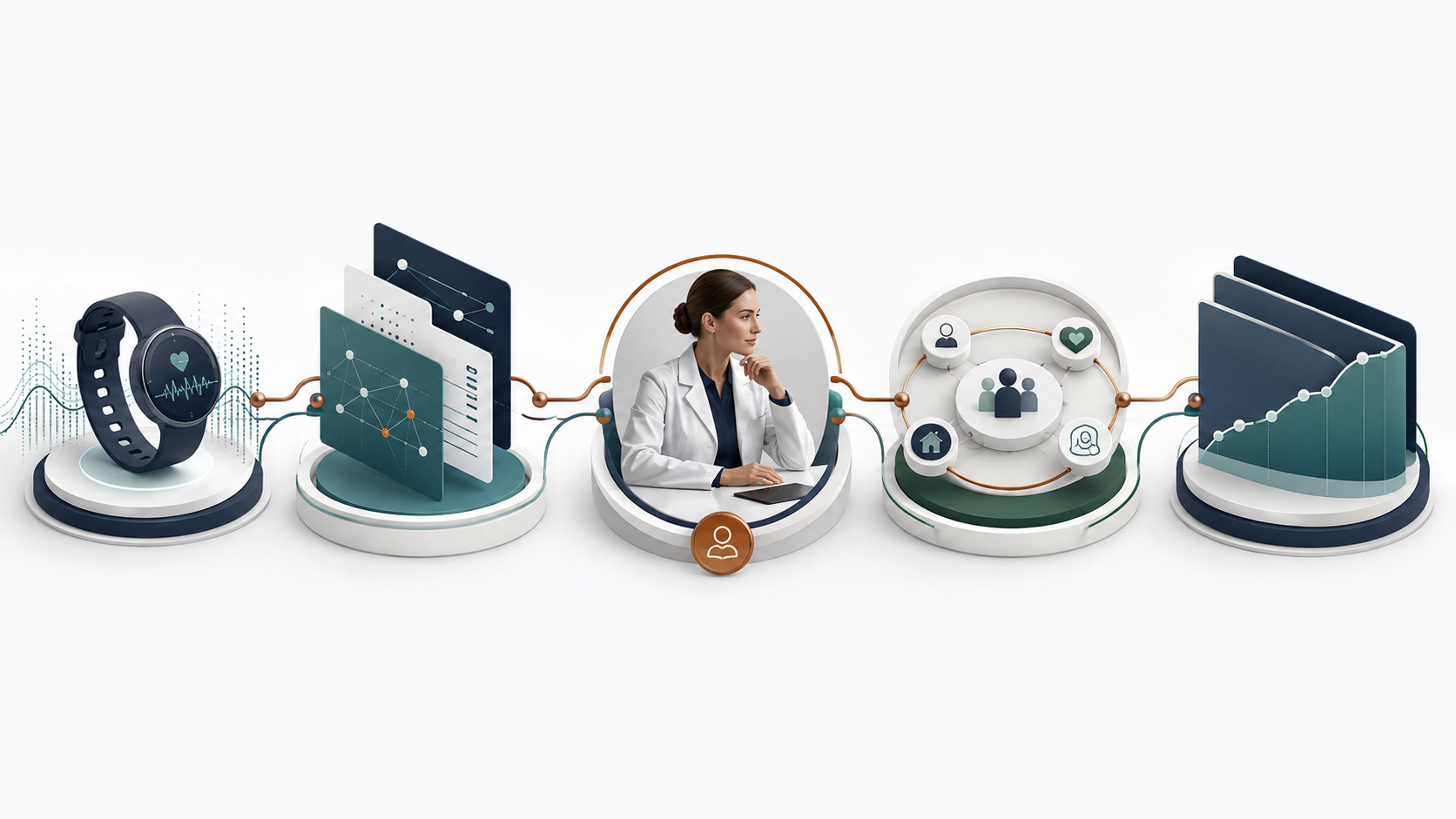
This week’s strongest signals point to one operating priority for longevity clinics: treat wearables, AI and obesity interventions as parts of a governed service, not as standalone innovations.
Wearable data needs a defined decision boundary. AI-supported care needs visible clinician accountability and member communication. Prevention programmes need longitudinal delivery and outcome review around any medicine, test or dashboard. The practical advantage comes from connecting all three into a traceable workflow.
Key takeaways
- A wearable’s value depends on its intended use, accuracy, reliability and place in the clinical workflow.
- Member trust in healthcare AI is conditional. Long-term care relationships require visible clinician involvement, data governance and a clear explanation of the system’s limits.
- GLP-1 medicines may be one component of obesity care, but treatment access is not the same as a sustained prevention programme.
- Clinic leaders should be able to trace each new input through interpretation, clinician decision, action and follow-up outcome.
In this brief
- Why wearable data needs an intended-use boundary
- Why AI trust is an operating requirement
- Why obesity prevention needs a delivery system
- The Input-to-Outcome Trace
Evidence scope
This brief reviews three items published from 3 to 9 August 2026: a U.S. government technology assessment, a qualitative study involving 34 adults in Queensland, Australia, and a population-policy analysis from England.
The settings are not equivalent and none tests a complete longevity-clinic operating model. The operational implications below are HolistiCare editorial inferences for clinic leadership. They are not legal advice, clinical guidance, treatment recommendations or regulatory classifications.
Why wearable data needs an intended-use boundary
The U.S. Government Accountability Office published a 50-page technology assessment of wearables in clinical decision-making on 6 August. It found potential for more timely information, personalised care and remote monitoring, but also material variation in device accuracy and reliability.
The assessment makes an important distinction. In its U.S. regulatory discussion, medical and general-wellness devices are separated by the manufacturer’s intended use. Medical devices intended for diagnosis or treatment are subject to FDA review, while general-wellness devices are not reviewed by FDA for those clinical purposes.
That does not make all wellness data unusable. It means a clinic cannot infer clinical suitability from the presence of a sensor or a polished dashboard. The device, function and proposed decision must be evaluated together.
The GAO also identified workflow integration, clinician responsibility, performance disclosure and postmarket monitoring as unresolved challenges. It reported that no fully autonomous wearables were marketed for clinical diagnosis or prescribing at the time of the assessment. AI may expand device capabilities, but the clinical decision boundary remains central.
For a clinic, the operational response is to create a controlled intake path for wearable data. Record the device and function, intended use, supporting evidence, known limitations, data-quality rules, named reviewer and escalation threshold. If the data could change a protocol or trigger follow-up, define whether and how it must be confirmed.
This is also a data-provenance problem. A longitudinal record can become misleading when readings from different devices, versions or collection conditions are treated as interchangeable. The same discipline needed to address fragmented longevity-clinic data applies to wearable streams.
Why AI trust is an operating requirement
A JAMA Network Open qualitative study, published on 4 August, examined how consumers understand the informal public acceptance of healthcare AI. The researchers used scenario-based workshops with 34 adults in Queensland in September 2025.
The study found that acceptance was conditional and dynamic rather than permanently granted. Three themes shaped it: relational engagement, structural support and performance reliability. Participants placed particular value on clinician-patient interaction in long-term care settings and on active clinician oversight of AI-supported recommendations.
The limitations matter. This was a small English-speaking sample from one Australian state, and the scenarios were hypothetical. The results do not estimate how common a view is, establish a universal consent standard or predict how members in another jurisdiction will respond.
The study still offers a useful operating question for longevity clinics. Longitudinal preventive care depends on repeated interactions, sensitive health data and decisions that may evolve over time. A generic statement that “AI is used” does not explain what the system does or who remains accountable.
Member communication should reflect the actual workflow. Explain the purpose of the AI-supported function, the data it uses, what the clinician reviews, the limits of the output and how a member can raise a question or concern. The aim is not to promise trust. It is to make the basis for informed trust visible and reviewable.
For teams building that operating model, HolistiCare’s independent-clinic AI governance control map provides a broader set of questions covering intended purpose, ownership, evidence, data, workflow, change control, monitoring and transparency.
Why obesity prevention needs a delivery system
On 7 August, The King’s Fund published an analysis of obesity trends in England. Using Health Survey for England prevalence estimates and ONS mid-2024 population data, it reported that the proportion of adults living with obesity or severe obesity rose from 15% in 1993 to 30% in 2024.
The organisation estimated that 14.3 million adults were living with obesity or severe obesity in England in 2024. Its figure of 7.2 million additional adults is a counterfactual comparison with a hypothetical 2024 in which the 1993 prevalence had not increased. It is not an observed treatment effect.
The King’s Fund argues that GLP-1 medicines could make a meaningful difference for some people but should complement, rather than replace, longer-term prevention. This is a population-policy analysis, not evidence that a particular clinic programme or medicine succeeds or fails.
The bounded operational lesson for private clinics is about service design. A medicine, diagnostic test or risk score may be important, but it is not the programme around it. The programme also needs eligibility and review rules, shared decisions, follow-up ownership, behaviour and environment support where appropriate, adverse-event and escalation routes, and a defined outcome-review cadence.
Without that service layer, a clinic can deliver an intervention while remaining unable to show whether the surrounding programme is consistent, equitable or producing the intended result. This is part of the wider challenge of proving clinical outcomes in longevity programmes.
The Input-to-Outcome Trace
The three signals can be connected through one five-step leadership review:
- Input: What enters the workflow, from which source and under which intended use?
- Interpretation: What evidence, quality rule and limitation govern its meaning?
- Decision: Which qualified professional reviews it and records the decision?
- Action: What protocol, communication or follow-up changes as a result?
- Outcome: What measure and review interval determine whether the service should continue, change or stop?
The Input-to-Outcome Trace is a HolistiCare editorial decision aid. It is not a validated clinical tool, legal standard or regulatory classification.
Its purpose is to expose missing connections. Wearable data without a decision boundary remains an ungoverned input. AI without accountable review weakens the relationship between evidence and action. An obesity intervention without longitudinal follow-up remains separate from the outcome it is intended to influence.
Clinic leaders should be able to inspect the full path for one live use case. If any step lacks a named owner, evidence boundary or recorded state, that is the next operating gap to resolve.
What clinic leaders should do next
Choose one wearable, AI-supported workflow or preventive-care intervention currently used by the clinic. Trace it from input to outcome. Confirm its intended use, evidence limits, clinician authority, member communication, follow-up ownership and review measure before expanding it.
The Longevity Clinic Operating System explains how data, protocols, teams, governance and outcomes can be coordinated around the clinic’s existing systems of record.
If your clinic is evaluating that operating model, book a clinical workflow demo.
Sources
- U.S. Government Accountability Office. Wearable Technologies: Potential Benefits and Challenges in Clinical Decision-Making. GAO-26-107847. 6 August 2026.
- Duong T, Plage S, Woods L, et al. Consumer Perspectives on Trust in and Benefits of Artificial Intelligence in Health Care. JAMA Network Open. 4 August 2026.
- The King’s Fund. At least 7.2 million more adults living with obesity than would have been if rates stayed the same as when first obesity strategy published in 1992. 7 August 2026.
HolistiCare provides clinical decision-support infrastructure; it is not a licensed medical provider or electronic health record. All diagnostics, care protocols and clinical decisions remain exclusively the responsibility of qualified healthcare professionals. Insights generated by HolistiCare’s AI engine are for clinical and informational use only and do not constitute medical advice, diagnosis or treatment.