
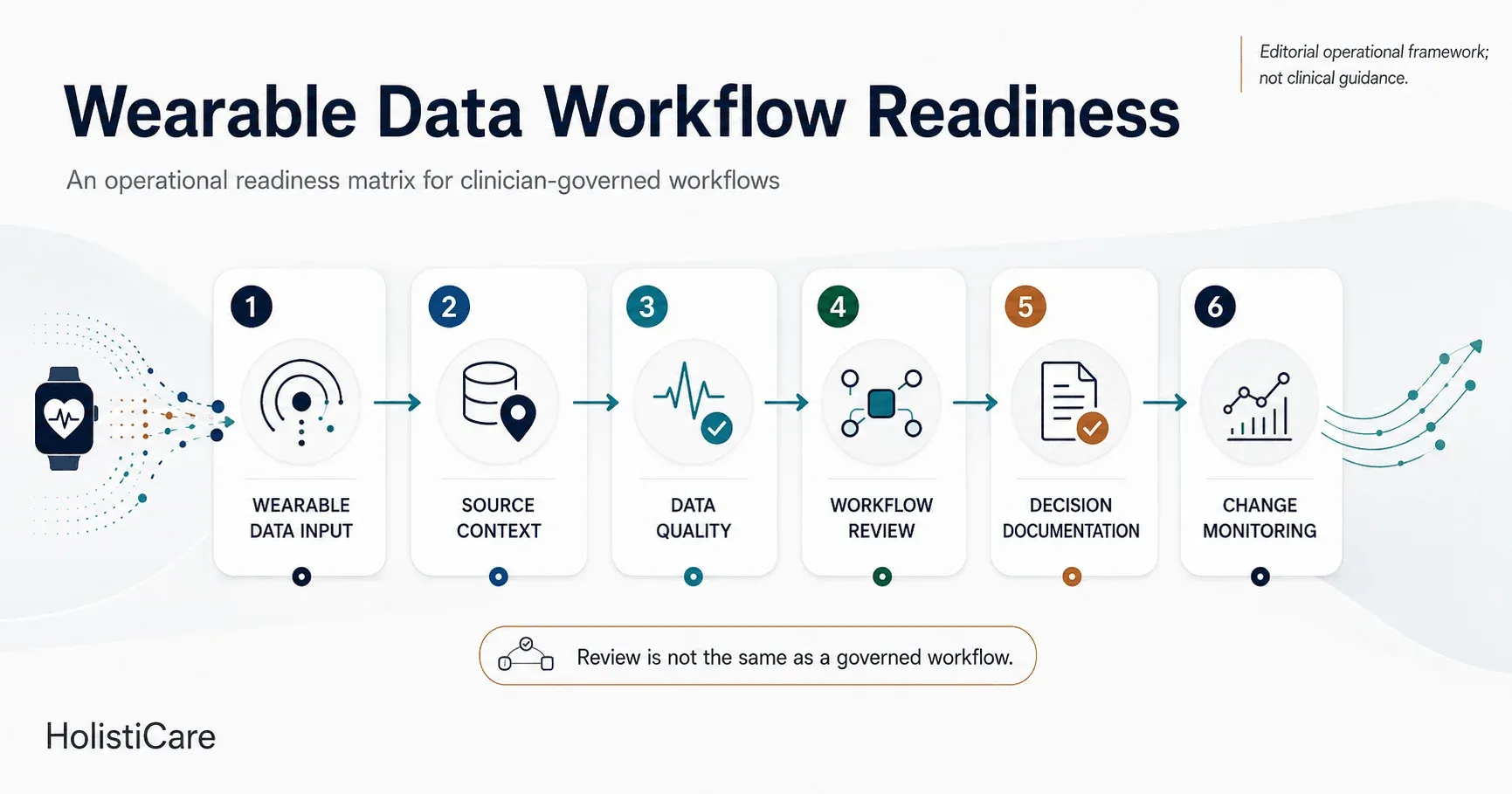
Before consumer-wearable data becomes part of a repeatable clinic workflow, the clinic should make its intended workflow use, source context, evidence record, provenance, data-quality handling, ownership, review cadence, clinic-defined confirmation or escalation policy, decision documentation, and change monitoring explicit. These are operational documentation controls. They do not establish that a device or measurement is clinically suitable for a particular person or decision.
The practical distinction is simple: wearable data can be visible to a clinician without the clinic having a defined, repeatable process for handling that data.
Key takeaways
- Review is not integration. Wearable data can be visible or discussed without a defined workflow around it.
- Context should travel with the data. Source, evidence record, limitations, provenance, and data-quality handling should not be left implicit.
- Workflow ownership matters. Review cadence, service expectations, clinic-defined confirmation or escalation policy, and documentation need an identified process.
- This is an operational framework, not clinical guidance. The matrix below does not validate devices, set clinical thresholds, or decide whether wearable data should change care.
Evidence scope
This article combines four evidence types: the 2026 AMA and Medscape multi-country physician survey on consumer wearables, the U.S. Government Accountability Office's 2026 technology assessment on wearables in clinical decision-making, patient-generated health data implementation and data-quality research, and evolving HL7 interoperability guidance. The evidence is not equally direct for every setting.
The AMA survey directly describes physician experience with consumer-wearable data across six countries. The GAO assessment addresses wearable accuracy, reliability, workflow integration, and policy questions in the United States. Much of the workflow and data-quality literature comes from patient-generated health data, remote monitoring, chronic-disease programmes, and larger health systems. This research did not identify a peer-reviewed sector-wide study quantifying mature governed wearable workflows across independent longevity, concierge, or functional-medicine clinics. Those adjacent findings support bounded operational questions only, not sector-wide prevalence or outcome claims.
What changes when wearable data moves from review to a repeatable workflow?
For operational analysis, it helps to distinguish several states without turning them into a maturity scale.
A member may bring a sleep summary, heart-rate trend, activity record, or other consumer-generated measure to an appointment. A clinician may then review or discuss it. A clinic may also choose to incorporate a data stream into a defined process for review, documentation, follow-up, or another internally specified workflow purpose. The operational difference is whether the clinic has made the handling process explicit: what the data is, why it is present in the workflow, who reviews it, what limitations are recorded, what the clinic's own policy requires before action, and how decisions are documented.
That distinction is consistent with the broader PGHD literature. Zeng and colleagues' framework for integrating person-generated data into routine clinical care treats integration as an organisational and workflow problem, not merely a data-transfer task. Project HealthDesign implementation work likewise describes the need for explicit workflow protocols, storage and access arrangements, usable presentation, and clarity about how patient-generated information enters clinical work.
For this article, wearable workflow readiness means that the operational controls around a specific wearable data stream are explicit, documented, owned, and reviewable. It is an editorial definition for workflow analysis, not a clinical-validity judgement, score, or standard.
Why does high exposure not equal workflow integration?
The clearest current signal comes from the 2026 AMA Center for Digital Health and AI and Medscape primary report. It surveyed 2,222 physicians in the United States, Canada, France, Germany, Spain, and the United Kingdom. The report indicates that 97% of surveyed physicians reviewed consumer-wearable data in some capacity, while no surveyed country reported formal integration above 6%.
Those figures should not be converted into a universal review-to-integration rate. They are based on a self-reported physician survey and do not provide a sector-specific estimate for longevity, concierge, or functional-medicine clinics. Their value here is narrower: widespread exposure to wearable information does not, by itself, demonstrate that an organisation has a repeatable workflow around that information.
The same AMA study reports barriers involving workflow design, reimbursement, data infrastructure, accuracy or trust, and medico-legal concerns. The operational implication is not that wearables are ready or unready as a category. It is that visibility of data and governance of a workflow are different questions.
What operational problems can occur between a wearable signal and a governed workflow?
Five recurring domains appear across the approved evidence base. They do not form a validated taxonomy. They are a practical way to organise the implementation issues that recur across the sources.
Evidence context and known limitations
A clinic may record what evidence or validation it relies on for a chosen workflow use and what limitations remain. That record is different from declaring that the evidence is clinically sufficient. The GAO technology assessment on wearable technologies in clinical decision-making highlights accuracy, reliability, and clinical-workflow integration as material challenges. It does not provide a universal rule for deciding whether a particular consumer wearable should be used for an individual clinical decision.
Data quality and provenance
Wearable and PGHD datasets can be affected by missing values, inconsistent collection, interpretation or normalisation problems, and uncertainty about source or context. Abdolkhani and colleagues' wearable-data quality workshop identified technical, behavioural, organisational, and operational barriers across the path from data collection to clinical use. Separate JAMIA Open work on PGHD management and quality also documents management and quality challenges for patient-generated data.
For workflow design, provenance means recording the source, collection context, transformations, and material changes that may affect longitudinal comparability.
Interoperability and presentation
Moving data into a record or FHIR resource can solve part of the transport problem. It does not define the clinic's local review policy, service model, or decision process. A technically available value can still be operationally difficult to use if source context, units, transformations, or longitudinal comparability are not clear.
This is the narrower workflow counterpart to the broader problem of fragmented longitudinal clinic data. Interoperability can improve exchange. Operational readiness still requires the clinic to define what happens around the exchanged data.
Workflow ownership and service expectations
A clinic needs to identify who owns operational handling and review of a wearable data stream, when that review occurs, and what service model has actually been communicated to members. Those are implementation questions, not conclusions about professional accountability. The AHRQ practical guide to integrating patient-generated digital health data treats workflow design and stakeholder responsibilities as core implementation considerations.
For clinic leadership, the operational question is what role, review cadence, and response model the clinic has actually defined and documented.
Documentation and change
A repeatable workflow benefits from a traceable record of which wearable input was considered, what material limitations were known, what confirmation step the clinic's own policy required, what the clinician decided, and what happened next. The workflow also needs a way to identify when a material change in device function, algorithm, evidence, data feed, workflow, or intended use should trigger an operational review.
That change-control question is related to, but distinct from, governing clinical protocol variation. The protocol-governance article owns protocol versions, deviations, overrides, and clinician sign-off. This article stays focused on the operational controls around wearable-data handling.
The Wearable Workflow Readiness Matrix
The Wearable Workflow Readiness Matrix is a source-attributed set of ten questions for documenting whether the workflow around one wearable data stream is explicit and governed. It is designed to make assumptions visible. It does not determine whether the underlying measurement is clinically appropriate for a person or decision.
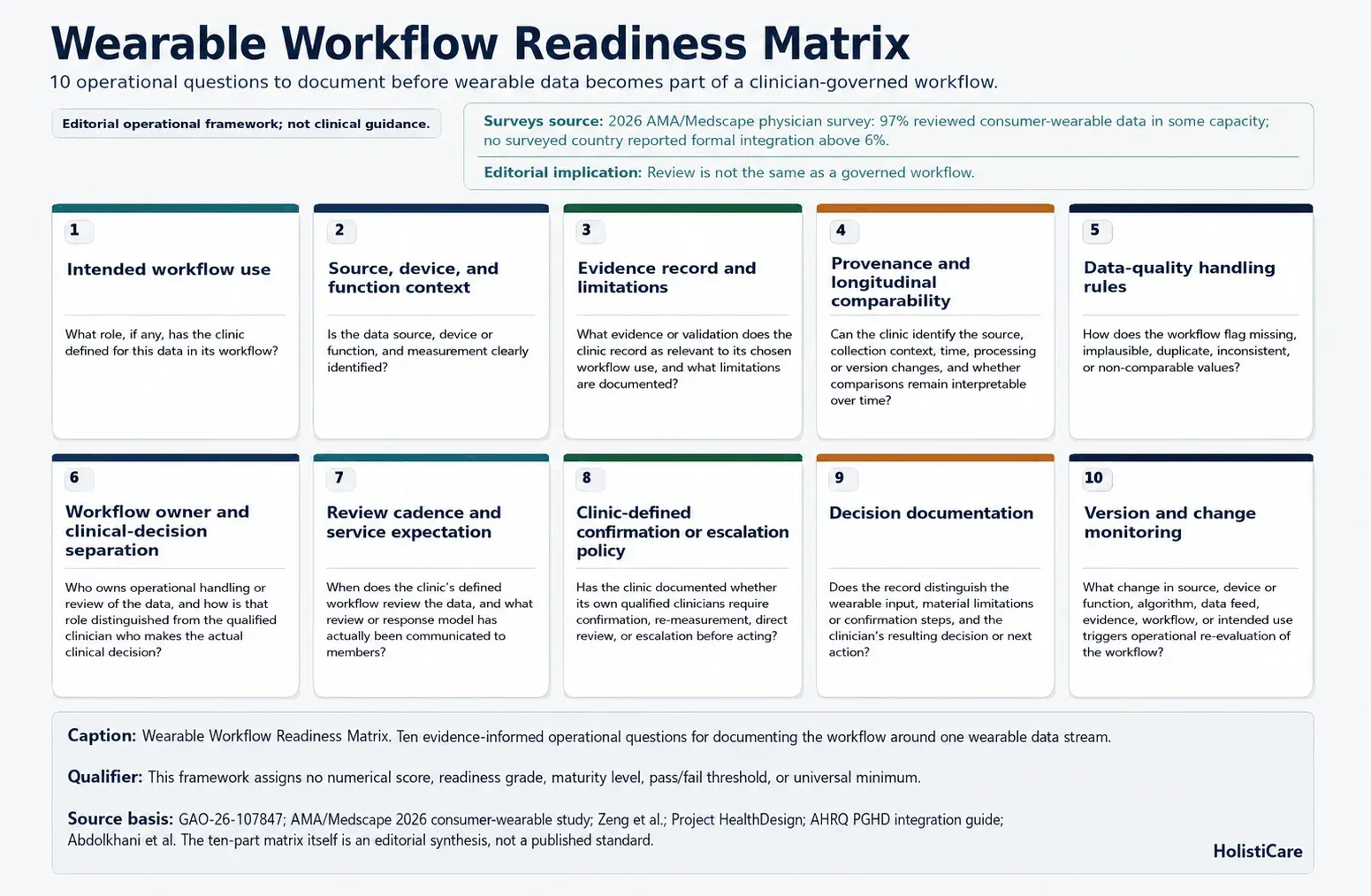
1. Intended workflow use. What role, if any, has the clinic defined for this data in its workflow? Describe the operational purpose without recommending a clinical action.
2. Source, device, and function context. Is the data source, device or function, and measurement clearly identified? Record authoritative intended-use or regulatory context when already known, without using the matrix to classify the device.
3. Evidence record and limitations. What evidence or validation does the clinic record as relevant to its chosen workflow use, and what limitations are documented? The matrix does not judge whether that evidence is clinically sufficient.
4. Provenance and longitudinal comparability. Can the clinic identify the source, collection context, time, processing or version changes, and whether comparisons remain interpretable over time?
5. Data-quality handling rules. How does the workflow flag missing, implausible, duplicate, inconsistent, or non-comparable values? Are transformations or normalisations visible to the people reviewing the record?
6. Workflow owner and clinical-decision separation. Who owns operational handling or review of the data, and how is that role distinguished from the qualified clinician who makes the actual clinical decision?
7. Review cadence and service expectation. When does the clinic's defined workflow review the data, and what review or response model has actually been communicated to members?
8. Clinic-defined confirmation or escalation policy. Has the clinic documented whether its own qualified clinicians require confirmation, re-measurement, direct review, or escalation before acting? The matrix does not define the clinical triggers.
9. Decision documentation. Does the record distinguish the wearable input, material limitations or confirmation steps, and the clinician's resulting decision or next action?
10. Version and change monitoring. What change in source, device or function, algorithm, data feed, evidence, workflow, or intended use triggers operational re-evaluation of the workflow?
Method note: The Wearable Workflow Readiness Matrix is a HolistiCare Editorial Team synthesis of cited evidence for operational documentation and workflow review. It assigns no numerical score, readiness grade, maturity level, pass/fail threshold, or universal minimum. It does not determine clinical validity, device suitability, a standard of care, regulatory classification, safety, compliance, clinical outcomes, workload, liability, or operational performance.
Evidence basis: The ten dimensions synthesize recurring implementation and governance issues across the GAO wearable assessment, the AMA/Medscape consumer-wearable study, Zeng et al., Project HealthDesign, AHRQ's PGHD integration guide, and the two Abdolkhani data-quality studies cited below. None of those sources publishes this ten-part matrix as a standard. The grouping, labels, and operational definition are editorial synthesis.
How should clinic leaders use the matrix without turning it into a clinical score?
Start with one data stream and one defined workflow use. Do not ask whether “wearables” as a category are ready for clinical use. Ask what operational role the clinic has assigned to one defined data stream and whether the surrounding handling process is explicit.
Then document what is defined and what remains unresolved. An unresolved item is not an automatic pass or fail. Clinical-suitability, evidence-sufficiency, diagnosis, treatment, monitoring, confirmation, or escalation questions belong to the clinic's qualified clinicians and applicable governance process.
Repeat the operational review after a material change in device function, algorithm, data feed, evidence, workflow, or intended use. The purpose is to keep the workflow record current, not to certify the data stream.
Traffic-light grading is inappropriate because it would imply thresholds the evidence pack does not establish. The useful output is a record of explicit controls, unresolved questions, owners, and review points.
What can interoperability standards solve, and what remains a clinic workflow decision?
Interoperability standards can make wearable information easier to represent and exchange. They do not define the clinic's local review policy or establish clinical suitability.
At the 16 August 2026 verification, the HL7 Personal Health Records PGHD guidance was a continuous build for version 1.0.0-ballot2, and the PGHD page was marked informative. It describes principles and patterns for representing and exchanging patient-generated data using FHIR.
At the same verification, the HL7 Personal Health Device Implementation Guide was version 3.0.0-draft with trial-use status. Its purpose is to map personal health device information into FHIR resources. The guide does not provide interpretations of the mapped observations or assign clinical importance to them.
That boundary matters. Standards can address representation and exchange, while review cadence and the clinic's own pre-action requirements remain local workflow and clinical-governance questions.
What does the evidence still not establish?
The evidence base has important limits.
This research did not identify a sector-wide adoption rate for mature governed wearable workflows in independent longevity, concierge, or functional-medicine clinics. It also did not identify robust longitudinal outcome evidence showing that governed consumer-wearable workflows, as a general category, improve outcomes in this segment.
Disease-specific remote-monitoring studies can inform implementation questions, but they should not be treated as direct evidence for consumer-wearable workflows in preventive clinics. More data or more monitoring does not, by itself, establish better outcomes.
The matrix also does not show that a clinic has met a legal or regulatory requirement, reduced liability, demonstrated safety, or established that a device or measurement is clinically suitable. Privacy, data-protection, device, and professional requirements remain jurisdiction- and context-specific. Those questions require the appropriate clinical, legal, regulatory, or organisational authority rather than an editorial framework.
That distinction mirrors a wider issue in longevity care: collecting more measures is not the same as proving clinical outcomes in longevity programmes.
What should clinic leadership document before expanding routine wearable-data workflows?
Five questions can expose where a workflow is still implicit without asking an editorial framework to make a clinical judgement:
- What operational role has the clinic assigned to this specific data stream? Name the workflow use rather than the device category.
- What source context, evidence record, limitations, provenance, and data-quality assumptions are documented? Make the surrounding context visible to reviewers.
- Who owns operational handling, review cadence, and documentation? Separate workflow ownership from the clinician's responsibility for the actual clinical decision.
- What review or response model has been communicated to members, and what confirmation or escalation policy has the clinic itself defined? Record the policy without turning the article into a source of clinical triggers.
- What material change would trigger operational re-evaluation? Include changes in source, device function, algorithm, data feed, evidence, workflow, or intended use.
The point is not to produce a score. It is to make the operating boundary explicit enough that leadership can see which controls are defined, which assumptions remain implicit, and which questions belong to qualified clinical or other specialist review.
Conclusion: make the workflow boundary explicit
The operating goal is not to accept or reject consumer wearables as a category. It is to make the clinic's process around wearable data explicit, bounded, traceable, and reviewable.
For a specific data stream, clinic leadership should be able to identify the intended workflow use, source context, evidence record and limitations, provenance, data-quality handling, workflow owner, review cadence, the clinic's own confirmation or escalation policy, decision documentation, and change-monitoring process. Where those elements remain implicit, the operational workflow is not yet fully described, even if the data is technically available.
If wearable information is one of several inputs entering a longitudinal programme, the broader operating question is how the clinic represents data, review states, clinician decisions, protocols, and follow-up across the whole service. Explore the clinical operating system for longevity clinics for that wider operating-layer model.
Book a clinical workflow demo if you want to examine how your current workflow represents these states. A workflow demo does not validate a wearable device, determine clinical suitability, set care thresholds, or decide whether wearable data should influence care.
References
- American Medical Association Center for Digital Health and AI and Medscape. Multi-country study on consumer wearable data in clinical practice. July 2026.
- American Medical Association. Wearable data adoption stalled by system barriers. 8 July 2026.
- U.S. Government Accountability Office. Wearable Technologies: Potential Benefits and Challenges in Clinical Decision-Making. GAO-26-107847. 6 August 2026.
- Zeng B, Bove R, Carini S, et al. Standardized Integration of Person-Generated Data Into Routine Clinical Care. 2022.
- Cohen DJ, Keller SR, Hayes GR, et al. Integrating Patient-Generated Health Data Into Clinical Care Settings or Clinical Decision-Making: Lessons Learned From Project HealthDesign. 2016.
- Abdolkhani R, Gray K, Borda A, DeSouza R. Quality Assurance of Health Wearables Data: Participatory Workshop on Barriers, Solutions, and Expectations. 2020.
- Agency for Healthcare Research and Quality. A Practical Guide to Integrating Patient-Generated Digital Health Data into Ambulatory Care.
- HL7 International. Patient Generated Health Data in the Personal Health Records Implementation Guide. Continuous build, version 1.0.0-ballot2; PGHD page informative at 16 August 2026 verification.
- HL7 International. Personal Health Device Implementation Guide. Continuous build, version 3.0.0-draft; trial-use at 16 August 2026 verification.
- Abdolkhani R, Gray K, Borda A, DeSouza R. Patient-generated health data management and quality challenges in remote patient monitoring. JAMIA Open. 2019.