By HolistiCare Editorial Team
Published: 26 July 2026 | Last updated: 28 July 2026
Five developments in this issue point to one operating lesson for clinic leadership: a new clinical AI clearance, a benchmark result, a data standard, a biomarker study or a regulatory vote is not yet a safe workflow. Each signal still requires a decision about where it applies, what evidence is missing, who owns the decision and what must be monitored after adoption. This issue interprets a clinical AI oversight editorial, a healthcare agent benchmark, a U.S. data-standard release, a plasma biomarker study and an FDA advisory committee vote through that lens, and offers a framework for translating external signals into internal controls.
Key takeaways
- Initial validation or regulatory clearance does not remove the need to monitor clinical AI after it goes live.
- A healthcare agent benchmark, χ-Bench, shows that one successful run is not evidence of repeatable performance across a long, policy-rich workflow.
- USCDI v7 expands the U.S. standardised data baseline, while a related ONC challenge shows that available data can still be difficult to understand and act on.
- Plasma p-tau217 shows prognostic potential in selected research cohorts, but the underlying study does not establish routine screening for cognitively unimpaired clinic members.
- An FDA advisory committee recommended six peptides for a U.S. compounding list; this was an advisory vote, not a drug approval.
In this brief
- Clinical AI oversight after clearance
- What χ-Bench reveals about repeatable agent performance
- Why better data exchange does not guarantee usable workflows
- What p-tau217 shows, and what it does not show
- What the FDA advisory committee actually recommended
- What clinic leaders should do with these signals
What changed in clinical AI oversight?
On 20 July 2026, NEJM AI published an editorial arguing that continuous real-world monitoring should become a foundation of clinical AI oversight after clearance (After Clearance: Continuous Monitoring as the Foundation of Clinical AI Oversight, NEJM AI, 20 July 2026). This is an editorial argument, not a trial result, a regulator rule or a mandatory standard. A separate scoping review of the review literature frames trustworthy clinical AI as a lifecycle issue involving local validation, ongoing surveillance, controlled updating, incident response and, where necessary, rollback or retirement (Beyond Model Development in Healthcare AI, Healthcare, 25 May 2026). Mature operational evidence from live systems remains limited, and most comes from hospitals and health systems. The reasonable inference is that a clinic adopting AI that materially affects clinical decisions should define intended use, named ownership, local validation, ongoing monitoring and escalation thresholds. This is risk-based governance, not proof that clearance guarantees safety in every setting.
What does χ-Bench reveal about repeatable agent performance?
χ-Bench is an arXiv preprint that tests AI agents on long, policy-rich healthcare workflows inside a high-fidelity simulator built from 20 healthcare applications, 87 MCP tools and a 1,279-document managed-care operations handbook, covering provider prior authorisation, payer utilisation management and care management (χ-Bench: Can AI Agents Automate End-to-End, Long-Horizon, Policy-Rich Healthcare Workflows?, Chen et al., arXiv preprint, version 2, 19 May 2026). Across 30 agent-harness and model configurations, the best pass@1 result was 28.0%. No configuration cleared 20% on the stricter pass³ reliability metric, which requires success across all three independent trials. In a marathon run across 25 tasks in one continuous session, performance fell to 3.8%. This is a preprint, not a peer-reviewed clinical study, and the simulated tasks concern U.S. managed-care operations rather than private longevity-clinic protocols. The study neither validates nor invalidates agentic AI for longevity clinics. It does support a general operating inference: a single successful demonstration does not establish that an agent will perform a long workflow reliably and repeatedly. End-to-end runs, repeated trials and failure-state testing should precede any use near a clinical or operational workflow.
Why does better data exchange not guarantee usable workflows?
On 23 July 2026, the Office of the National Coordinator for Health IT released USCDI v7, adding 30 new data elements and one significantly revised element to the U.S. core data set for interoperability, including Appointment, Referral Order, Medication Administration, Medical Device Order and Diagnostic Imaging Reference (ONC Standards Bulletin 2026-2: USCDI v7, ONC, updated 23 July 2026). USCDI v7 is a U.S. standard; it does not govern UK implementation, and broader adoption depends on certification and programme timelines rather than taking effect everywhere at once. In the same week, ONC announced nine Phase 1 winners of its EHIgnite challenge, created because single-person electronic health information exports are, in ONC’s own description, often hundreds of pages long and hard to use (Nine Teams, One Mission: Meet the EHIgnite Phase 1 Winners, ONC, 21 July 2026). Phase 1 selection reflects proposed concepts, not demonstrated clinical effectiveness. Read together, the announcements support an editorial synthesis, not an ONC finding: data availability, semantic standardisation, human comprehension and workflow execution are separate operating layers, and exchanged health data can remain operationally fragmented even as underlying standards improve.
What does p-tau217 show, and what does it not show?
A JAMA study pooled 2,684 cognitively unimpaired older adults from six selected research cohorts based in North America, Japan and Australia (Prognostic Value of Blood-Based P-Tau217 Levels for Progression to Cognitive Impairment, Buckley et al., JAMA, 14 July 2026). Over a median follow-up of 5.4 years, 478 participants progressed to cognitive impairment, and higher baseline plasma p-tau217 was associated with greater progression risk and faster cognitive decline. Within the pooled cohorts, participants in the high and very-high p-tau217 groups had estimated five-year progression risks of 24% and 38% respectively; these are cohort-specific prognostic estimates, not general-population risks or an individual prediction tool. The authors describe the findings as supporting future prognostic-model development and trial design, while explicitly calling for validation in unselected populations before the biomarker informs individual prognosis or clinical decision-making. The study did not evaluate routine screening, did not test whether testing improves outcomes, and did not establish a test-guided care pathway. Current Alzheimer’s Association guidance addresses diagnostic workup in people with objective cognitive impairment in specialised care settings (Alzheimer’s Association Clinical Practice Guideline on the Use of Blood-Based Biomarkers, Palmqvist et al., Alzheimer’s & Dementia, July 2025), not routine screening of cognitively unimpaired clinic members. For clinics evaluating emerging biomarkers, this is a useful case study in the difference between biomarker movement and proven clinical outcomes.
What did the FDA advisory committee actually recommend?
On 23 and 24 July 2026, the FDA’s Pharmacy Compounding Advisory Committee met to consider seven peptide-related bulk drug substances for possible inclusion on the U.S. section 503A Bulks List, a pathway covering specified compounding by state-licensed pharmacies, federal facilities or licensed physicians (FDA Pharmacy Compounding Advisory Committee Meeting, 23 to 24 July 2026, FDA). FDA staff had proposed that none of the seven substances be included, citing safety and evidence concerns (FDA Briefing Document for the July 2026 PCAC Meeting, FDA/CDER, July 2026). According to specialist regulatory reporting, the committee nonetheless recommended inclusion of BPC-157, KPV, TB-500, MOTS-c, Epitalon and Semax, and recommended against Emideltide (FDA Advisory Committee Backs Two More Peptides, Rejects One for Compounding List, RAPS, 24 July 2026). The votes were advisory and non-binding. As of the 26 July 2026 research cut-off, FDA had not taken final action. A recommendation for inclusion on the 503A Bulks List is not FDA approval of a substance’s safety, effectiveness, an indication or marketing claims. This is a U.S. section 503A matter and should not be read across to the UK or other jurisdictions. For clinics operating in relevant U.S. settings, the appropriate response is a governed review of jurisdiction, pharmacy qualification, substance identity and quality, evidence, informed consent and adverse-event monitoring, not automatic protocol adoption.
What should clinic leaders do with these signals?
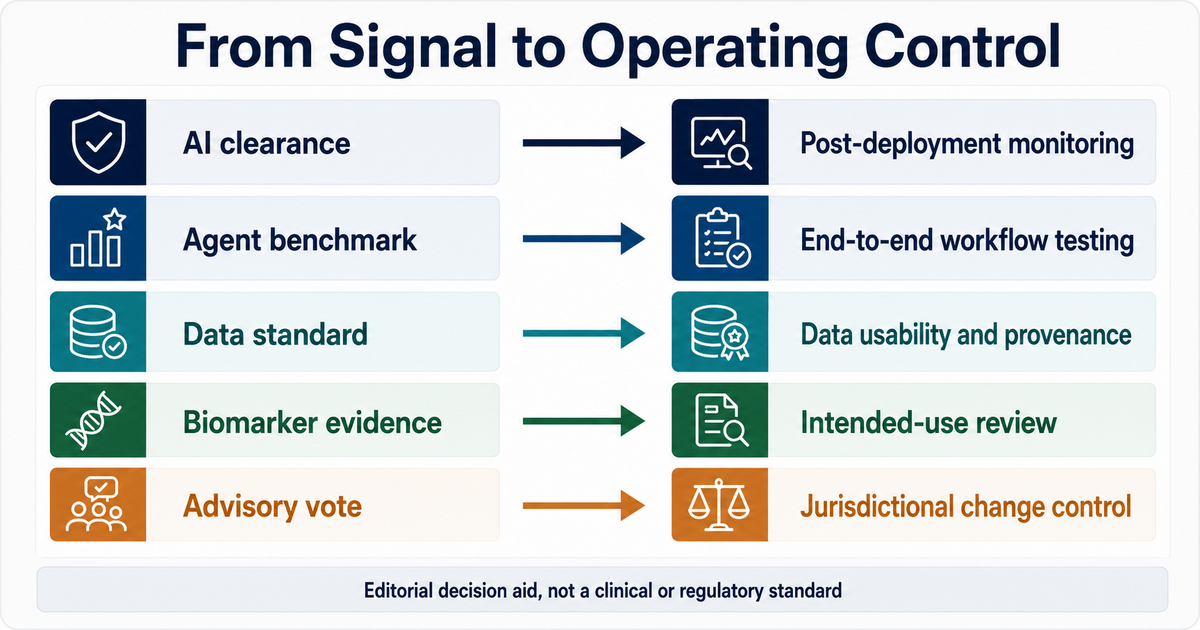
Each signal in this issue maps to a specific operating control, which is the Signal-to-Control Test:
- Clinical AI clearance or validation -> post-deployment monitoring.
- Agent benchmark performance -> end-to-end and repeatability testing.
- Expanded data standards -> usability, provenance and workflow mapping.
- Promising prognostic biomarker -> intended-use and evidence-boundary review.
- Advisory regulatory vote -> jurisdictional review and protocol change control.
This is an editorial decision aid, not a validated clinical standard, a legal checklist or a regulatory framework. It is intended to help clinical and operations leaders ask the right question when a new capability, standard, study or vote appears, rather than to replace clinical judgement, legal advice or a compliance programme. AI augments clinicians; it does not substitute for their judgement, and none of these signals changes that. The common thread is that opportunity tends to arrive before certainty, so the governed decision, not the headline, determines whether a signal is safe to act on.
Read next
- Why longevity clinic data stays fragmented across labs, wearables and EHRs
- Why longevity clinics struggle to prove clinical outcomes
Explore how a Clinical Operating System can give clinic teams a governed operating layer that connects data, protocols, review states and longitudinal follow-up without replacing the EMR.
Editorial scope and provenance
The HolistiCare Editorial Team reviewed official government and regulator documents, primary research, clinical guidance, a current healthcare-agent benchmark preprint and specialist regulatory reporting available through 26 July 2026. This review was targeted to five developments selected for the week ending 26 July and was not a systematic review. Most operational evidence comes from U.S. regulators, academic research and large healthcare settings rather than private longevity clinics. Jurisdiction-specific conclusions should not be transferred without local review.
Sources
- After Clearance: Continuous Monitoring as the Foundation of Clinical AI Oversight, NEJM AI, editorial, 20 July 2026.
- Beyond Model Development in Healthcare AI: Post-Development Robustness, Post-Deployment Monitoring, and Lifecycle Governance, Healthcare, scoping review, 25 May 2026.
- χ-Bench: Can AI Agents Automate End-to-End, Long-Horizon, Policy-Rich Healthcare Workflows?, Chen et al., arXiv preprint version 2, 19 May 2026.
- ONC Standards Bulletin 2026-2: USCDI v7, ONC, official U.S. standard, updated 23 July 2026.
- Nine Teams, One Mission: Meet the EHIgnite Phase 1 Winners, ONC, official programme announcement, 21 July 2026.
- Prognostic Value of Blood-Based P-Tau217 Levels for Progression to Cognitive Impairment, Buckley et al., JAMA, longitudinal cohort study, 14 July 2026.
- Alzheimer’s Association Clinical Practice Guideline on the Use of Blood-Based Biomarkers, Palmqvist et al., Alzheimer’s & Dementia, clinical practice guideline, July 2025.
- WHO Preferred Product Characteristics for Blood Tests for Alzheimer Disease, WHO, product-development guidance, 23 October 2024.
- FDA Pharmacy Compounding Advisory Committee Meeting, 23 to 24 July 2026, FDA, official advisory committee meeting.
- FDA Briefing Document for the July 2026 PCAC Meeting, FDA/CDER, official briefing document, July 2026.
- FDA Advisory Committee Backs Two More Peptides, Rejects One for Compounding List, RAPS, specialist regulatory reporting, 24 July 2026.