By HolistiCare Editorial Team | Published 11 June 2026 | Updated 25 August 2026
Key Takeaways
- Biomarker movement alone does not establish better long-term clinical outcomes.
- Epigenetic clocks measure different constructs. Responsiveness is not proof of clinical benefit.
- Evidence for NAD+, plasma exchange, regenerative treatments, and repurposed drugs does not support broad anti-aging claims.
- Clinics need conservative interpretation, measurement provenance, clinician review, and longitudinal tracking tied to meaningful endpoints.
Table of Contents
Evidence Scope
This article is an evidence review and operational analysis, not original research, a clinical practice guideline, or medical advice. It draws on regulatory guidance and peer-reviewed geroscience and biomarker research. Evidence varies by intervention and endpoint. A better biomarker or biological-age estimate should not be interpreted as proof of longer healthspan, reduced disease, treatment effectiveness, or lower mortality.
What Are Longevity Clinics Actually Measuring?
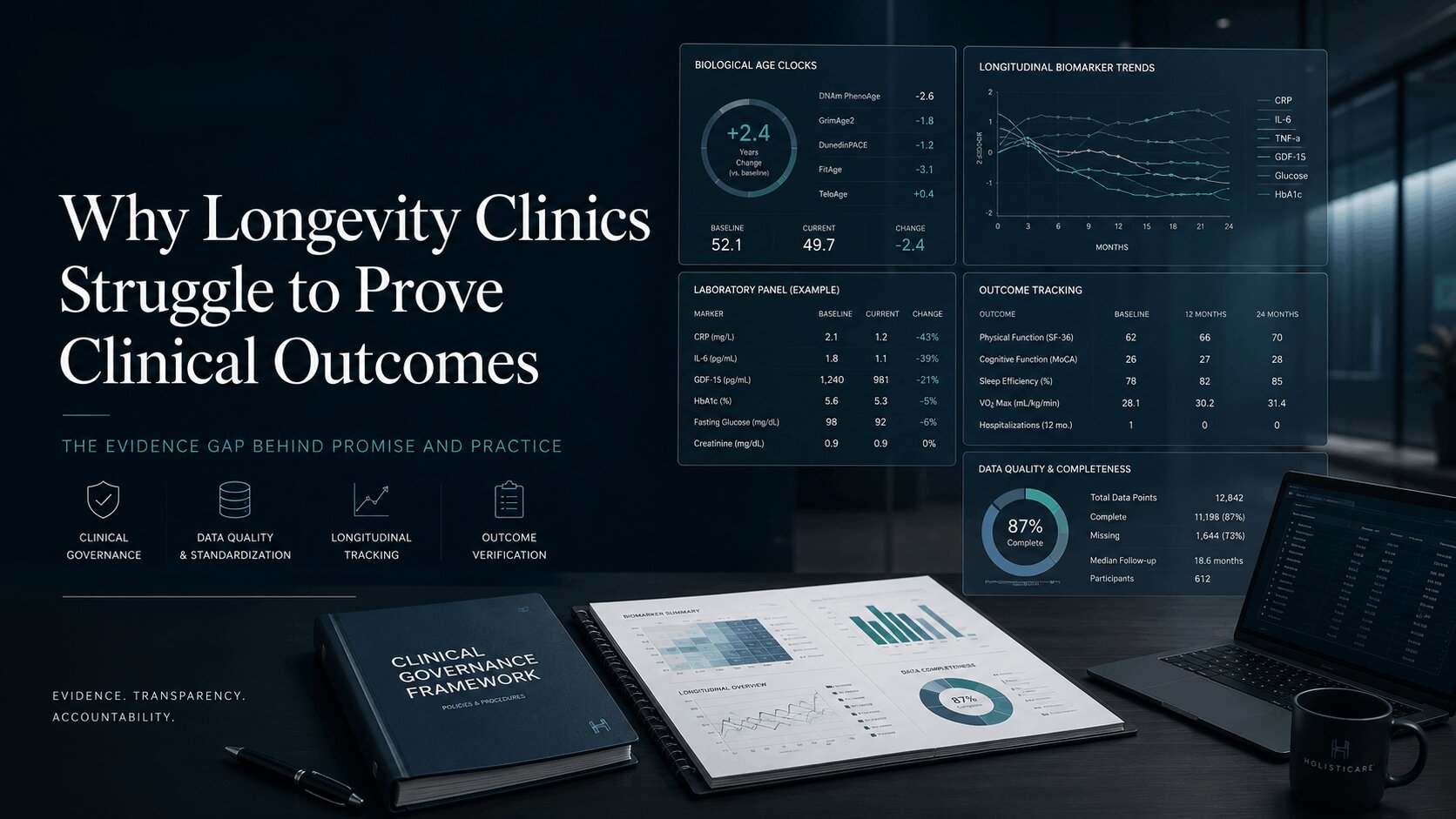
Longevity programs may track epigenetic clocks, metabolic and inflammatory markers, hormone panels, wearable data, and wellness outcomes. These measures can support risk stratification and monitoring, but they do not by themselves establish that a protocol improves healthspan.
A clinic can show that a laboratory value changed or a biological-age estimate declined without proving fewer cardiovascular events, less frailty, or longer healthy life. A published healthy-longevity-clinic framework likewise emphasizes structured assessment, evidence-based intervention, and ongoing evaluation rather than a single marker.
Why Are Biomarkers Not Enough to Prove Efficacy?
Researchers use biomarkers because disability, multimorbidity, and mortality can take years to observe. The FDA-NIH BEST Resource defines a biomarker as an indicator of biological processes or responses, not a direct measure of how a person feels, functions, or survives.
FDA also states that surrogate use is context-specific. The sources reviewed here do not establish any epigenetic clock or multi-omic aging measure as a regulator-qualified surrogate endpoint for a broad aging indication. A marker may correlate with risk without showing that changing it causes clinical benefit.
Are Aging Clocks Valid Surrogate Endpoints?
Not for broad routine longevity claims on the evidence reviewed here. Reviews of aging-biomarker validation and geroscience trial endpoints separate analytical validity, association with outcomes, intervention responsiveness, and clinical utility. Evidence for one does not establish the others.
How Should Clinics Interpret Epigenetic Clock Changes?
A change in an epigenetic clock is a biomarker signal. It is not automatic proof that an intervention improved healthspan, reduced disease risk, extended life, or made a member biologically younger in a clinically meaningful sense.
Some clocks estimate chronological age. Others reflect phenotypic risk, mortality-related signals, or pace of aging. A result may move because the measured construct changed, the clock is sensitive to a particular context, or technical variation affected the measurement. A validated surrogate endpoint requires stronger evidence that change reliably predicts a defined clinical benefit.
What Does the Latest Intervention Evidence Show?
In August 2026, Sehgal and colleagues analyzed 51 longitudinal intervention studies, calculating 16 epigenetic clocks and 94 other DNA-methylation biomarkers. Responsiveness varied by clock, intervention, population, and duration.
Some mortality-risk and pace-of-aging clocks responded more consistently than chronological-age clocks. The study did not show that clock movement predicts healthspan or another clinical benefit, establish causality, or validate routine clinic use. Cross-clock agreement can strengthen confidence that a signal is not unique to one measure, but it still does not prove patient benefit.
Why Does Measurement Reliability Matter?
A 2022 methods study reported deviations of up to nine years between technical replicates for six clocks in the methods and datasets assessed. This is not a universal error bound, but it shows why clinics should not attribute every pre-to-post difference to biology or treatment.
Interpretation should account for specimen type, assay platform, laboratory, preprocessing version, collection conditions, repeat interval, technical variation, concurrent interventions, and population fit.
Epigenetic Clock Interpretation and Measurement Governance Matrix v1.0
Use this evidence-informed editorial framework before describing a clock change as interpretable, actionable, or evidence of benefit. It is not a clinical guideline, diagnostic instrument, regulatory qualification, or validated score.
1. Intended Construct
Ask: What was the clock trained to estimate? Record: Chronological age, phenotypic or mortality-related risk, pace of aging, or another target.
2. Intended Use
Ask: What decision should the result support? Record: Research, risk stratification, monitoring, member communication, or another bounded use.
3. Specimen and Assay
Ask: Are measurements technically comparable? Record: Specimen, platform, laboratory, preprocessing version, collection conditions, and quality controls.
4. Analytical Reliability
Ask: Could technical noise explain the change? Record: Reliability evidence, replicates where available, and expected variation.
5. Longitudinal Design
Ask: Can the repeat process detect change? Record: Dates, interval, same-method confirmation, and pre-analytical controls.
6. Population Applicability
Ask: Does the evidence fit this member or cohort? Record: Age, sex, health status, tissue, ancestry or geography where available, and setting.
7. Intervention Responsiveness
Ask: Has the clock responded consistently to this intervention class? Record: Direct, adjacent, conflicting, or unavailable evidence.
8. Cross-Clock Concordance
Ask: Do other suitable measures support the signal? Record: Agreement, disagreement, isolated result, or not assessed.
9. Clinical-Outcome Relationship
Ask: Is the score associated with outcomes in a comparable setting? Record: Association, setting, and limits on causal inference.
10. Surrogate Status
Ask: Does change predict a specific patient benefit? Record: Validated, reasonably likely, candidate, or not established for this context.
11. Clinical Corroboration
Ask: Do established measures support the interpretation? Record: Symptoms, function, risk factors, laboratories, adverse events, and clinical assessment.
12. Permitted Interpretation
Ask: What can the clinic say without overstatement? Record: One qualified statement and its prohibited overclaim.
13. Governance
Ask: Who owns the interpretation? Record: Named clinical role, approval state, audit record, and reassessment trigger.
Five Distinctions to Preserve
- Prediction is not intervention evidence.
- Reliability is not validity.
- Responsiveness is not causality.
- Causality is not clinical benefit.
- A candidate surrogate is not a validated surrogate.
What Should the Longitudinal Record Contain?
Record the clock and version; specimen, laboratory, assay, and preprocessing; baseline and repeat dates; interventions and concurrent changes; health events and confounders; effect size and expected technical variation; corroborating clinical measures; and the clinician, interpretation, and approval date.
If the clinic cannot reconstruct what was measured, how it was processed, what changed, and who approved the interpretation, the score’s apparent precision can exceed the conclusion’s reliability. Governed interpretation therefore depends on transparent longitudinal data.
How Can a Clinic Communicate the Result Conservatively?
The repeat test showed a change in this DNA-methylation biomarker under the documented method. It may indicate change in the construct measured by this clock, but it does not by itself prove improved healthspan, reduced disease risk, or longer life. We will interpret it alongside clinical measures, the intervention timeline, potential confounders, and evidence from comparable populations.
This pattern is not approved member-facing medical advice. Claims such as “this treatment reversed aging by five years,” “the score proves the protocol worked,” or “this clock is clinically validated” require evidence matching the assay, context, intervention, population, and claimed benefit.
Why Is Long-Term Clinical Evidence Hard to Generate?
An outcome trial must run long enough, include an appropriate comparison, enroll enough participants, and measure meaningful endpoints. Commercial clinics often combine nutrition, exercise, supplements, pharmacology, infusions, and procedures, making attribution difficult. Transparent protocols and longitudinal reporting are therefore essential.
What Do Current Intervention Studies Prove?
NAD+
Human studies of NAD+ precursors show biological activity and generally acceptable short-term tolerability, but effects vary. A 2026 systematic review found anti-aging and wellness effectiveness inconclusive. An earlier clinical review also separates target engagement from clinical benefit. The evidence does not establish reduced morbidity, longer healthspan, or age reversal.
Plasma Exchange
A 2025 randomized therapeutic plasma-exchange study reported changes in multi-omic age measures and selected functional outcomes. A separate 2025 plasmapheresis study found no significant epigenetic rejuvenation under its protocol and increases in several clock measures.
The studies differ in procedures, populations, and endpoints. Together they support a cautious conclusion: findings are mixed and protocol-specific, not proof of broad anti-aging efficacy.
Stem-Cell Therapies
A knee-osteoarthritis review examined pain, function, and safety in that defined context. Heterogeneous products and studies limit wider conclusions. Indication-specific evidence does not support claims of systemic rejuvenation.
Repurposed Drugs
Reviews of geroscience-guided repurposing and human pharmacological interventions explain why approved drugs are studied against aging-related pathways. Evidence for an approved disease indication does not prove that a drug slows aging in healthy adults.
Why Are Regulators Cautious About Longevity Claims?
In the United States, aging is not itself an approved disease indication. The National Institute on Aging outlines a route for FDA review of geroscience-related IND applications, but studies still require defined populations, interventions, and endpoints.
FDA’s surrogate-endpoint table and qualification resources emphasize context of use. A useful biomarker in one program should not be assumed to support another.
What Should Clinics and Investors Look For?
Clinics should define each measure’s purpose, standardize protocols, preserve provenance, record confounders and adverse events, and require clinical review before communicating interpretations. Outcome claims should remain conservative unless supported by fit-for-purpose methods and validated endpoints.
Investors should ask whether a clinic can standardize care, distinguish service delivery from research, collect auditable longitudinal data, and build a credible path from biomarkers to meaningful outcomes. The central risk is mistaking surrogate movement for durable clinical value. Governed clinical operating infrastructure can make uncertainty visible without pretending to eliminate it.
What Will Define the Next Phase?
Progress will depend on better biomarker validation, rigorous study design, clinician oversight, and transparent longitudinal reporting. Until then, the core challenge remains: longevity clinics can measure biomarker change more readily than they can establish definitive clinical outcomes.
HolistiCare provides clinical decision-support infrastructure; it is not a licensed medical provider or electronic health record. Diagnostics, care protocols, and clinical decisions remain the responsibility of qualified healthcare professionals. HolistiCare’s AI-generated insights do not constitute medical advice, diagnosis, or treatment.
References
- Healthy longevity clinic framework
- Validation of biomarkers of aging
- Endpoints for geroscience clinical trials
- FDA-NIH BEST Resource
- Validated Surrogate Endpoint
- Responsiveness of epigenetic aging biomarkers
- Reliability of epigenetic clocks
- FDA surrogate-endpoint resources
- FDA surrogate-endpoint table
- NIA geroscience-related IND information
- NAD+ anti-aging and wellness systematic review
- Clinical evidence for targeting NAD
- Randomized therapeutic plasma-exchange study
- Human plasmapheresis study
- Stem-cell therapy for knee osteoarthritis
- Geroscience-guided drug repurposing
- Pharmacological interventions in human aging