
By HolistiCare | Published 12 July 2026 | Updated 29 July 2026
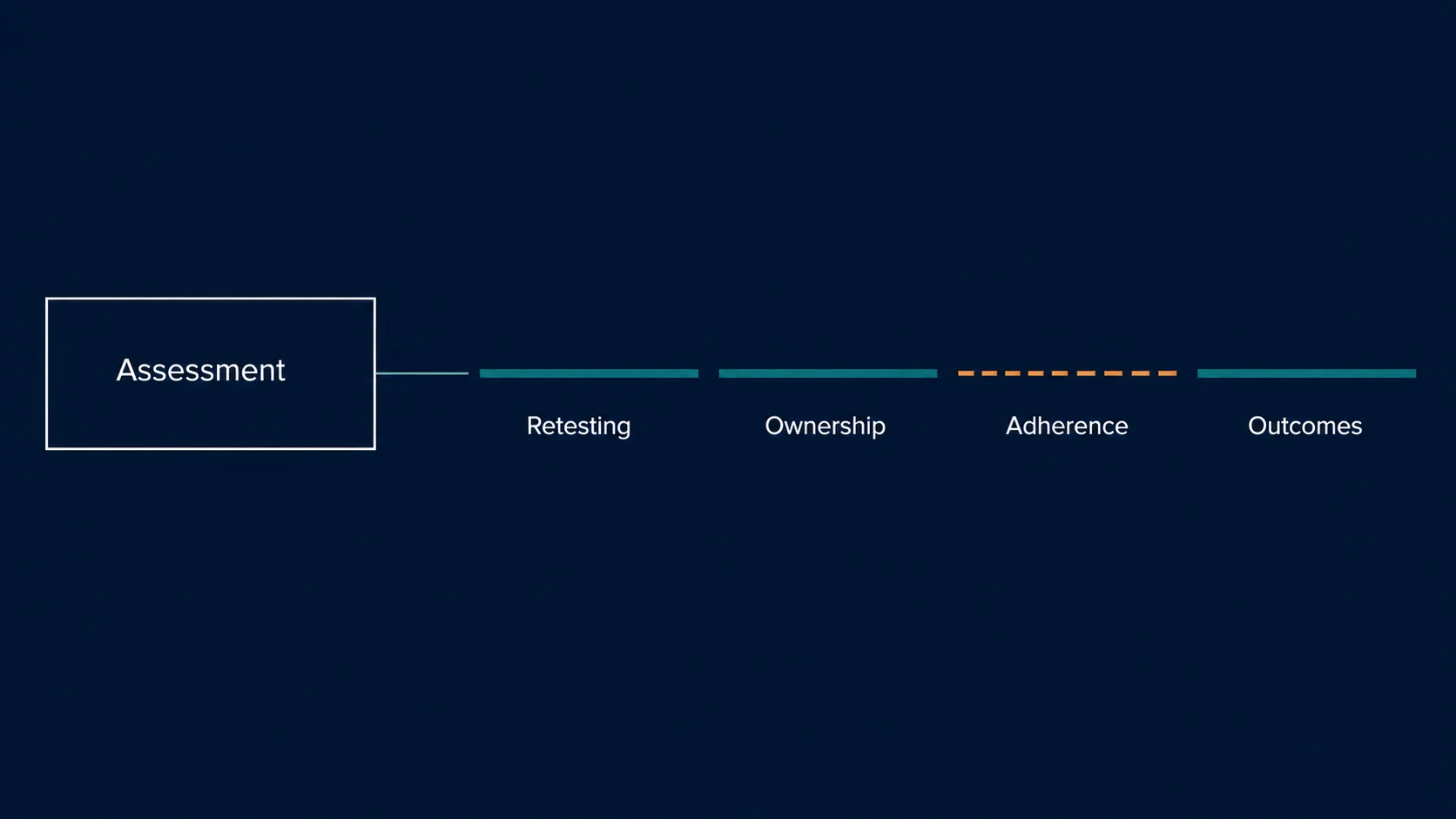
A member completes a comprehensive assessment, receives a protocol, and is scheduled for a 12-week retest. The retest is missed. No one notices for three weeks. By the time the care team follows up, the member has disengaged. On paper, this looks like churn. Operationally, it may be a failed handoff.
This pattern is highly relevant to longevity, concierge, preventive, executive health, and functional medicine programs, though the strongest supporting evidence comes from adjacent healthcare settings rather than from longevity clinics themselves. The initial assessment is rarely the whole program. The real operational test begins afterward, in retesting, protocol adjustment, adherence visibility, team ownership, and longitudinal outcomes tracking. When these workflows run on memory, spreadsheets, or disconnected systems, protocols drift, and members can appear disengaged when the actual failure is that no system owned the next step.
What causes follow-up breakdowns in longevity and preventive clinics? Follow-up breakdowns are typically driven by unclear ownership of next steps, missed or delayed retests, manual tracking that substitutes for a system, and fragmented data across labs, wearables, and record systems. This pattern is well documented in ambulatory care and chronic disease research. Direct evidence specific to longevity and concierge clinics remains limited.
Table of Contents
The Assessment Is Not the Program
Clinics invest heavily in the assessment phase: comprehensive biomarker panels, structured intake, and a well-designed protocol. This phase is bounded and staffed. Someone owns it, it happens on a schedule, and its output, a protocol, is a concrete deliverable.
What follows looks different. A program spans months or years, involves multiple team members, and depends on the completion of many small tasks: a retest ordered here, a reminder sent there, a protocol adjustment made after a result comes back. Ambulatory care research on test-result management shows that this longer, distributed phase is where breakdowns concentrate. A systematic review of ambulatory test follow-up found that failure to document follow-up ranged from 6.8% to 62% for abnormal laboratory results and from 1.0% to 35.7% for abnormal imaging results, with consequences that included delayed cancer diagnoses (Callen JL, Westbrook JI, Georgiou A, Li J. “Failure to Follow-Up Test Results for Ambulatory Patients: A Systematic Review.” Journal of General Internal Medicine, 2012). These figures describe general ambulatory care settings, including outpatient, academic medical, community health center, and primary care contexts, not longevity or concierge clinics, and should not be read as an estimate of failure rates in those settings. What the review does establish is a documented pattern: test follow-up is a known point of failure in medicine broadly, independent of clinic type. It is reasonable to expect the same category of risk, if not the same magnitude, wherever retesting and protocol follow-through are structurally similar.
A program is not finished once the protocol is issued. It is only beginning.
What Follow-Up Breakdown Actually Looks Like
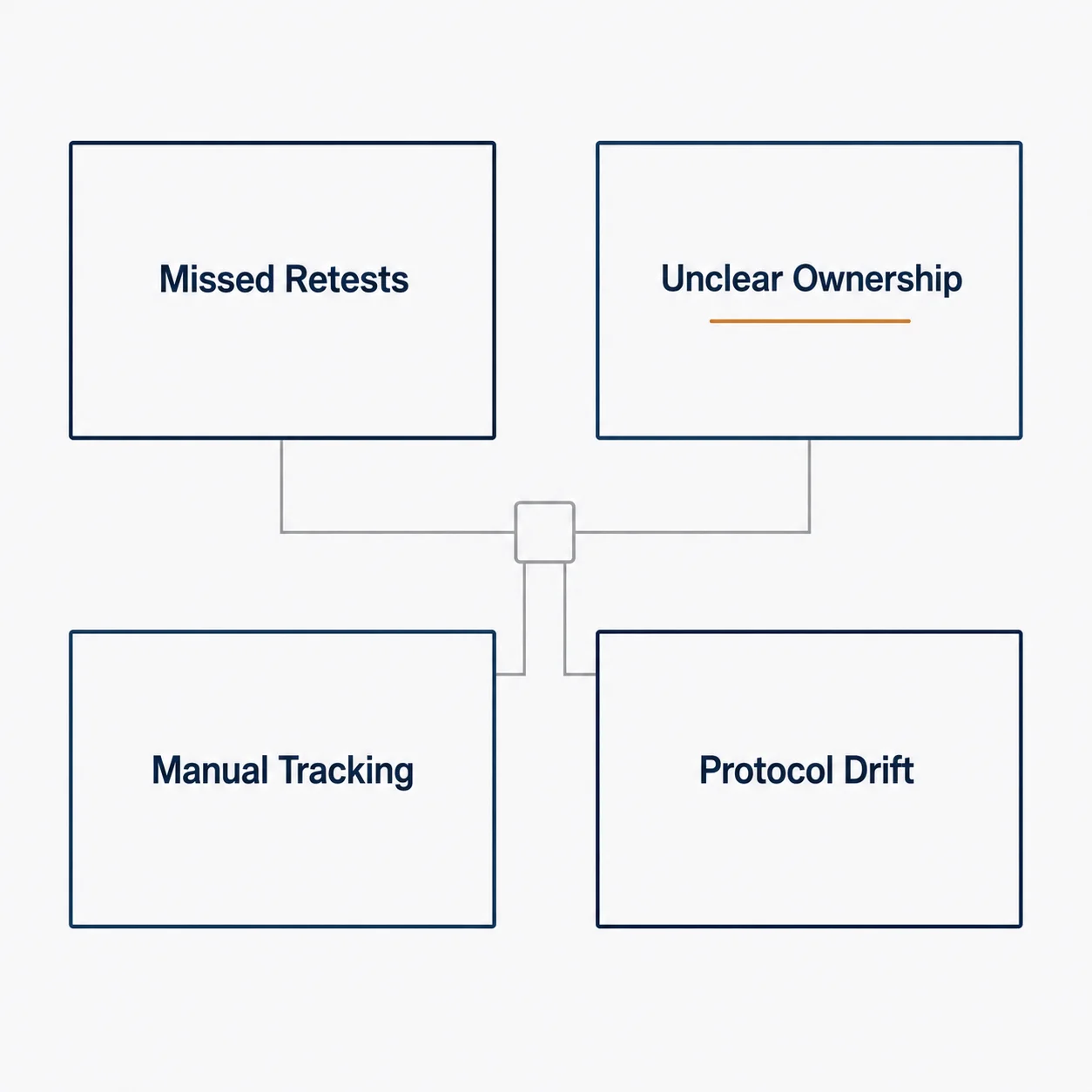
Follow-up breakdown is rarely a single failure. It is a cluster of related failure modes that tend to appear together.
Missed or delayed retests
Retesting is how a clinic confirms whether a protocol is working. When retests are missed or delayed, the clinic loses its primary signal for adjusting care. The Callen et al. review found that hybrid paper-and-electronic tracking systems were associated with higher rates of missed follow-up than either fully electronic or fully paper-based systems. Partial or inconsistent tracking infrastructure, not any single technology, drives the failure.
Unclear ownership of next steps
The Callen et al. review repeatedly cites the absence of explicit policies defining who is responsible for follow-up as a central contributor to missed results. In multidisciplinary care environments, this ambiguity compounds. The same review describes a study of dual-notification systems, where an abnormal result was sent to two clinicians instead of one as a safeguard, that found this arrangement actually increased the odds that the result would go unread and unactioned. More owners without clear accountability can produce worse outcomes than a single, clearly assigned owner.
Manual tracking substituting for a system
A qualitative study of primary care teams found that even where practices had electronic health records, staff often built parallel manual processes (spreadsheets, paper logs, personal reminder systems) to track what the record itself did not surface clearly: who owed a follow-up action and when it was due (O’Malley AS, Draper K, Gourevitch R, Cross DA, Scholle SH. “Electronic Health Records and Support for Primary Care Teamwork.” Journal of the American Medical Informatics Association, 2015). This manual layer works until it doesn’t. It depends on institutional memory, is invisible to new team members, and degrades as caseloads grow.
Protocol drift over time
Even in fields with formal, structured protocols, adherence proves difficult to sustain without active tracking. Conference-reported oncology pathway data presented at ASCO 2020 found that adherence to evidence-based treatment pathways increased from 58% to 72% across nine statewide oncology practices after a clinical decision-support tool was implemented within the electronic health record (“Clinical Decision Support Helps Compliance with Evidence-Based Oncology Pathways,” American Health & Drug Benefits, 2020). Because this finding comes from a conference-reported retrospective cohort rather than a peer-reviewed randomized trial, it should be treated as suggestive rather than definitive. Even so, it points to the same conclusion as the stronger ambulatory care evidence: protocol adherence is not automatic, even with a defined pathway, and drifts without reinforcement. Longevity protocols, typically more individualized and less standardized than oncology pathways, may face a similar category of structural risk, although this has not been directly measured in longevity clinic settings.
Why This Happens After the Assessment
The assessment phase and the follow-up phase differ in structure, and that difference helps explain why breakdowns concentrate downstream.
Assessment is episodic: a single visit, a defined set of inputs, a single output. Follow-up is longitudinal. It unfolds over months, involves changing team members, and requires that information from one point in time remain accessible and actionable much later. Samal L, Wright A, Wong BT, Linder JA, and Bates DW, in “Leveraging Electronic Health Records to Support Chronic Disease Management: The Need for Temporal Data Views” (Informatics in Primary Care, 2011), argue that most EHRs do not adequately support longitudinal data management, and that the way most systems display data over time makes it difficult for clinicians to trend changes and review a patient’s course efficiently. The authors call for improved “temporal data views,” ways of seeing trends, gaps, and overdue actions across long periods, as a needed enhancement to primary care EHR functionality.
Qualitative research on chronic disease management adds a second dimension. A study of patients managing anticoagulation therapy found that gaps between clinical recommendations and daily life arose because clinician recommendations did not fit patients’ daily routines or living contexts, and because information failed to transfer across settings. These gaps increased patient workload and compromised adherence to the therapy plan (Ozkaynak M, Valdez R, et al. “Understanding Gaps Between Daily Living and Clinical Settings in Chronic Disease Management: Qualitative Study.” Journal of Medical Internet Research, 2021). This pressure intensifies at scale, a theme explored in more depth in why personalized longevity care becomes operationally unscalable, where the same handoff problem that affects a single member’s follow-up compounds across a growing panel of members.
Disengagement vs. Failed Follow-Up
One of the hardest operational distinctions a clinic has to make is whether a member who has gone quiet has disengaged from the program or simply fallen through a gap in the clinic’s own workflow.
The two problems require different responses. Genuine disengagement calls for a member-focused conversation. A failed follow-up calls for a workflow fix. Clinics without structured tracking tend to default to the first explanation because it is the only one visible to them. There is no missed-task record, no overdue-retest flag, no audit trail showing what should have happened and did not.
Research on appointment adherence offers a useful proxy, again drawn from adjacent primary care settings rather than longevity clinics directly. The Junod Perron et al. randomized controlled study on missed appointments at an urban primary care clinic found that a sequential reminder intervention (phone call, then SMS, then postal letter) significantly reduced missed appointments, from 11.4% in the control group to 7.8% in the intervention group, and identified specific patient risk factors, including younger age and longer gaps since the last visit, that predicted non-attendance (“Reduction of Missed Appointments at an Urban Primary Care Clinic: A Randomised Controlled Study.” BMC Family Practice, 2010). A meaningful share of what looks like non-adherence may simply be a response to the absence of a prompt, rather than a considered decision to disengage. The Ozkaynak et al. study similarly found that structural barriers, recommendations that didn’t fit daily routines, unclear instructions, information that failed to transfer between settings, were common causes of what appeared, from the clinic’s side, as simple non-compliance. Without tracking that can distinguish these causes, a clinic cannot know which problem it actually has.
How is member disengagement different from failed follow-up? Disengagement originates with the member’s decision to step back from the program. Failed follow-up originates with the clinic’s own systems: a missed reminder, an unclear owner, a data gap. Without structured tracking, the two are easily conflated.
What the Evidence Says, and What It Does Not
Strong evidence from adjacent healthcare settings
The strongest evidence on follow-up breakdown comes from ambulatory care, primary care coordination, and chronic disease management, fields with decades of systematic study. The Callen et al. systematic review remains the most cited synthesis on ambulatory test follow-up failure, documenting wide variation in missed results and direct links to missed or delayed diagnoses. The O’Malley et al. study on primary care teamwork and the Krist et al. consensus statement on EHR functionality both document gaps in registry functionality, care-plan tools, and longitudinal tracking that force practices into manual workarounds (Krist AH, Beasley JW, Crosson JC, et al. “Electronic Health Record Functionality Needed to Better Support Primary Care.” Journal of the American Medical Informatics Association, 2014). The Junod Perron et al. reminder study provides randomized evidence that structured recall systems measurably reduce missed follow-up.
Limited direct evidence in longevity and concierge medicine
Direct research on follow-up workflows inside longevity, concierge, or executive health clinics remains limited. A 2024 literature review in the Journal of Family Medicine and Primary Care on concierge medicine focused mainly on member satisfaction, access, and preventive service uptake, and explicitly noted a shortage of outcome-focused research in this care model. Separate economic analysis published through the University of Pennsylvania’s Leonard Davis Institute found that concierge medicine enrollment was associated with substantially higher total health spending, with no corresponding change in mortality. That finding matters for program value, though it does not speak directly to follow-up workflow design. No study identified in this research base quantifies retest completion rates, adherence tracking accuracy, or protocol drift specifically within longevity or concierge clinic populations.
Why adjacent evidence still matters
The absence of direct longevity-specific data does not remove the pattern’s relevance. It changes how carefully the pattern must be applied. Longevity, concierge, and functional medicine programs share the same structural features that drive follow-up failure elsewhere: multi-step protocols, distributed team involvement, retesting intervals, and reliance on records that were not purpose-built for longitudinal tracking. Ambulatory care, chronic disease management, and care coordination research consistently identify unclear ownership, manual tracking, and fragmented data as root causes of follow-up failure. It is reasonable to expect similar categories of risk in longevity-style programs, without assuming the same numeric failure rates.
Why EMRs Do Not Resolve This on Their Own
Electronic health and medical records remain the system of record for most clinics, and they perform that function well: documentation, billing, clinical history. The evidence points to a narrower limitation. Most EMRs were not designed to manage longitudinal protocol execution across a team.
The O’Malley et al. study found that clinicians and staff frequently could not rely on the EHR alone to answer basic operational questions: who owns this task, what is overdue across the panel, what is the current state of this member’s plan. Respondents specifically identified the lack of integrated care-manager software, poor practice registry functionality and interoperability, and inadequate tools for tracking patient data over time as the weakest areas of EHR functionality for teamwork. The Krist et al. consensus statement reached a similar conclusion at a broader level: current EHR objectives remain focused on documenting disease-specific encounters rather than tracking and interpreting information over time, and primary care needs EHRs to support team-based care and population-management tools that most systems do not yet provide. Separate research published through the Commonwealth Fund found that electronic records improved communication within a single practice but did less to support coordination across settings and care team members, partly due to interoperability limitations (“Are Electronic Medical Records Helpful for Care Coordination? Experiences of Physician Practices.” The Commonwealth Fund, 2009).
None of this suggests that EMRs are unsafe or that they should be replaced. They remain the authoritative clinical record and a regulatory necessity. The evidence points to a gap in scope: documentation systems and longitudinal execution systems solve different problems, and a program built on biomarker retesting, protocol adjustment, and multi-team coordination needs both. For a deeper look at this distinction, see why EMRs alone are not enough for protocol-driven longevity clinics.
Why are EMRs not enough for longitudinal protocol execution? EMRs are built to document encounters and maintain clinical records, not to track protocol state, retesting intervals, or task ownership across a care team over time. Those functions require dedicated registry and longitudinal-tracking infrastructure.
What Structured Follow-Up Infrastructure Should Include
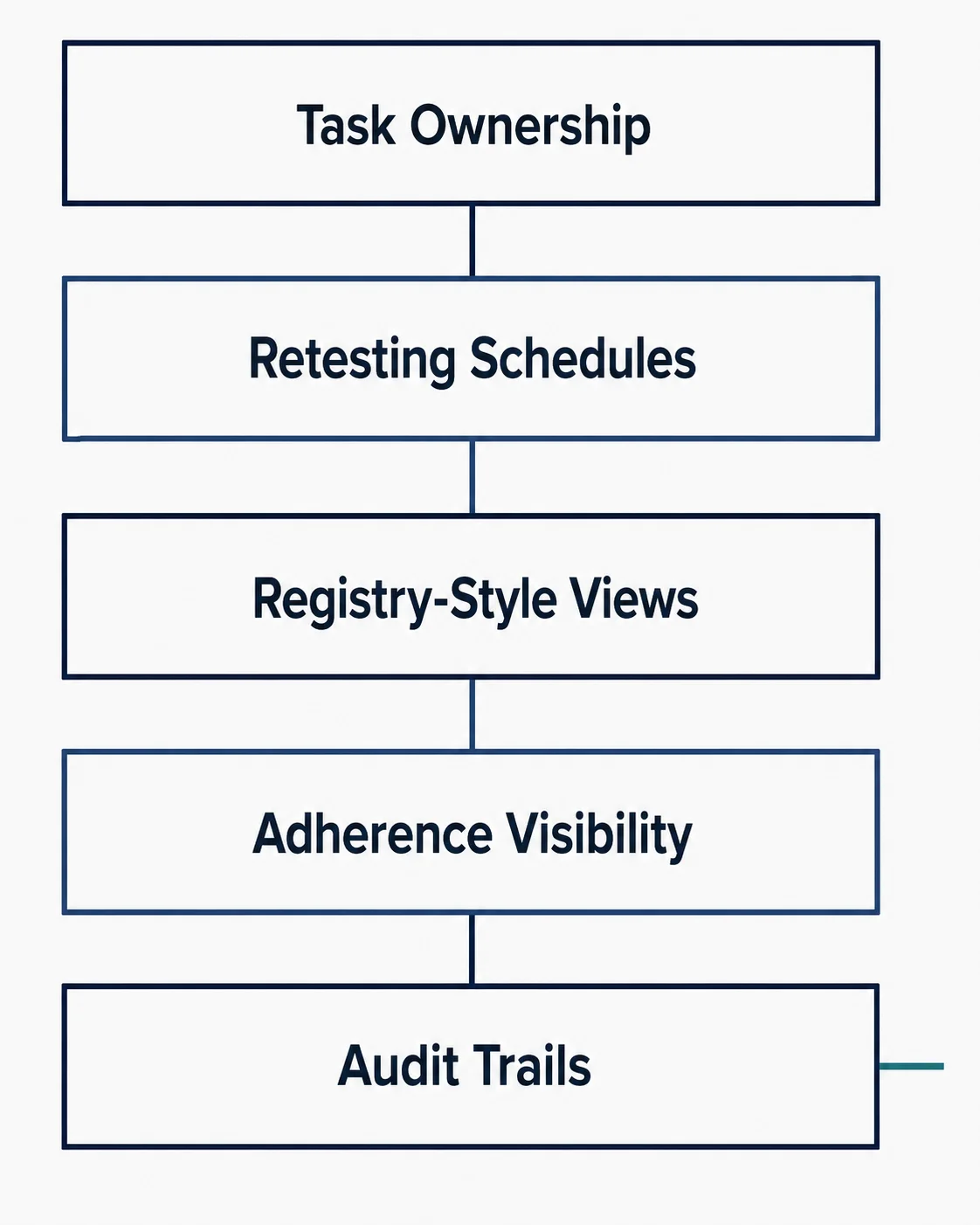
Across ambulatory care, chronic disease management, and integrated care research, several recurring infrastructure components are associated with better follow-up outcomes.
Explicit task ownership
The Callen et al. systematic review consistently points to the absence of clear responsibility as a root cause of missed follow-up, and shows that ambiguous or duplicated ownership (as in the dual-notification finding) can make outcomes worse, not better. Structured infrastructure assigns a specific owner to each follow-up action, rather than leaving it to be picked up by whoever notices.
Retesting schedules and protocol state tracking
The conference-reported oncology pathway data and the Ozkaynak et al. chronic disease research both point toward the same conclusion: protocols require active tracking of where a member currently stands, what has been completed, what is due, what is overdue. Adherence to even well-defined pathways erodes without reinforcement. A registry that can answer “what is this member’s current protocol state” does more than a record that only shows what happened at each visit.
Registry-style population views
The Krist et al. consensus statement specifically calls for population-management tools that allow primary care teams to identify which patients across an entire panel need a given action, rather than requiring a clinician to check each record individually. This population-level view is what allows a growing member base to be monitored without proportionally increasing manual review time.
Adherence visibility and escalation
The Junod Perron et al. reminder study demonstrates that timely, appropriately targeted outreach measurably improves follow-through, and that effectiveness increases when reminders are matched to known risk factors for non-attendance. Structured infrastructure builds this in as a default behavior, flagging overdue items and escalating them rather than relying on staff to remember. This capability supports adherence visibility. It does not, on its own, guarantee that members will adhere to a given protocol.
Audit trails and outcomes tracking
Governance-oriented research on integrated care, including the OECD’s 2023 policy report on chronic disease management, emphasizes that coordinated data systems and accountability structures support both quality improvement and better population outcomes (“Integrating Care to Prevent and Manage Chronic Diseases: Best Practices in Public Health.” OECD Publishing, 2023). An audit trail is not a compliance formality. It is the mechanism that lets a clinic learn from its own follow-up failures rather than repeating them.
What should structured follow-up infrastructure include? Explicit task ownership, retesting schedules with visible protocol state, registry-style views across the member population, adherence visibility with escalation logic, and audit trails connecting actions to outcomes.
How Follow-Up Workflows Connect to Outcomes Reporting
Follow-up infrastructure and outcomes reporting are often treated as separate problems, but they share a dependency. A clinic cannot report meaningfully on program outcomes without first establishing which members actually completed their protocols, on what timeline, and with what degree of adherence. Without that layer, outcomes data mixes true clinical response with simple incompleteness. A member who shows no improvement because the protocol did not work looks identical, on paper, to one who shows no improvement because the retest never happened.
This is closely related to why longevity clinics struggle to prove clinical outcomes: outcome measurement depends on execution data that follow-up infrastructure is responsible for generating. It also connects to why longevity clinic data stays fragmented across labs, wearables, and EHRs. Fragmented inputs make it structurally difficult to construct a single, reliable view of what actually happened for a given member over time. Follow-up tracking is not a downstream convenience. It is a precondition for outcomes reporting to mean anything.
Better follow-up tracking does not, on its own, guarantee improved clinical outcomes. Outcomes depend on many clinical and contextual factors beyond process execution. What structured follow-up provides is visibility: an accurate account of what was actually delivered, which is the necessary foundation for any credible outcomes claim.
What This Means for Clinic Leaders
The evidence base for this problem is strongest in adjacent fields: ambulatory test management, chronic disease care, oncology pathways, and primary care coordination. Direct research on longevity and concierge clinic workflows is still limited. That gap is itself informative. It suggests that the operational risks well documented elsewhere in medicine have not yet been rigorously studied in premium preventive care, not that those risks are absent.
For clinic leaders, the practical takeaway is diagnostic before it is technological. The first step is naming precisely where a program currently loses track of members: is it retesting, ownership, tracking, or protocol drift? Each breakdown type requires a specific structural response, not a general appeal to “better engagement” or “more communication.” Clinics that build structured operating infrastructure around explicit ownership, protocol state tracking, and adherence visibility are better positioned to distinguish system failure from member disengagement.
This is the broader operating model explored in our guide to the longevity clinic operating system.
Frequently Asked Questions
What causes follow-up breakdowns in longevity clinics?
Follow-up breakdowns are typically caused by unclear ownership of next steps, missed or delayed retests, manual tracking that substitutes for a structured system, and fragmented data across labs, wearables, and records. These patterns are well documented in adjacent ambulatory and chronic care research.
Is follow-up breakdown a member motivation problem or an operational problem?
Research on ambulatory test management and chronic disease care frames it primarily as an operational and workflow-design issue, driven by unclear responsibility and weak tracking infrastructure, rather than a simple failure of individual motivation.
Are missed retests common in longevity and concierge clinics specifically?
Direct data on retest completion rates in longevity and concierge clinics is limited. The strongest evidence on missed retests comes from ambulatory care generally, where systematic review data shows meaningful variation in follow-up rates. These figures should not be assumed to transfer directly to longevity clinic populations.
Do EMRs solve the follow-up problem?
EMRs are the authoritative system of record for clinical documentation, but research on primary care teamwork and EHR functionality identifies specific limitations in supporting team-based task ownership, registry-style tracking, and longitudinal protocol state, functions distinct from documentation.
How can a clinic tell if a member has disengaged or if follow-up failed internally?
Without structured tracking that records what should have happened and when, this distinction is difficult to make reliably. Evidence on reminder systems suggests that a meaningful share of apparent non-adherence responds to structured outreach, indicating that workflow gaps, not member intent, are often a contributing factor.
Does improving follow-up infrastructure guarantee better clinical outcomes?
No. Structured follow-up improves visibility into what was actually delivered and completed, which is a precondition for credible outcomes reporting. Clinical outcomes depend on additional factors beyond process execution.
What should a clinic look for to diagnose a follow-up breakdown?
Common signals include retests without a scheduled owner, protocols with no documented review checkpoint, reliance on individual staff memory rather than a shared system, and an inability to distinguish overdue actions from completed ones at a glance.
Can reminder systems alone fix follow-up gaps?
Reminder and recall systems measurably reduce missed appointments and follow-up lapses in controlled studies, but they address one part of the problem. They do not resolve unclear ownership, protocol state tracking, or data fragmentation on their own.
Sources and Further Reading
- Callen JL, Westbrook JI, Georgiou A, Li J. “Failure to Follow-Up Test Results for Ambulatory Patients: A Systematic Review.” Journal of General Internal Medicine, 2012. https://pmc.ncbi.nlm.nih.gov/articles/PMC3445672/
- Agency for Healthcare Research and Quality (AHRQ) Patient Safety Network. “Failure to Follow-Up Test Results for Ambulatory Patients.” https://psnet.ahrq.gov/issue/failure-follow-test-results-ambulatory-patients-systematic-review
- O’Malley AS, Draper K, Gourevitch R, Cross DA, Scholle SH. “Electronic Health Records and Support for Primary Care Teamwork.” Journal of the American Medical Informatics Association, 2015. https://pubmed.ncbi.nlm.nih.gov/25627278/
- Krist AH, Beasley JW, Crosson JC, et al. “Electronic Health Record Functionality Needed to Better Support Primary Care.” Journal of the American Medical Informatics Association, 2014. https://pubmed.ncbi.nlm.nih.gov/24431335/
- Ozkaynak M, Valdez R, Hannah KL, et al. “Understanding Gaps Between Daily Living and Clinical Settings in Chronic Disease Management: Qualitative Study.” Journal of Medical Internet Research, 2021. https://www.jmir.org/2021/2/e17590/
- “Reduction of Missed Appointments at an Urban Primary Care Clinic: A Randomised Controlled Study.” BMC Family Practice, 2010. https://pubmed.ncbi.nlm.nih.gov/20973950/
- Organisation for Economic Co-operation and Development (OECD). “Integrating Care to Prevent and Manage Chronic Diseases: Best Practices in Public Health.” OECD Publishing, 2023. https://www.oecd.org/en/publications/integrating-care-to-prevent-and-manage-chronic-diseases_9acc1b1d-en.html
- “Are Electronic Medical Records Helpful for Care Coordination? Experiences of Physician Practices.” The Commonwealth Fund, 2009. https://www.commonwealthfund.org/publications/journal-article/2009/dec/are-electronic-medical-records-helpful-care-coordination
- “A Literature Review on the Impact of Concierge Medicine Services on Individual Healthcare.” Journal of Family Medicine and Primary Care, 2024. https://pmc.ncbi.nlm.nih.gov/articles/PMC11254062/
- “Concierge Medicine Drives Higher Health Costs Without Extending Lives.” University of Pennsylvania Leonard Davis Institute for Health Economics, 2023. https://ldi.upenn.edu/our-work/research-updates/concierge-medicine-drives-higher-health-costs-without-extending-lives/
- Patt DA, et al. “Clinical Decision Support Helps Compliance with Evidence-Based Oncology Pathways.” American Health & Drug Benefits, presented at ASCO 2020 Annual Meeting. https://www.ahdbonline.com/issues/2020/august-2020-vol-13-special-issue/clinical-decision-support-helps-compliance-with-evidence-based-oncology-pathways
- Samal L, Wright A, Wong BT, Linder JA, Bates DW. “Leveraging Electronic Health Records to Support Chronic Disease Management: The Need for Temporal Data Views.” Informatics in Primary Care, 2011;19(2):65–74. https://pubmed.ncbi.nlm.nih.gov/22417816/
HolistiCare provides clinical decision-support infrastructure; it is not a licensed medical provider or electronic health record. All diagnostics, care protocols, and clinical decisions remain exclusively the responsibility of qualified healthcare professionals. Insights generated by HolistiCare’s AI engine are for clinical and informational use only and do not constitute medical advice, diagnosis, or treatment.