
Data Fragmentation Slows Down Your Practice
Clinicians today spend substantial time manually normalizing units, reconciling reference ranges, and hunting for clinically relevant trends across disjointed vendor reports.
This fragmentation creates three critical problems:
- Slow Decision-Making: Hours wasted cross-referencing PDFs.
- Data Inconsistency: Variability across providers and lab vendors.
- Reduced Capacity: Less time available for high-value patient care and cohort analytics.
OUR SOLUTION
A Unified, Audit-Ready Clinical Profile
HolistiCare acts as your central intelligence layer. We ingest multi-vendor data, standardize it into a canonical model, and apply a transparent interpretation layer trained in clinical and longevity medicine.

Universal Data Ingestion & Normalization
Stop manually converting units. We connect directly to Lab Information Systems (LIS), genetic vendors, and wearable APIs.
-
Auto-Normalization: We automatically handle unit conversions (e.g., mmol/L ↔ mg/dL) and map vendor-specific reference ranges to age/sex-specific intervals.
-
Legacy Data Import: We support bulk historic imports via CSV or HL7, allowing you to backfill patient histories for immediate longitudinal trend analysis.
-
Multi-Omics Support: Consolidate clinical labs, genomics, microbiome, and lifestyle data in one view.
Smart Prioritization & Pattern Detection
Don’t just see results; see the signal in the noise. Our platform applies deterministic rules and probabilistic models to rank findings by likely clinical impact.
-
Cluster Detection: Surface high-impact clusters first (e.g., inflammation + dyslipidemia + iron abnormality) rather than isolated metrics.
-
Confidence Scores: Every finding includes a confidence indicator and specific evidence links, helping you triage high-risk patients instantly.

Glass-Box Transparency
We believe in enhancing clinician authority, not replacing it. Unlike “black box” AI, HolistiCare offers full traceability.
-
Audit-Ready: Each interpreted finding links back to the exact source data point, the specific reference range used, and the interpretation rule version.
-
Source Verification: Clinicians can expand any view to see raw lab reports and assay notes (e.g., hemolysis flags or fasting status).
-
Clinician Control: All summaries are editable. You can override automated findings, with every edit versioned and noted for compliance.
what you get
Seamless Integration with Your Clinical Workflow
We are built to sit on top of your existing stack, not complicate it.
Data Ingestion & Normalization
HolistiCare’s data ingestion pipeline supports HL7/FHIR feeds, CSV/SFTP imports, API pulls from genetic and microbiome vendors, and consumer wearable connectors. During onboarding, we map each vendor’s output to a canonical data model. This includes unit standardization (for example, mmol/L ↔ mg/dL conversions where appropriate), reference range harmonization (age- and sex-specific intervals), and tagging of special assay metadata such as fasting status, sample hemolysis and instrument flags. Importantly, the pipeline preserves every raw artifact: original file, timestamp, and vendor identifier. That means clinicians can audit or re-interpret findings if new evidence emerges. The normalization layer also annotates data quality issues (missing values, implausible results) and applies basic plausibility checks before passing data into the interpretive engine. These pre-checks reduce false positives and avoid clinician time wasted chasing data errors. Finally, HolistiCare supports bulk historic imports so clinics can backfill patient histories and immediately benefit from trend analysis across months or years.
Pattern Detection & Prioritization
Rather than presenting clinicians with a long list of isolated abnormal results, HolistiCare identifies clinically meaningful patterns and ranks them by probable impact. The engine uses a hybrid approach: explicit clinical heuristics derived from guideline thresholds and evidence-based multi-marker rules, plus probabilistic models that consider age, sex, medications and comorbidities. For instance, a mild ALT elevation combined with high GGT and recent statin initiation surfaces as a prioritized “hepatic stress” cluster with suggested immediate checks (med list review, counsel on alcohol), monitoring cadence and a confidence note. Each cluster displays contributing datapoints, timing (acute vs chronic pattern), and recommended next steps including urgency level. Prioritization settings are configurable at the clinic level so high-risk populations can be triaged faster. This focus on clusters reduces cognitive load, shortens chart review time and helps teams catch early signals that single-value alerts miss.
Explainability & Evidence Links
Explainability is central to acceptance among clinicians. For every automated inference, HolistiCare displays a short, clinician-readable rationale: which values drove the inference, relevant thresholds, and a linked reference (guideline or primary literature). For model-based outputs, the platform summarizes contributing features and provides a confidence interval (e.g., “Model confidence: 78% based on 3 months of trend data”). All literature and guideline references are accessible with one click. The system tracks model and rule versions used for each report so clinicians can trace why a recommendation changed between visits. This design supports medico-legal transparency, internal quality review and local clinical governance. It also makes it straightforward to validate algorithms via pilot datasets and to document clinician acceptance or overrides for continuous improvement.
Clinical Workflow & Integration
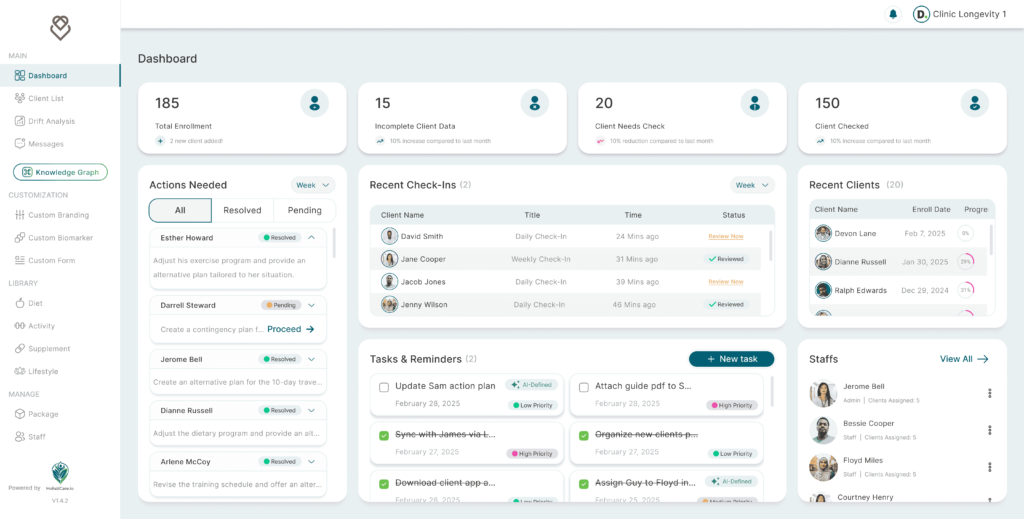
Comprehensive Analysis is built to fit into existing workflows. The clinician review screen presents a prioritized summary, editable suggestions, and a one-click action panel to order follow-up labs, schedule visits or message patients. Overrides and edits create versioned audit records. The platform integrates with EHRs for documentation and schedules, or it can operate as a standalone white-label portal if desired. For teams, role-based routing assigns items to the appropriate staff (physician, nurse, dietitian) along configured escalation paths. The platform also generates cohort reports so quality teams can monitor population trends and program performance. Implementation includes templated interpretations and escalation plays for common clusters (e.g. cardiometabolic risk, iron deficiency workup), but clinics can customize templates to reflect local protocols. This reduces ramp time and ensures the tool is immediately useful in daily practice.
Creating Success
What makes HolistiCare unique for your practice
Clinician-first provenance
HolistiCare shows raw values, mapped reference ranges and the rule or model that produced each conclusion so clinicians can audit and trust every interpretation.
Multi-vendor normalization
We reconcile lab, genetic, microbiome and wearable outputs into a canonical clinical model, eliminating manual unit conversions and inconsistent reference ranges.
Actionable triage and routing
Prioritized clusters, configurable escalation rules and one-click actions (orders, scheduling, messages) ensure findings become timely clinical care rather than reports.
“I’ve really enjoyed working with the Holisticare team. Their AI-powered platform is the future of health coaching—streamlined, scalable, and built to keep clients engaged. I’m excited to see how it will continue to transform the way we deliver personalised care.”
Chief Medical Officer

FAQ
FAQs about HolistiCare Comprehensive analysis feature
Practical answers for clinicians evaluating the Comprehensive Analysis.
Typical vendor mapping and validation take 1–3 weeks depending on sample formats and documentation.
Yes. All recommendations are editable; overrides are versioned with clinician notes for audit.
HL7/FHIR, CSV/SFTP, common genetic vendors and a growing list of wearable APIs. We provide middleware where needed.
Prioritization filters and configurable thresholds minimize low-value alerts; teams can tune sensitivity during pilot.
Data is encrypted at rest and in transit; role-based access and audit logs support HIPAA and GDPR requirements.