
Published: 29 July 2026
Last reviewed: 29 July 2026
Author: HolistiCare Editorial Team
Independent clinics need ten operational controls before AI influences clinical interpretation, protocol drafting, monitoring or member communication. The controls should define intended use, clinical influence, accountability, evidence, data, workflow, local verification, versioning, monitoring and transparency.
This does not require a hospital-sized governance committee. It requires a written operating model that makes the system’s purpose, evidence, data, version, escalation route and monitoring responsibilities visible.
This is not an AI-vendor procurement checklist or a specialty-specific prescribing framework. It defines the operating controls around each approved AI use case.
Key takeaways
- Start with the use case. Administrative, interpretive and member-facing uses create different operating questions.
- Human review is meaningful only when the clinician can inspect the relevant evidence, data, limitations and decision boundary.
- Local workflow verification is distinct from model training or formal statistical validation.
- Governance must continue after deployment. Version changes, incidents, subgroup performance and retirement decisions need named owners and review triggers.
- This control map is an evidence-informed starting point. It is not a legal opinion, regulatory classification, compliance standard or validated clinical safety instrument.
Evidence scope and limitations: The Independent Clinic AI Governance Control Map v1.0 is an editorial synthesis of regulator materials, professional guidance and peer-reviewed governance reviews available through 29 July 2026.
A 2026 Journal of Medical Internet Research review identified 19 health-system AI governance frameworks, only six derived from primary studies. A separate 2026 npj Digital Medicine review examined 35 frameworks and noted resource barriers for smaller healthcare organisations. Neither validates a minimum control set for independent clinics. (Alami et al.; HAIRA maturity-model review)
The map adapts recurring governance functions to a smaller operating environment. It does not establish that the controls prevent harm, ensure compliance or make a system clinically effective.
In this article
- Why independent clinics need a minimum viable model
- Independent Clinic AI Governance Control Map v1.0
- The ten operational controls
- What the working register should contain
- What this map does not establish
- Turn governance principles into visible operating controls
Why independent clinics need a minimum viable model
In the American Medical Association’s 2026 physician survey, 81% of respondents reported awareness or use of at least one professional AI use case. Validation, privacy, involvement in adoption and training were also high priorities. The adoption question included 1,342 respondents, was self-reported, and used a revised instrument, so it is not a direct estimate for independent clinics. (AMA 2026 Physician Survey on Augmented Intelligence)
A small clinic may lack dedicated informatics, safety and procurement teams while still using tools that affect clinical work. Its minimum model should make essential decisions, owners and review points visible.
Independent Clinic AI Governance Control Map v1.0
The map organises ten controls across four lifecycle stages:
- Decide: intended use, clinical influence, owner, evidence and jurisdiction.
- Validate: data, workflow, human oversight and local verification.
- Operate: active version, approved workflow, staff competence and communication.
- Review: performance, incidents, changes, escalation and retirement.
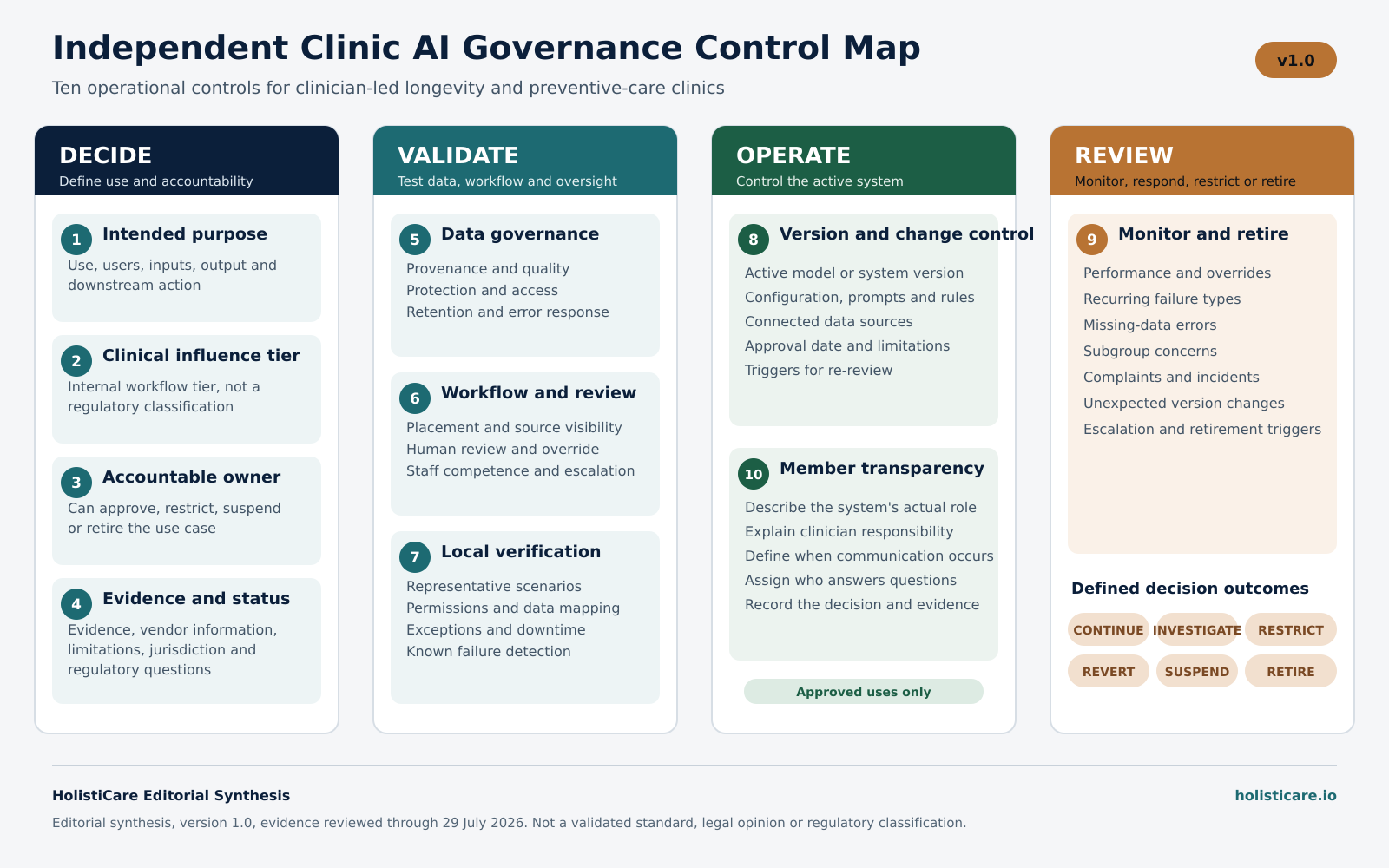
The stages are operational prompts, not regulatory categories. Some controls will span more than one stage.
The ten operational controls
1. Maintain a use-case and intended-purpose register
Record the purpose, users, data inputs, output and any decision or communication that follows. Separate administrative uses from functions that influence clinical interpretation or care.
Govern the use case, not a vendor name. Review the entry whenever its purpose, audience, data or downstream action changes.
2. Assign an internal clinical-influence and risk tier
Classify how strongly the use case may influence clinical work and how easily an error can be detected or corrected.
This is an internal workflow tier. It is not a medical-device classification or legal conclusion. Regulatory status depends on intended use, functionality, claims and jurisdiction. The FDA’s January 2026 clinical decision-support guidance, for example, addresses specific US statutory criteria and should not be generalised to every clinic tool or market. (FDA Clinical Decision Support Software guidance; FDA CDS FAQs)
3. Name an accountable clinical owner
Assign one person who can approve, restrict, suspend and retire the use case. Record supporting responsibilities for data protection, technical administration, vendor management and incident response, but do not let distributed participation obscure final accountability.
The AMA’s governance toolkit similarly emphasises leadership, roles, policy, training and monitoring, although it serves organisations with varying resources. (AMA Governance for Augmented Intelligence toolkit)
4. Review evidence, vendor information and jurisdictional status
Document the evidence supporting the intended use, its relevance to the clinic’s population and workflow, known limitations, vendor documentation, update policy, data arrangements and unresolved regulatory questions.
Keep three judgments separate: legal permissibility, performance and workflow fit. The NICE Evidence Standards Framework offers a risk-sensitive evidence structure but does not replace jurisdiction-specific assessment.
5. Record data provenance, quality, protection, access and retention
List the data sources used by the system, how identity and units are reconciled, which fields may be missing, who can access the data, where it is processed and how long inputs and outputs are retained.
Include a response to stale, incomplete, contradictory or incorrectly matched data. NHS guidance provides useful UK considerations, but independent clinics must assess their own responsibilities. (NHS artificial-intelligence information-governance guidance)
6. Define workflow placement, human review, override and staff competence
Specify where the AI output appears, what source information the reviewer can inspect, which roles may accept or modify it, how disagreements are documented, and what happens when the system is unavailable.
The reviewer needs enough time, information and competence to form an independent judgment. Training should cover limitations, escalation, automation bias, data handling and failure modes.
7. Conduct proportionate pre-deployment verification
Before routine use, test the full local workflow with representative scenarios. Check data mapping, permissions, output presentation, exception handling, escalation, downtime and whether reviewers can detect known failure modes.
Call this local workflow verification unless formal model validation was performed. It does not prove general clinical performance. Testing should increase with clinical influence, uncertainty and difficulty detecting error.
8. Maintain version and change control
Record the active model or system version, configuration, important prompts or rules, connected data sources, approval date and known limitations. Define which changes require re-review.
A vendor update, data connector, revised prompt, interface change or new purpose can alter operating risk. Change control connects the approval to the system actually in use.
9. Monitor performance, subgroups, incidents and retirement triggers
Decide what the clinic will monitor, who reviews it and what action follows. Useful signals may include clinician overrides, recurring failure types, missing-data errors, subgroup concerns, complaints, incidents, workflow delays and unexpected changes after an update.
Monitoring should lead to a defined decision: continue, investigate, restrict, revert, suspend or retire. A July 2026 NEJM AI editorial supports continuous monitoring but is not a trial result or universal requirement. (After Clearance)
10. Record member transparency and communication
Define what members are told about the AI-supported function, when the explanation is given, who answers questions and how the clinic records the communication. The explanation should reflect the actual role of the system and the clinician.
Transparency, consent and disclosure duties may differ by data, function, setting and law. The map records the clinic’s decision and evidence; it does not supply universal wording.
What the working register should contain
A small clinic can begin with one record for each approved use case. At minimum, capture:
- accountable owner;
- intended purpose and users;
- jurisdiction and function;
- internal clinical-influence tier;
- lifecycle state;
- evidence and policy references;
- vendor, model or system version;
- approval date;
- staff competence or training record;
- known limitations;
- review trigger and last-review date;
- incident and escalation route;
- retirement decision when applicable.
The register should link to supporting evidence rather than becoming a repository for every document. Its purpose is to show what has been decided, by whom, for which version and under what conditions.
What this map does not establish
The Independent Clinic AI Governance Control Map v1.0 is not a validated instrument, legal opinion, regulatory classification, compliance standard, clinical safety case or certification scheme. It does not show that ten controls are sufficient for every use case.
The WHO’s global AI governance guidance and its later guidance on large multimodal models provide broad principles and recommendations. Current UK work, including the National Commission’s June 2026 research and engagement findings, continues to develop the policy context. The MHRA AI Airlock Phase 2 report provides useful lifecycle examples for AI medical devices but explicitly states that it is not formal MHRA guidance.
Clinics should seek appropriate clinical, information-governance, regulatory and legal advice for the systems they intend to use.
Turn governance principles into visible operating controls
The practical test is not whether a clinic has an AI policy. It is whether the team can identify the approved purpose, accountable owner, supporting evidence, active version, review boundary, monitoring signal and escalation route for each use case.
The Longevity Clinic Operating System explains why these responsibilities belong in the operating layer around a clinic’s existing record systems. Related guidance covers the boundary between the operating layer and the clinic’s EMR and the separate problem of governing variation in clinical protocols.
HolistiCare provides clinical decision-support infrastructure; it is not a licensed medical provider or electronic health record. All diagnostics, care protocols, and clinical decisions remain exclusively the responsibility of qualified healthcare professionals. Insights generated by HolistiCare’s AI engine are for clinical and informational use only and do not constitute medical advice, diagnosis or treatment.
References
- Alami H, et al. Artificial Intelligence Governance in Health Systems: Systematic Review of Frameworks and Integrative Model Proposal. Journal of Medical Internet Research. 2026.
- Advancing healthcare AI governance through a comprehensive maturity model based on systematic review. npj Digital Medicine. 2026.
- World Health Organization. Ethics and governance of artificial intelligence for health. 2021.
- World Health Organization. Ethics and governance of artificial intelligence for health: guidance on large multimodal models. 2025.
- National Institute for Health and Care Excellence. Evidence standards framework for digital health technologies.
- NHS England Digital. Artificial intelligence: information-governance guidance.
- Medicines and Healthcare products Regulatory Agency. AI Airlock Sandbox Phase 2 Programme Report. 2026.
- Medicines and Healthcare products Regulatory Agency. National Commission into the Regulation of AI in Healthcare: research, engagement and call for evidence findings. 2026.
- US Food and Drug Administration. Clinical Decision Support Software guidance. January 2026.
- American Medical Association. Governance for Augmented Intelligence. 2025.
- American Medical Association. 2026 Physician Survey on Augmented Intelligence. 2026.
- Agarwal AA, et al. After Clearance: Continuous Monitoring as the Foundation of Clinical AI Oversight. NEJM AI. 2026. Editorial.