
10 Common Applications of Artificial Intelligence in Healthcare
Executive summary
Artificial intelligence (AI) has transitioned from experimental phases to active deployment across hospitals, clinics, payer systems, and digital health vendors. This overview summarizes ten common, validated applications that are reshaping clinical workflows and administrative processes. The focus is practical: what these tools do, their limitations, and considerations when evaluating platforms that combine multiple use cases. For a deeper technical treatment see our [pillar page on enterprise AI in healthcare](→ /ai-software-for-healthcare).
1. Clinical documentation & AI-assisted charting
NLP-powered ambient documentation
Natural language processing (NLP) captures clinician–patient interactions and converts them into structured text. These systems draft visit notes, summarize history, and extract problem lists. They reduce repetitive typing and cursor time, but accuracy depends on model tuning, specialty-specific templates, and real-world validation against charted notes.
Administrative burden reduction
AI-assisted charting lowers clerical load by auto-populating note sections, generating differential lists, and suggesting follow-up items. Immediate gains include clinician time savings; subtler benefits are fewer omitted items that trigger later queries. Expect a learning curve and frequent clinician review rather than turnkey elimination of documentation.
Workflow integration
Documentation AI must integrate within the visit flow, not run alongside it. Seamless EMR insertion points, quick edit affordances, and voice-to-text toggles are critical. Poor integration creates extra clicks and alerts that negate time savings. Evaluate workflow mapping early in procurement.
HolistiCare.io platform role
HolistiCare.io bundles ambient NLP with configurable templates and EMR connectors so generated notes appear where clinicians expect. The platform emphasizes audit trails and clinician sign-off to maintain medico-legal clarity while reducing repetitive documentation tasks.
Compliance and data security
Any ambient documentation system processes PHI in real time; encryption in transit and at rest, role-based access, and detailed logging are non-negotiable. Verify BAA terms and audit capabilities before pilot deployment.
2. AI-powered diagnostic imaging support
Radiology anomaly flagging
Imaging AI flags areas of interest—pulmonary nodules, fractures, intracranial bleeds—for radiologist review. Algorithms prioritize studies, surface suspected findings, and generate heat maps. These are triage and assistance tools, not definitive interpreters.
Pathology image assistance
Digital pathology workflows use AI to highlight suspicious slide regions, quantify cell types, and standardize measurements. This helps pathologists focus on high-yield fields and can speed throughput when integrated with lab information systems.
Retinal scan evaluation
Ophthalmic AI algorithms screen retinal images for diabetic retinopathy, macular edema risk markers, and other referable conditions. These are useful at scale in screening programs, but positive screens require ophthalmologist confirmation.
Radiologist review augmentation
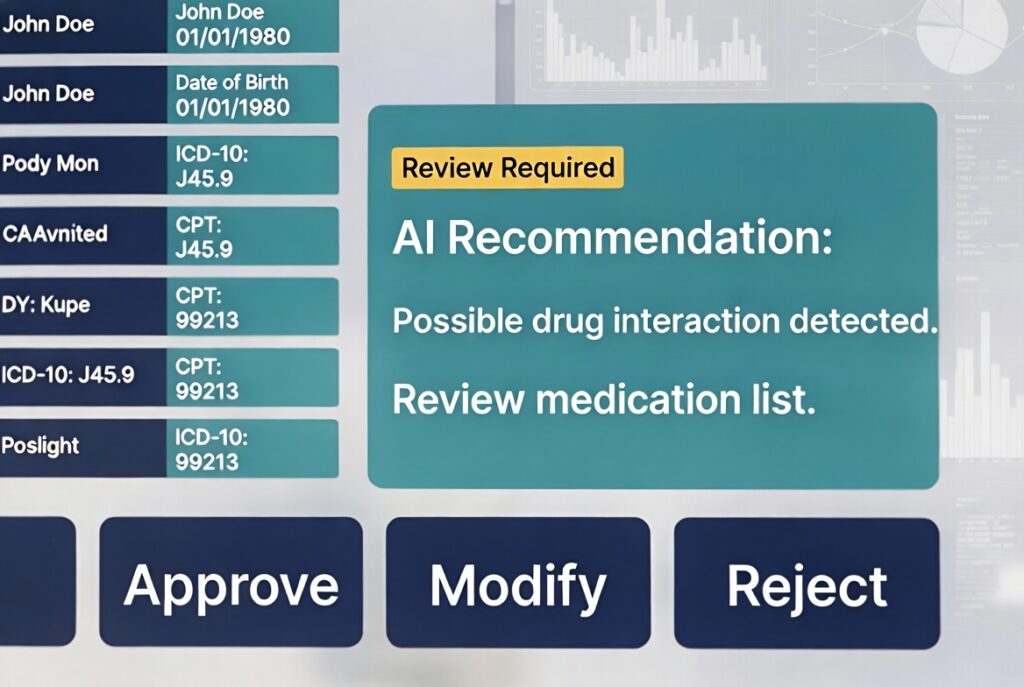
The sensible model is augmentation: AI pre-screens and radiologists confirm and contextualize findings. Good systems allow easy acceptance, modification, or discard of suggestions and provide provenance of AI output (training data type, confidence metrics, model version).
Limitations and oversight
Algorithms exhibit biases tied to training populations and imaging equipment. They produce false positives and negatives; institutions must validate performance locally and maintain oversight for discrepant reads and continuous revalidation.
3. AI for prior authorization automation
Revenue cycle impact
Automating prior authorization reduces treatment delays and administrative overhead. AI extracts clinical context, maps it to payer rules, and prepares authorization packets. The downstream cash-flow effect can be substantial for high-volume procedures.
Manual work reduction
By auto-filling forms and surfacing supporting documentation, AI cuts repetitive tasks by clinical staff. Complex or novel cases still require human adjudication; automation handles repetitive bulk, not exceptions.
Payer rule engine integration
Effective automation plugs into payer-specific rule engines and refreshes logic as policies change. Integration with payer APIs and secure file exchange reduces manual faxing and phone calls.
Turnaround time improvements
Faster authorizations reduce care delays and can shrink denial rates if documentation is consistent. Track cycle times and denial reasons post-deployment to ensure bottlenecks are addressed rather than hidden.
Return on investment
ROI is measured in FTE-hours saved, reduced claim denials, and shorter treatment start times. Validate projected savings against local staffing models before committing.
4. Clinical decision support systems (CDSS)
Guideline surfacing
AI-driven CDSS surfaces relevant guidelines at point of care—recommended diagnostics, drug choices, follow-up intervals—based on problem lists and labs. Currency is critical: guideline databases must be versioned and auditable.
Drug interaction alerts
Smart CDSS prioritizes interactions by clinical relevance and patient context, reducing alert fatigue. Systems incorporating renal function, age, and lab trends reduce unnecessary interruptions.
Risk score calculation
Automated risk scores (e.g., VTE, sepsis) help timely interventions. These scores are model outputs requiring clinician interpretation and should include suggested next steps.
Point-of-care integration
CDSS should embed into order entry and progress note flows rather than separate windows. Usable interventions allow clinicians to act within existing workflows without context switching.
HolistiCare.io linkage
HolistiCare.io links CDSS modules to patient data feeds and order entry workflows, with configurable thresholds and override audit. The platform aims to make decision support actionable, not just informational. See [clinical decision support software](→ /clinical-decision-support-software).
5. AI-enhanced EMR & EHR data intelligence
Predictive analytics
Within EHRs, AI forecasts risk for readmission, deterioration, and high-cost utilization. These predictions help prioritize case management and discharge planning. Model performance varies; local recalibration is usually necessary.
Coding accuracy
AI suggests ICD-10 and CPT codes based on documentation and encounter data, reducing errors and denials. Coders must validate suggestions, especially for complex inpatient cases.
Documentation gap identification
Tools scan charts for missing problem list entries, unbilled procedures, or absent consent forms to reduce compliance risk. These run as background jobs and surface items in workqueues for staff action.
Data-driven insights
Aggregated EHR data plus AI reveal utilization patterns, care variation, and guideline adherence gaps. Clinicians should review outputs before policy changes.
HolistiCare.io integration
HolistiCare.io provides connectors and data normalization layers so analytics work on consistent patient records, reducing fragmented data errors. See [AI-EMR integration](→ /ai-emr-integration).
6. Patient triage & virtual health assistants
Symptom checker tools
Symptom checkers use questionnaires and decision logic to suggest next steps—self-care, primary care, or urgent evaluation. They are intake triage aids, necessarily conservative, trading sensitivity for safety.
Intake automation
Virtual assistants collect histories, medication lists, and reasons for visit before encounters, populating intake fields and saving clinic time. Accuracy depends on question design and patient usability; poor design creates noise.
Patient routing optimization
AI routes patients to appropriate care settings—telemedicine, primary care, urgent care, or ED—based on risk signals and capacity. Routing algorithms must be transparent and auditable to avoid inappropriate steering.
Compliance as triage aids
These tools are informational triage aids—not replacements for clinical evaluation—and include clear disclaimers and escalation triggers. They must be validated for served populations and always operate under clinician supervision.
Non-diagnostic support
Virtual assistants excel at scheduling, medication reminders, and post-visit check-ins. Clinicians should view them as amplifiers of patient engagement, not diagnostic actors.
7. Predictive analytics for readmission & risk stratification
Population health management
Risk stratification identifies patients benefiting from case management or transitional care. Models flag social determinants, missed follow-ups, and medication risks to guide targeted interventions.
Early warning systems
On inpatient units, predictive analytics surface patients at risk of deterioration so rapid response teams act earlier. These require tight calibration to minimize false alarms and explicit escalation protocols.
Evidence-based risk models
High-quality models combine clinical variables, labs, and sometimes social data. Institutions should prefer peer-reviewed or locally validated models; black-box outputs without provenance pose risks.
Resource allocation
Predictive insights inform staffing, bed assignment, and outpatient outreach. Utility lies in converting predictions into actions—e.g., targeted home health referrals—and measuring downstream effects.
Outcome improvement potential
Models enable earlier interventions that may prevent readmissions and deterioration, but specific outcome claims require peer-reviewed validation before acceptance.
8. AI in medical coding & revenue cycle management
ICD-10 and CPT code suggestion
Coding AI analyzes documentation and suggests codes with supporting text snippets. Good systems provide confidence scores and cite chart locations for coder validation.
Claim scrubbing automation
Automated scrubbing checks syntactic and payer-specific rules pre-submission, catching missing modifiers or mismatched codes. This reduces rework and shortens AR days when integrated with claims pipelines.
Revenue cycle efficiency
AI reduces manual touches in billing—fewer edits, faster approvals, improved cash flow. However, automation can amplify systemic errors if initial rules or mappings are incorrect; monitor early metrics closely.
Error reduction
Systematizing pattern recognition reduces transcription errors and missed charges. Maintain feedback loops between coders and models to correct systematic misclassifications.
Commercial ROI
Vendors model ROI from recovered revenue and reduced FTE burden. Validate assumptions against your payer mix and denial drivers before projecting savings.
9. Healthcare workflow automation
Scheduling optimization
AI optimizes clinic schedules by predicting no-shows, estimating visit lengths, and clustering similar appointments. This increases throughput without extending hours but requires continuous tuning to local patterns.
Referral management
Automated referral routing and status tracking shorten handoffs. AI suggests appropriate specialists based on problem lists and availability, but clinicians must confirm suitability and patient preference.
Lab result routing
Intelligent routing sends critical values to the right clinician and surfaces trending abnormalities. Alert thresholds must align with clinical practice to avoid misses and alert fatigue.
Staff allocation
Predictive staffing uses historical volume and acuity signals to suggest staffing levels. Models support operational planning but must reconcile with union rules, contracts, and staff preferences.
HolistiCare.io workflow automation
HolistiCare.io ties automation modules to clinical systems so tasks and alerts appear in clinicians’ existing workqueues, reducing cognitive burden from siloed tools. See [healthcare workflow automation](→ /healthcare-workflow-automation).
10. AI for drug discovery & clinical trial matching
Industry context
AI in drug discovery accelerates target identification, virtual screening, and candidate prioritization. These are long-horizon activities with complex regulatory paths and are not direct clinical tools for bedside care.
Drug candidate identification
Machine learning triages molecular libraries and predicts candidate properties, accelerating preclinical workflows and reducing costly lab validations. Success remains probabilistic and resource-intensive.
Trial participant matching
AI improves trial recruitment by matching EHR phenotypes to protocol criteria, increasing efficiency and reducing screen failures when integrated with consent workflows and site feasibility data.
Market education focus
Because drug discovery timelines are long and uncertain, near-term clinical impact is improved trial access and recruitment. Health systems should request concrete pilot results and IRB oversight details.
Indirect clinical impact
Most institutions do not run discovery pipelines, but improved trial matching and research efficiency have downstream clinical benefits: faster access to novel therapies and better-aligned cohorts.
What to look for in a platform that covers these applications
Integration capabilities
A useful AI platform connects cleanly to your EHR, PACS, LIS, and scheduling systems. Look for configurable APIs, event-driven architecture, and standardized data models rather than brittle point-to-point scripts.
Compliance and security posture
Any system handling PHI must support a signed Business Associate Agreement (BAA). Confirm encryption standards, role-based access control, retention policies, and third-party penetration test results. HIPAA compliance is an evaluation requirement, not optional.
Breadth of AI coverage
Single-use tools solve narrow problems; integrated platforms reduce vendor sprawl. Evaluate whether a vendor offers interoperable modules sharing common identity, logging, and governance rather than bolt-on add-ons.
Interoperability considerations
Standards support (FHIR, DICOM, HL7) and vendor-neutral data normalization reduce data translation errors and ease module upgrades without rip-and-replace projects.
Scalability and support
Assess operational support: model retraining cadence, incident response SLAs, and clinical governance. Scalable platforms allow piloting small, measuring impact, and expanding without repeated integration.
Explore how HolistiCare.io brings these AI capabilities together in one platform — see a [walkthrough](→ /holisticare-demo).