
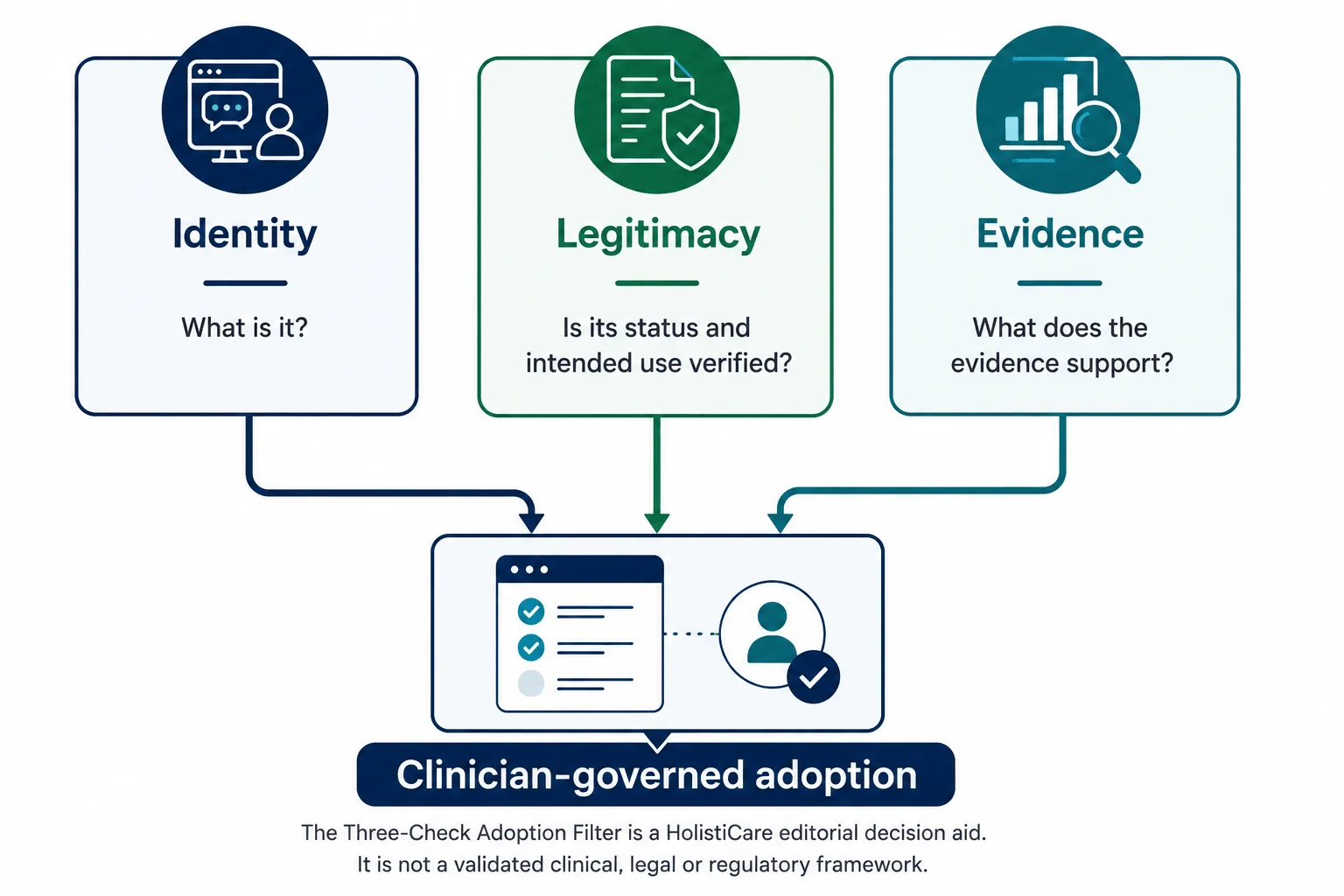
The strongest signals this week point to a simple operating principle for longevity clinics: verify what something is, whether it is legitimate for the intended use, and what the evidence actually supports before it becomes part of routine care.
A US policy proposal has renewed attention on clear disclosure when older adults interact with AI. The UK regulator has told healthcare organisations to quarantine specific medical devices supplied without the required conformity markings. A new longevity study in adults aged 75 and older illustrates why single-factor lifestyle claims can weaken once broader health context is considered.
For clinic leadership, these are different domains with the same operational lesson. Adoption should not begin with enthusiasm for a technology, device or intervention. It should begin with an explicit verification step.
Key takeaways
- Member-facing AI should make its non-human identity, limits and escalation path clear, especially where health information is involved.
- A device can lack an identified safety defect and still be inappropriate to use if its regulatory status and conformity documentation are not in order.
- Lifestyle evidence should be interpreted in context. Associations around one diet or behaviour can change after multimorbidity, BMI and broader lifestyle patterns are considered.
- Clinics need a repeatable adoption record that separates identity, legitimacy, and evidence rather than collapsing them into one vendor or intervention decision.
- None of this removes clinician judgment. The purpose is to make the basis for that judgment more visible and reviewable.
In this brief
- Why AI disclosure is becoming an operating issue, not only a policy issue
- What an MHRA device warning says about procurement verification
- What a new longevity study says about single-factor interpretation
- A three-check adoption filter for clinic leadership
Evidence scope
This brief reviews material published or materially surfaced from 10 to 16 August 2026. It includes an MHRA regulatory notice, an American Medical Association advocacy update concerning proposed US legislation, and a peer-reviewed cross-sectional study in adults aged 75 years and older.
The sources answer different questions and should not be treated as one evidence base. The US chatbot proposal is not enacted law. The MHRA notice concerns specific affected devices and does not establish a defect or safety signal for those products. The Loma Linda Longevity Study is observational and cross-sectional, so it does not establish that the measured lifestyle factors caused better quality of life or self-rated health.
The operational implications below are HolistiCare editorial inferences for clinic leadership. They are not legal advice, regulatory classification or clinical guidance.
AI disclosure is moving closer to a practical operating requirement
On 14 August, the American Medical Association highlighted the proposed Senior Chatbot Protection Act, introduced by US senators Mark Kelly and Jim Justice. The proposal would create transparency, privacy and consumer-protection requirements for AI chatbots used by older Americans, including disclosure when a person is interacting with AI rather than a human and additional safeguards around sensitive areas such as health information.
The proposal is not law. Its importance for clinic operators is therefore not that it creates a current compliance duty. It is that it reinforces a direction already visible in healthcare AI governance: the identity and role of an AI system should not be ambiguous to the person interacting with it.
For a longevity or concierge clinic, that creates a useful operational question whenever AI touches a member-facing workflow:
Would a reasonable member understand that they are interacting with software, what the software is allowed to do, and when a human clinician or team member takes over?
That question applies whether AI is used for education, intake, navigation, reminders or other communication. The higher the clinical influence, the more important it becomes to define the boundary between automated assistance and clinician-reviewed care.
HolistiCare's existing AI governance control map for independent clinics makes the same distinction at a broader level: govern the use case, assign ownership and define what human review means rather than treating the presence of a clinician somewhere in the process as sufficient control.
Device status belongs in the procurement record, not in an assumption
On 10 August, the UK Medicines and Healthcare products Regulatory Agency advised healthcare professionals to stop using and supplying specified medical devices that had entered the UK market without the required conformity markings and supporting certification.
The MHRA explicitly said it had not identified a specific defect, performance issue, quality issue or safety signal with the affected products. The problem was different: the products had not undergone the appropriate conformity assessment for legal supply in the UK, so the regulator did not have enough assurance that they met the relevant requirements for quality, safety and sterility.
That distinction matters for clinic operations.
A procurement process should not ask only whether a device works, is popular or has been used elsewhere. It should also record whether the device is legitimate for the intended jurisdiction and use, what documentation supports that status, which supplier provided it, and who is responsible for rechecking status when the product or supplier changes.
For a clinic using a growing mix of diagnostics, wearables, point-of-care tools and specialist testing equipment, the practical control is simple: regulatory and supplier verification should be a named field in the adoption record, not a verbal assumption.
The MHRA notice is specific to the listed products. It should not be generalized into a claim that similar devices are unsafe. Its broader value is procedural: product performance and regulatory legitimacy are related but distinct questions.
The Loma Linda study is a reminder not to turn one lifestyle factor into the whole story
A study first published online on 13 August in the American Journal of Lifestyle Medicine examined diet, lifestyle, quality of life and self-rated health in 421 adults aged 75 years and older from the Loma Linda Longevity Study.
The researchers found a strong dose-response association between a composite Healthy Lifestyle Index and both quality of life and self-rated health. Among long-term adherents, a vegetarian dietary pattern was associated with better self-rated health. But after fuller adjustment, the overall vegetarian-diet association weakened, while multimorbidity and BMI emerged as stronger independent predictors for some outcomes.
The study does not show that a particular lifestyle pattern caused better health. It is cross-sectional, uses subjective outcomes and examines a specific older population. It also does not validate a clinic protocol or longevity intervention.
What it does illustrate is an interpretation problem that matters in personalised preventive care: a single attractive variable can look different once broader health context is included.
For clinic teams, that argues against reducing a longitudinal plan to one dietary label, supplement, wearable score or biological-age result. The operational record should preserve the wider context: comorbidities, body composition, laboratory data, medications, activity, sleep, member goals and other relevant inputs.
That is also why a clinical operating system for longevity clinics should be evaluated by how well it preserves the relationship between inputs, clinician interpretation, protocols and follow-up, not simply by how many data points it can display.
The Three-Check Adoption Filter
Clinic leadership can turn these three signals into one lightweight pre-adoption review.
1. Identity
What exactly is entering the workflow?
Record whether it is a device, data source, algorithm, chatbot, assessment, biomarker, protocol or intervention. Name the intended user and the action that may follow from its output.
If a member interacts with AI, make the AI role visible. If a clinician reviews the output, define what review requires rather than relying on a generic “human in the loop” statement.
2. Legitimacy
Is it appropriate and properly supported for this jurisdiction and intended use?
For regulated products, record the relevant status and supporting documentation. For suppliers, keep traceability. For software, distinguish product claims, contractual assurances and any applicable regulatory classification rather than treating them as interchangeable.
A lack of a known safety signal is not the same as verified legitimacy.
3. Evidence
What does the evidence support, and what does it not support?
Record the population, setting, method, outcome and major limitations. Separate association from causation. Separate evidence for a biomarker or intervention from evidence that a specific clinic workflow improves outcomes.
When evidence comes from an adjacent setting, label the transfer rather than presenting it as directly validated in longevity practice.
One action for clinic leadership this week
Choose one recently added tool, assessment, device or AI-enabled workflow and review it against the three checks:
- Identity: What is it, who uses it and what action follows?
- Legitimacy: What verifies its status, supplier and intended use?
- Evidence: What is the strongest supporting evidence, and what limitation should remain visible?
If any answer exists only in someone's memory, convert it into a shared operating record.
The goal is not to slow adoption. It is to make the basis for adoption inspectable, reviewable and easier to revisit when a vendor, model, device, data source or clinical protocol changes.
Sources
- MHRA: quarantine of medical devices supplied without appropriate conformity markings, 10 August 2026
- American Medical Association: National Advocacy Update, 14 August 2026
- Sella LF et al. The Association of Diet and Lifestyle Factors With Quality of Life and Self-Rated Health in Older Adults: The Loma Linda Longevity Study. American Journal of Lifestyle Medicine. First published online 13 August 2026.
HolistiCare provides clinical decision-support infrastructure; it is not a licensed medical provider or electronic health record. All diagnostics, care protocols, and clinical decisions remain exclusively the responsibility of qualified healthcare professionals. Insights generated by HolistiCare's AI engine are for clinical and informational use only and do not constitute medical advice, diagnosis, or treatment.