
Most healthcare practices that deployed AI between 2023 and 2025 didn’t fail at implementation. They failed at selection — choosing a tool built for a different problem, in a different environment, for a different buyer. The result was the same in most cases: additional complexity layered on top of the workflow problems the AI was supposed to solve.
This guide exists to prevent that. It is a practical evaluation framework for clinical operations leaders, functional medicine practitioners, and health system administrators who need to select AI software with precision — not with a feature checklist borrowed from a vendor’s own marketing.
What Is AI Software for Healthcare?
AI software for healthcare refers to technology platforms that apply machine learning, natural language processing (NLP), computer vision, and process automation to support clinical workflows, administrative operations, and health data management.
The Office of the National Coordinator for Health Information Technology (ONC) has identified clinical decision support and AI-assisted documentation as two of the highest-priority application areas for health system AI adoption.2 The defining characteristic across all categories is context: healthcare AI tools must meet the regulatory, data privacy, and workflow demands of clinical environments — including HIPAA-compliant infrastructure, appropriate consent frameworks, and outputs designed for clinical interpretation.
What healthcare AI does not do — in any responsible, compliant implementation — is replace clinical judgment. These tools assist clinicians and care teams. They surface information, flag items for clinician review, reduce manual burden, and accelerate workflows. Final clinical decisions remain entirely with licensed professionals.
The category spans four primary domains:
- Clinical intelligence — tools that support care decisions by surfacing relevant patient data, interpreting biomarkers, and generating evidence-based protocol suggestions for clinician review
- Diagnostic assistance — AI that analyzes imaging, lab patterns, or structured data to identify findings for clinician evaluation
- Administrative automation — AI that handles prior authorization, scheduling, coding, and billing workflows
- Population health analytics — platforms that analyze aggregated patient data to support care management programs and resource planning
Understanding this spectrum is the first step to making a sound purchasing decision.
Types of Clinical AI Solutions
Healthcare AI has expanded rapidly beyond narrow use cases. These are the primary solution categories health system leaders and clinical practice operators encounter today.
Clinical Decision Support Software
Clinical decision support (CDS) tools assist clinicians at the point of care by surfacing relevant evidence, interpreting biomarker data, flagging potential drug interactions, identifying care gaps, or generating protocol suggestions grounded in peer-reviewed research. The Agency for Healthcare Research and Quality (AHRQ) defines CDS as tools that “provide clinicians, staff, patients, or other individuals with knowledge and person-specific information, intelligently filtered or presented at appropriate times, to enhance health and health care.”3
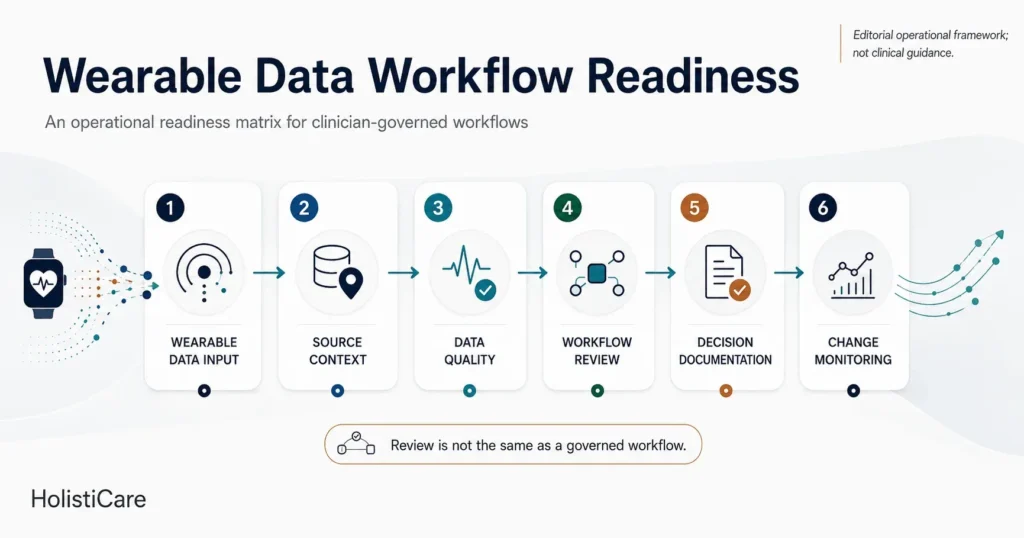
Modern AI-powered CDS moves well beyond static rule engines. Advanced platforms can interpret hundreds of biomarkers simultaneously — drawing on data from laboratory panels, genetic reports, microbiome analyses, wearable devices, and patient questionnaires — to generate holistic, personalized clinical insights for practitioner review. In functional and longevity medicine settings in particular, where the clinical picture spans multiple data domains, this capacity for multi-source integration is a significant operational advance.
CDS tools support clinical interpretation; they do not prescribe treatment, issue diagnoses, or make decisions. All clinical determinations remain with the treating clinician.
AI-Assisted Clinical Documentation
Documentation burden is one of the most consistently cited drivers of clinician burnout. A study published in the Annals of Family Medicine found that physicians spend a substantial proportion of their working day on EHR documentation tasks unrelated to direct patient care.4 AI documentation tools — including AI scribes and ambient clinical intelligence platforms — assist clinicians by converting clinical encounters into structured draft notes using NLP, for clinician review and sign-off before entry into the official record.
The clinician remains the author of record. Organizations evaluating this category should confirm that any platform integrates with their existing EHR and supports a clinician review workflow before draft submission.
AI Diagnostic Assistance Tools
AI diagnostic assistance tools support clinicians in interpreting medical imaging (radiology, pathology, ophthalmology), analyzing structured clinical data, or identifying patterns in laboratory results. These tools flag findings for clinician review — they do not issue diagnoses independently.
Healthcare Workflow Automation Platforms
Administrative AI automates high-volume, rule-based processes that consume staff time without requiring clinical judgment. Prior authorization is a primary target: the American Medical Association has documented the significant weekly time burden prior authorization places on clinical practices across the United States.6
AI platforms assist by extracting relevant clinical documentation, matching it against payer criteria, and preparing submission packages for staff review and submission. Other automation use cases include scheduling optimization, eligibility verification, claim scrubbing, and automated patient follow-up.
AI Physician Assistant Software: A Note on Terminology
A brief clarification that matters: in the context of healthcare technology, the phrase “AI physician assistant software” refers to AI tools designed to assist physicians — not software that replaces or functions as licensed Physician Assistants (PAs). PAs are credentialed clinical professionals with independent practice authority in most US states, as defined by the American Academy of Physician Associates.7 The terminology is a search convention, not a clinical category. Any AI tool operating in a clinical environment must be understood as a support layer for licensed professionals, not a replacement.
Key Capabilities to Look for in a Healthcare AI Platform
Evaluating healthcare AI requires a different lens than evaluating general enterprise software. These are the capabilities that separate deployable platforms from proof-of-concept tools.
HIPAA-Compliant Infrastructure with BAA Availability
Any AI platform that processes protected health information (PHI) must operate within HIPAA-compliant infrastructure and must be willing to execute a Business Associate Agreement (BAA). The U.S. Department of Health and Human Services outlines BAA requirements in detail under the HIPAA Privacy Rule.8 This is non-negotiable. Request documentation of compliance frameworks — SOC 2 Type II, HITRUST CSF — as part of standard vendor diligence.
For organizations operating in EU or UK markets: GDPR classifies health data as a special category requiring explicit consent or a documented healthcare necessity basis under Article 9. Verify GDPR readiness and confirm data processing agreements align with applicable data residency requirements before deployment.
Clinician Review at Every Step
A non-negotiable requirement for compliant, trustworthy clinical AI: no recommendation reaches a patient without licensed clinician review and approval. Platforms that deliver AI-generated advice directly to patients — without a clinician in the loop — create significant liability and regulatory exposure. Verify that the platform’s architecture enforces clinician approval as a structural requirement, not an optional setting.
Explainability and Audit Trails
Clinical environments require accountability. AI outputs that cannot be explained or traced are difficult to defend clinically, legally, or operationally. Look for platforms that surface the evidence basis for each AI-generated recommendation, support clinician override capability, and maintain complete audit logs of data access, AI outputs, and clinician actions.
White-Label and Brand Control
For clinics and practices deploying AI to their patient panels, brand continuity matters. The most practice-friendly platforms operate as invisible infrastructure — all patient-facing interfaces (portals, mobile apps, reports) carry the clinic’s branding, not the software vendor’s. This preserves the patient-provider relationship and maintains practice identity at scale.
Configurable Safety Controls and Protocol Customization
Responsible platforms allow organizations to align AI-generated protocol suggestions with their own clinical methodology, adjust alert thresholds, and configure escalation rules. A platform that generates generic recommendations without reflecting the practice’s clinical philosophy is of limited utility — and potentially inconsistent with the practitioner’s standard of care.
How to Evaluate AI App Development Tools and Healthcare AI Vendors
Health systems and clinical practices approaching AI vendor selection face a fundamental choice: build, buy, or partner. Each path carries different risk and resource profiles.
Build vs. Buy: A Framework
Building proprietary AI software requires dedicated data science, ML engineering, and clinical informatics resources — plus the compliance and regulatory infrastructure to support it. For most practices and health systems outside of major academic medical centers, building from scratch is neither practical nor advisable given the pace of AI development and the complexity of healthcare data compliance.
Buying from established, purpose-built healthcare AI vendors offers faster deployment, pre-validated data integrations, and shared compliance frameworks. The trade-off is customization depth and long-term platform dependency. Evaluate whether the vendor’s product roadmap aligns with your clinical priorities.
A growing middle path — white-label platforms that provide configurable infrastructure under your own brand — allows practices to scale rapidly while maintaining clinical identity and control.
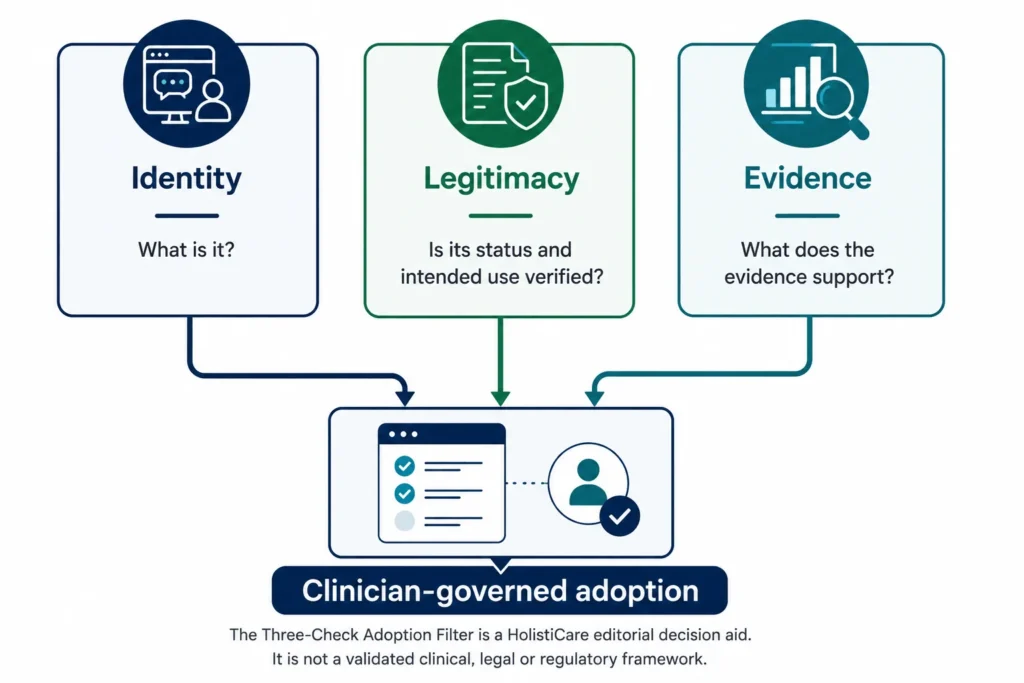
Vendor Evaluation Checklist
When evaluating healthcare AI vendors, clinical procurement teams should assess:
- Regulatory status: Is any component classified as a medical device (SaMD) under FDA or EU MDR? What is its clearance or approval status?
- Compliance documentation: SOC 2 Type II, HIPAA BAA availability, GDPR data processing agreements, HITRUST CSF certification where applicable
- Data integration breadth: Which data sources does the platform support — labs, genetics, microbiome, wearables, patient questionnaires? What normalization and quality controls are in place?
- Clinician review architecture: Is clinician approval structurally enforced before any recommendation reaches a patient?
- Implementation and onboarding: What does the deployment roadmap look like? What training is provided to clinical staff?
- Explainability framework: How does the platform surface AI reasoning? Can outputs be audited end-to-end?
- White-label capability: Can the platform be fully branded under the clinic or practice?
- Exit and data portability: In the event of contract termination, how is patient data returned and in what format?
Real-World Use Cases for AI Tools in Healthcare
The following represent areas where healthcare organizations and clinical practices are actively deploying AI tools today.
Multi-Biomarker Interpretation and Personalized Protocol Generation
In functional and longevity medicine, practitioners routinely interpret complex panels spanning clinical labs, genetics, microbiome results, and lifestyle factors simultaneously. AI CDS platforms assist clinicians by normalizing data across these sources, identifying clinically relevant patterns across hundreds of biomarkers, and generating personalized protocol suggestions — covering nutrition, supplementation, exercise, and lifestyle — for clinician review and editing before delivery to the patient. This supports faster, more comprehensive clinical planning without reducing the practitioner’s role in the care process.
Patient Engagement and SMART Action Planning
Translating a complex clinical protocol into patient-facing daily actions is a significant operational challenge. AI platforms assist by converting clinician-approved protocols into structured, time-specific daily tasks delivered through a patient mobile app — with automated reminders, check-in prompts, and wearable data integration that feeds adherence signals back to the clinical team. All patient-facing content is derived from the clinician-approved plan; the AI handles delivery and monitoring logistics.
Clinical Documentation Assistance
AI documentation tools assist clinicians by generating structured draft notes from clinical encounters. Physicians review, edit, and sign off before notes enter the official record. Published research in clinical informatics has examined documentation efficiency in this context, though organizations should evaluate evidence specific to their specialty and workflow before projecting outcomes.4
Automated Monitoring and Intervention Flagging
Rather than requiring clinicians to manually review every patient check-in, AI monitoring tools surface only those patients whose self-reported data or wearable vitals deviate from expected patterns — triggering configurable alerts for clinical team review. This supports more efficient patient panel management while ensuring that clinical attention is directed where it is most needed.
Prior Authorization Assistance
AI-assisted platforms can help clinical staff prepare prior authorization submissions by extracting relevant clinical documentation and matching it against payer criteria for staff review and submission. The AMA has documented the administrative scope of this challenge across US healthcare.6
Early Warning and Deterioration Detection
In acute care settings, AI tools assist clinical teams by monitoring structured patient data — vitals, lab trends, nursing assessments — and flagging elevated-risk patterns for clinical review. A systematic review published in JAMIA Open examined the evidence base for AI-based early warning systems and noted promising results alongside the need for rigorous clinical validation.9
How HolistiCare.io Approaches Healthcare AI
Most AI tools in healthcare are built as narrow point solutions — purpose-built for one workflow, one data type, or one department. That narrow scope can deliver isolated value, but it leaves practitioners managing fragmented tools, siloed data, and multiple compliance relationships simultaneously.
HolistiCare.io takes a different approach.
We are a white-label, AI-driven longevity and wellness platform built specifically for clinicians, functional and longevity medicine practices, integrative health clinics, and wellness coaches who want to scale personalized care without compromising clinical quality or their practice’s identity.
What HolistiCare.io does:
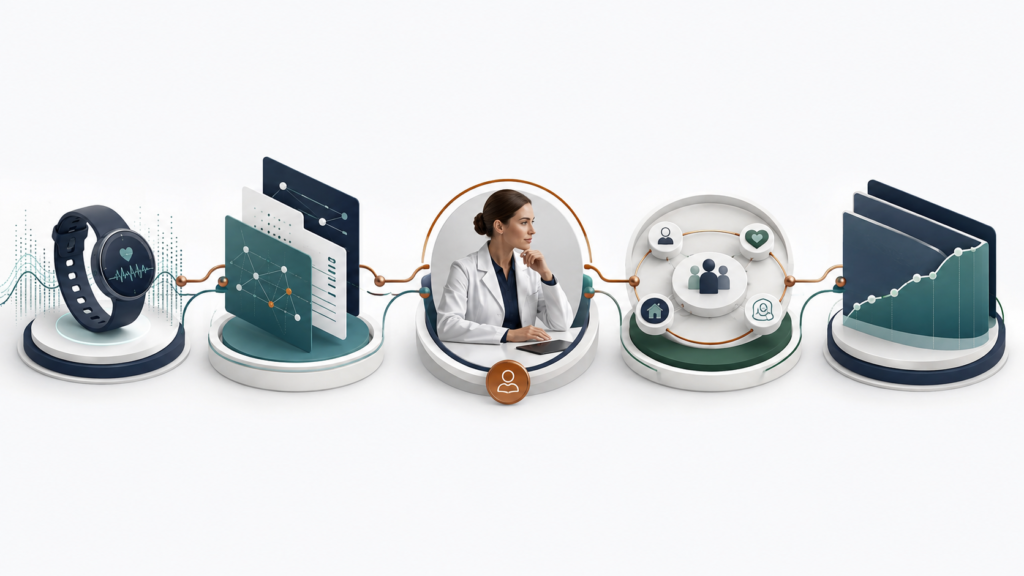
Our platform acts as a clinical intelligence layer for your practice. It aggregates patient data from multiple sources — laboratory panels, genetic and microbiome reports, wearable device vitals, and patient lifestyle questionnaires — and applies AI trained in functional and longevity medicine to interpret 800+ biomarkers and generate evidence-based, clinician-reviewable health plans. Every AI output — nutrition protocols, supplement recommendations, exercise plans, lifestyle interventions — is fully editable and requires clinician review and approval before it reaches the patient. Patients interact with care plans through a branded mobile app that carries your clinic’s identity, not ours.
What HolistiCare.io does not do:
HolistiCare.io does not diagnose, treat, or prescribe independently. It does not make clinical decisions. It does not deliver any recommendation to a patient without licensed clinician sign-off. It is not an EHR or electronic medical records system.
Compliance by design:
HolistiCare.io operates with a Business Associate Agreement as a standard contract term and maintains HIPAA-compliant infrastructure — including encryption in transit and at rest, role-based access controls, and audit trails. GDPR-readiness documentation and data processing agreements are available for EU and UK deployments. Our platform is built for practices that need to demonstrate compliance, not retrofit it.
Under FDA guidance, HolistiCare.io is designed as non-device clinical decision support — recommendations are clinician-reviewable, explainable, and produced under practitioner oversight, consistent with the FDA’s CDS non-device criteria.5
If your practice is evaluating AI to scale personalized, evidence-based care while maintaining complete clinician control, HolistiCare.io is built for that specific clinical and operational need.
Frequently Asked Questions
What is AI software for healthcare?
AI software for healthcare refers to technology platforms that apply machine learning, natural language processing, and automation to support clinical workflows, administrative operations, and health data management. These tools assist clinicians and administrators — they do not replace clinical judgment or independently make medical decisions.
What is clinical decision support software?
Clinical decision support (CDS) software assists licensed clinicians by surfacing relevant clinical information at the point of care — such as flagging abnormal lab values, identifying biomarker patterns across multiple data sources, or generating evidence-based protocol suggestions for clinician review. CDS tools support clinical interpretation; all final decisions remain with the treating clinician. HolistiCare.io is a CDS platform focused on multi-source biomarker interpretation and personalized protocol generation for functional and longevity medicine practitioners.
Is AI software for healthcare HIPAA compliant?
Compliance depends on the specific platform. Healthcare organizations should require vendors to provide a signed Business Associate Agreement (BAA) and documentation of HIPAA-compliant infrastructure before any protected health information is processed. GDPR readiness should also be verified for EU and UK deployments. See our HIPAA-Compliant AI Platform page for how HolistiCare.io approaches data compliance.
What is the difference between clinical AI and administrative AI in healthcare?
Clinical AI tools support patient care workflows — including multi-source biomarker interpretation, clinical decision support, AI-assisted documentation, and protocol generation for clinician review. Administrative AI handles non-clinical operations such as prior authorization, scheduling, coding accuracy, and billing workflows. Both categories can deliver significant operational value; the right priority depends on the practice’s most pressing needs.
What does “AI physician assistant software” mean?
In the context of healthcare technology, “AI physician assistant software” refers to AI tools designed to assist physicians — not software that replaces licensed Physician Assistants (PAs), who are independent clinical professionals. These tools surface relevant patient data, support biomarker interpretation, generate protocol suggestions for clinician review, and reduce planning and documentation burden.
How long does it take to implement AI software in a healthcare practice?
Implementation timelines vary by platform complexity and practice setup. Some solutions deploy in weeks; integrated platforms with multi-source data connections typically require 60–180 days for full configuration, staff training, and workflow validation. Organizations should request a detailed implementation roadmap and milestone commitments from vendors during the evaluation process.
What should we look for in a healthcare AI vendor?
Prioritize: HIPAA BAA availability and documented compliance infrastructure, multi-source data integration capability, a structural requirement for clinician review before any patient-facing output, white-label flexibility if brand continuity matters to your practice, FDA non-device CDS status documentation, and references from practices with a similar clinical model.
Does AI in healthcare replace clinicians?
No. Responsible, compliant healthcare AI is designed to augment clinical capacity — giving clinicians better information, faster, so they can focus on patient care. AI supports, assists, and generates suggestions for review. All clinical decisions remain with licensed professionals. Any vendor making claims to the contrary should be evaluated with significant skepticism.
Ready to evaluate AI for your practice or health system?
HolistiCare.io is a white-label AI longevity and wellness platform built for clinicians who want to deliver personalized, evidence-based care at scale — without autonomous AI, without replacing your clinical judgment, and without compromising your brand.
Request a tailored demo
References
-
American Medical Association. 2022 AMA Prior Authorization Physician Survey.
-
Office of the National Coordinator for Health Information Technology (ONC). Artificial Intelligence in Health and Health Care. U.S. Department of Health and Human Services.
-
Agency for Healthcare Research and Quality (AHRQ). Clinical Decision Support.
-
Arndt BG, et al. Tethered to the EHR: Primary Care Physician Workload Assessment Using EHR Event Log Data and Time-Motion Observations. Annals of Family Medicine. 2017;15(5):419–426.
-
U.S. Food and Drug Administration. Clinical Decision Support Software — Guidance for Industry and FDA Staff. FDA Digital Health Center of Excellence.
-
American Medical Association. 2023 AMA Prior Authorization Physician Survey.
-
American Academy of Physician Associates. What is a PA?
-
U.S. Department of Health and Human Services. Business Associate Contracts — HIPAA Privacy Rule.
-
Bedoya AD, et al. Machine Learning for Early Detection of Sepsis: An Internal and Temporal Validation Study. JAMIA Open. 2020;3(2):252–260.
Legal & Medical Disclaimer:
The content provided in this article is for educational and informational purposes only and does not constitute medical, legal, or financial advice. HolistiCare.io is a Clinical Decision Support (CDS) tool and is not intended to diagnose, treat, or cure any disease independently. All clinical decisions remain the responsibility of the licensed medical provider. Asynchronous care delivery is subject to state regulations; providers are responsible for ensuring compliance. References to third-party software are for comparative purposes only and do not imply endorsement.