A patient pays $5,000 for a premium longevity program, then tracks habits in a free app that has nothing to do with your clinic. No logo. No context. No clinical plan. Just another generic dashboard competing with hundreds of other icons on their phone.
That’s the digital disconnect: you deliver high-touch care, but the day-to-day experience lives inside someone else’s product. Over time, the patient’s “relationship” shifts—from your clinic to the tool.
If you’re serious about retention, you can’t outsource the patient experience to generic apps and portals. You need an ecosystem your clinic controls.
The “Generic” Trap: Where Premium Care Gets Diluted
Generic apps are designed for mass-market behavior, not premium clinical programs. They optimize for broad engagement, not for keeping patients anchored to your care pathway.
When you send high-paying patients to third-party tools (generic trackers, generic portals, disconnected chat apps), three things happen.
1) Your value becomes harder to see
Patients don’t judge value only during consults. They judge it every day.
If their daily “program” looks like a free consumer tracker, the premium positioning fades. The care may be excellent, but the experience feels commodity.
2) Your brand disappears between visits
Retention is won in the quiet moments: the Tuesday morning weigh-in, the supplement reminder, the lab follow-up, the “quick question” message.
If those touchpoints happen in generic software, you’re training the patient to engage with a vendor, not with your clinic.
3) Your workflow fragments (and patients feel it)
Fragmentation is more than inconvenient. It signals disorganization.
Common friction points patients notice immediately:
- Lab results live in one portal, plans live in a PDF, progress lives in a consumer app
- Messaging happens in email or WhatsApp with inconsistent boundaries and documentation
- Staff spends time reconciling data instead of coaching and follow-up
Friction is a retention killer. Patients don’t announce it—they just quietly disengage.
The Psychology of Branding: Build an Ecosystem, Not a “Tool Stack”
Trust forms the cornerstone of healthcare relationships, particularly in digital wellness environments where physical touchpoints are limited. Patients making health decisions online must navigate complex information while facing potential risks—a scenario that elevates trust from a mere preference to an essential requirement.
Why high-net-worth patients prefer branded patient apps
Retention isn’t only clinical. It’s behavioral. And behavior is shaped by cues, consistency, and trust.
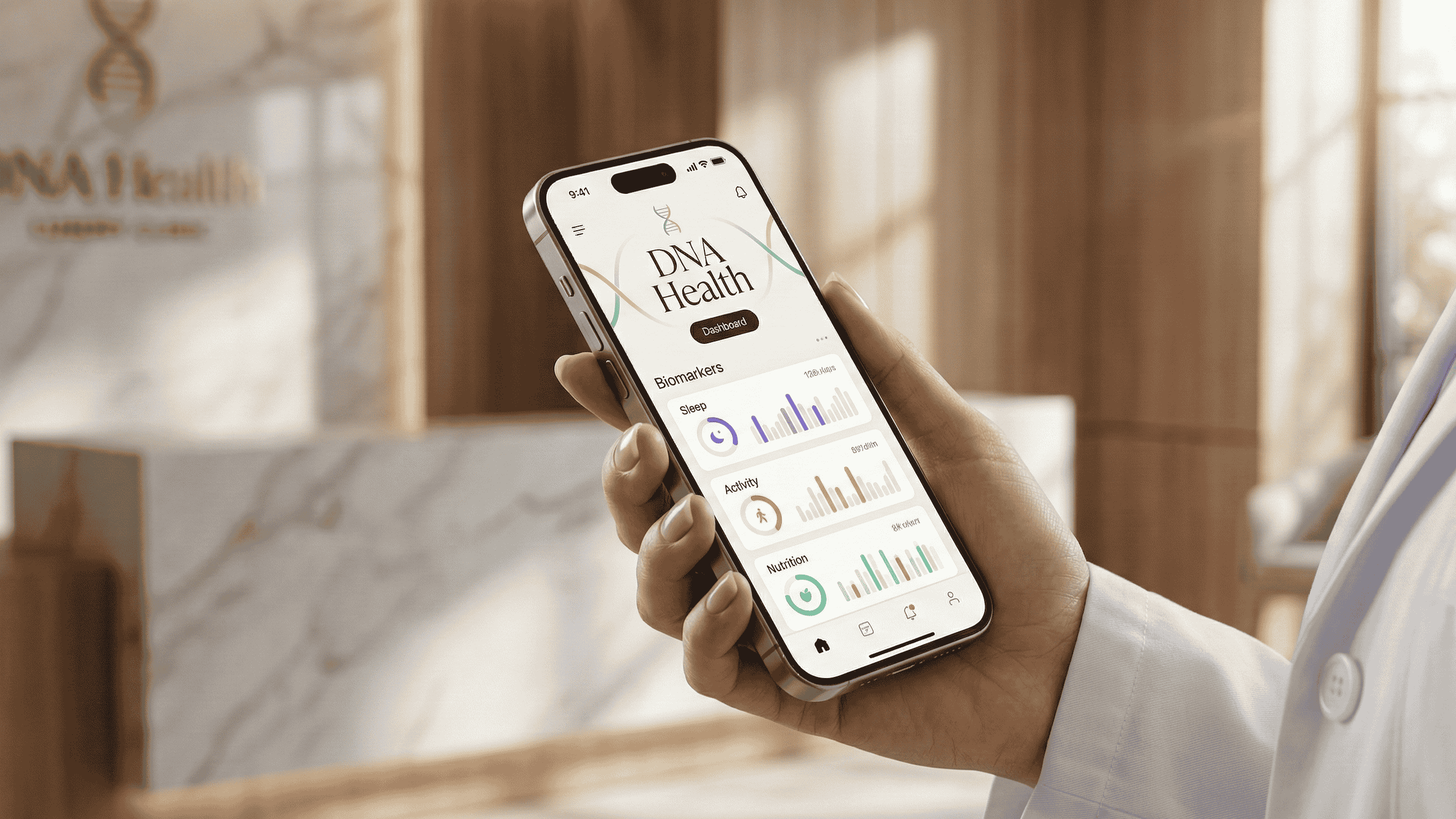
A white label wellness platform gives you a branded environment where your clinic is the default context for the patient’s health actions.
Top-of-mind awareness drives follow-through
When a patient sees your clinic’s logo on their phone multiple times a day, you gain what most clinics lack: repeated, passive reinforcement.
That matters because:
- Familiarity increases trust over time
- Trust increases compliance with plans
- Compliance improves perceived momentum
- Momentum reduces churn risk
This isn’t about vanity branding. It’s about anchoring the program inside a consistent identity so the patient doesn’t mentally “leave” your clinic between appointments.
Branded experiences increase perceived value (and reduce second-guessing)
Patients assign value to what feels coordinated, intentional, and professional.
A branded app supports that perception by making your program feel like a cohesive system rather than a set of disconnected tasks spread across random platforms.
Practical effects clinics commonly see when the experience is branded and unified (results vary by clinic and patient mix):
- Higher engagement with daily tasks and check-ins
- Fewer “I forgot” moments because reminders come from the clinic brand
- Less hesitation at renewal because the program feels ongoing, not episodic
If your care is premium, the daily interface should look and behave premium too.
Feature Spotlight: Integrated Health Records (and Why It Reduces Friction)
A white label wellness platform shouldn’t be “just a tracker.” For clinics, retention depends on reducing the friction that makes patients drop off and staff burn out.
That’s why HolistiCare.io is built to support care records management inside the same branded experience patients use every day.
Put labs, plans, and messaging in one branded app
When patients can see their plan, review labs, and message the care team in one place, the program becomes simpler to follow and harder to abandon.
A unified experience reduces common drop-off triggers:
- Patients don’t get lost across multiple logins
- Plans don’t get buried in email threads
- Lab results don’t feel disconnected from next steps
- Conversations are tied to the care journey, not scattered across tools
Operational benefit: fewer handoffs, fewer gaps
Retention is also affected by what happens behind the scenes.
When your team has a centralized system, you reduce:
- Administrative back-and-forth (“Where did we store that result?”)
- Duplicate data entry across multiple platforms
- Missed follow-ups caused by fragmented communication
The patient feels this as responsiveness and clarity—two drivers of long-term trust.
The SEO reality: patients want “patient retention software,” clinics need systems
Many clinics search for “patient retention software” as if it’s a messaging tool or reminder engine. Those features help, but they don’t solve the underlying issue: the experience is fragmented and unbranded.
Retention improves when the patient journey is:
- Branded (identity and trust)
- Integrated (labs, plans, chat, tracking)
- Consistent (same environment daily)
- Measurable (engagement and follow-up signals)
That’s the strategic difference between adding another tool and building your clinic’s ecosystem.
The ROI Calculation: The Cost of Churn vs. the Cost of White-Labeling
Churn isn’t abstract. It’s lost revenue, lost momentum, and often lost referrals.
Even without fancy math, the comparison is straightforward.
What one churned patient really costs
If a patient is paying for a program that’s worth several thousand dollars, losing them early doesn’t just remove revenue. It also creates hidden costs:
- Staff time spent re-onboarding replacements
- Marketing spend to refill the pipeline
- Opportunity cost of not extending care plans or follow-on programs
- Reputation drag when patients quietly disappear instead of referring
Why white-labeling can pay for itself quickly
A white-label wellness platform is an operating expense designed to protect lifetime value.
A simple way to look at it:
- If your branded app helps prevent even one high-value patient from disengaging, the platform can cover its cost for the period
- Everything beyond that is upside: retained revenue, extensions, cross-sells, referrals
The goal isn’t to “add an app.” It’s to stop leakage created by a generic experience that weakens continuity and brand connection.
Important note for responsible marketing: no software can guarantee retention outcomes. What you can control is the environment that makes adherence and communication easier—and makes your clinic the obvious center of the journey.
Conclusion: Stop Building Someone Else’s Brand. Build Yours.
Generic apps don’t just create inconvenience. They quietly transfer mindshare away from your clinic.
A white-label wellness platform keeps your logo on the patient’s home screen and keeps the program inside a unified, professional ecosystem. When you combine branding with integrated care records management, you remove the friction that causes drop-off and you reinforce the premium nature of your care.
If you’re investing in clinical excellence, match it with a patient experience that is unmistakably yours.
Launch your own branded clinic app in under 30 days. See the HolistiCare White-Label Demo.
HolistiCare.io helps longevity clinics and health coaches deploy a fully branded, white-label app that supports patient engagement, communication, and care records management—without sending patients to generic tools that dilute your value.
Disclaimer
The information in this article is provided by HolistiCare for general informational purposes only and is not intended to be a substitute for professional medical advice, diagnosis, or treatment. HolistiCare does not warrant or guarantee the accuracy, completeness, or usefulness of any information contained in this article. Reliance on any information provided here is solely at your own risk.
This content does not create a doctor-patient relationship. Clinical decisions should be made by qualified healthcare professionals using clinical judgment and all available patient information. If you have a medical concern, contact your healthcare provider promptly.
HolistiCare may reference biomarker roles, study examples, products, or tools. Mention of specific tests, biomarkers, therapies, or vendors is for illustrative purposes only and does not imply endorsement. HolistiCare is not responsible for the content of third party sites linked from this article, and inclusion of links does not represent an endorsement of those sites.
Use of HolistiCare software, services, or outputs should be in accordance with applicable laws, regulations, and clinical standards. Where required by law or regulation, clinical use of biomarker information should rely on validated laboratory results and regulatory approvals. HolistiCare disclaims all liability for any loss or damage that may arise from reliance on the information contained in this article.
If you are a patient, please consult your healthcare provider for advice tailored to your clinical situation. If you are a clinician considering HolistiCare for clinical use, contact our team for product specifications, regulatory status, and clinical validation documentation.
All claims and statistics are based on cited studies and industry reports as of 2026. Individual results may vary; consult healthcare professionals for personalized advice. HolistiCare features are designed to support evidence-based holistic care.