Did you know that according to the CDC, about half of U.S. employers offer corporate wellness programs? Yet the median participation rate without incentives is just 20%.
This gap represents a massive opportunity for forward-thinking clinics. With U.S. employers losing an estimated $36.4 billion annually to chronic condition-related absences, the business case for comprehensive corporate health and wellness programs has never been stronger. In fact, research shows employees with healthier habits have 27% lower absenteeism rates, demonstrating tangible corporate wellness programs’ benefits.
The healthcare landscape is rapidly evolving; however, with Deloitte Insights predicting that approximately two-thirds of health expenditures will shift toward well-being and prevention by 2040. This transformation is creating perfect conditions for the B2B2C Healthcare Model to thrive, especially as more than 150 million Americans spend most of their waking hours each week working.
As a clinic owner or medical director, your opportunity lies in positioning your services as “Executive Asset Protection” rather than just healthcare—a strategic approach that can deliver up to 4.4x economic return on health spend while scaling your practice exponentially.
This blueprint will show you exactly how to capitalize on this shift by 2026, turning data-driven wellness into your clinic’s most profitable growth engine.
Why Corporate Wellness is Evolving in 2026
The landscape of workplace health is undergoing a fundamental transformation. The global corporate wellness market is projected to reach USD 100.00 billion by 2026, growing at nearly 9% annually [1]. This explosive growth signals a pivotal shift in how employers view healthcare investments.
From sick-care to proactive health: the new employer mindset
Corporate health strategies are moving away from reactive treatment toward preventive wellness management. A 2024 Deloitte study found that 77% of employees have experienced burnout at least once [1]. In response, forward-thinking organizations are implementing proactive mental fitness programs instead of crisis-driven interventions.
Companies that integrate well-being into their leadership approach can achieve up to 20% higher productivity [1]. Additionally, 39% of employees stay at their jobs primarily because of strong wellness benefits [1]. This data demonstrates why employers are treating wellness as a strategic priority rather than just another perk.
The rise of B2B2C healthcare models
Business-to-business-to-consumer (B2B2C) healthcare has emerged as an effective delivery model for wellness solutions. In this approach, clinics partner with employers who then offer services to their workforce. Currently, 63% of covered workers are enrolled in self-funded plans [2], creating an immense addressable channel for digital wellness solutions.
The B2B2C model provides clinics with immediate scale and smoother adoption since employees already trust their employer. Furthermore, this approach yields predictable subscription revenue while allowing clinics to rapidly test and refine offerings through employer partnerships.
Why personalization and data are now expected
Gone are the days of generic wellness initiatives. As one expert notes, “one-size-fits-all well-being programs are quickly becoming one-size-fits-none” [3]. Employees now expect personalized experiences tailored to their unique health profiles, habits, and goals.
Research shows that tailored digital interventions significantly reduce depression and anxiety in employees with higher psychological distress [4]. Accordingly, successful programs leverage AI and data to customize recommendations while respecting privacy boundaries.
Personalization also drives engagement. Employees are more likely to participate and maintain healthy behaviors when recommendations align with their individual needs and preferences [5]. Through this targeted approach, clinics can deliver measurable outcomes that strengthen their value proposition to corporate clients.
How to Build a Clinic-Ready Wellness Offering
Corporate wellness has shifted from a simple employee perk to a strategic business necessity. Building an effective clinic-ready wellness offering requires understanding both the benefits and structure of successful programs.
Corporate wellness programs benefits for employers and clinics
Employers implementing comprehensive wellness initiatives see tangible returns across multiple metrics. Well-designed programs deliver measurable benefits through reduced absenteeism, higher productivity, lower healthcare costs, and stronger employee retention [6]. For every $1 invested in workplace wellness, organizations save approximately $6 in other costs [7]. This investment protection extends beyond financial metrics—companies that embed well-being into their culture can achieve up to 20% higher productivity [6].
For clinics, the corporate wellness market represents substantial growth potential, with industry revenue expected to reach $100 billion by 2026 [6]. By positioning your services as “Executive Asset Protection,” you create dual value streams: immediate clinical revenue plus long-term client retention through subscription-based monitoring.
Structuring your offer: from diagnostics to coaching
Effective wellness programs typically combine screening activities with targeted interventions [8]. Begin with comprehensive health risk assessments (HRAs) and biometric screenings to establish baseline measurements [8]. These assessments help identify at-risk employees and direct them toward appropriate preventive interventions [8].
Your program structure should include:
-
Primary prevention: Lifestyle management programs targeting nutrition, weight management, and smoking cessation (offered by 77% of employers with wellness programs) [8]
-
Secondary prevention: Disease management for employees with existing conditions [8]
-
Personalized coaching: One-on-one opportunities for employees to work toward health goals through support, education, and motivation [9]
Using white-label testing to create scalable solutions
White-label health testing platforms provide turnkey solutions that enable clinics to scale without building expensive infrastructure [10]. These platforms handle all logistics and testing while you maintain client relationships under your brand [11]. This approach creates what we call the “50:1 delivery model,” where a single practitioner can generate 50 unique wellness plans in the time previously required for one.
Consider platforms offering customizable dashboards plus robust API integration [11]. The best solutions provide comprehensive panel selections including core health metrics, hormones, thyroid, and metabolic markers [11]. Through this model, you can rapidly deliver cohort-level insights to corporate clients without compromising individual privacy.
How to Scale Without Hiring: Automation and AI Tools
Scaling your corporate wellness programs requires powerful technology that eliminates manual work. Modern clinics are discovering that automation and AI can dramatically expand capacity without adding staff.
Auto-normalization and the 50:1 delivery model
The 50:1 delivery model represents a fundamental shift in healthcare efficiency—where a single practitioner can generate 50 unique wellness plans in the time previously required for one. This revolutionary approach relies on AI-powered automation to handle repetitive administrative tasks that typically consume clinical hours.
AI-driven scheduling systems create fair staffing processes, subsequently freeing employees for more creative and meaningful work [12]. Essentially, this technology eliminates the routine processes that lead to provider burnout, particularly in high-pressure industries.
Clinical Data Analysis Software for plan generation
Advanced Clinical Data Analysis Software enables medical reviewers to evaluate safety and efficacy issues with minimal effort. These tools create interactive reports of adverse events, medications, labs, and vital signs with remarkable speed [1].
Notable benefits of modern clinical data platforms include:
-
Revealing trends and outliers through interactive visualization [1]
-
Automatically composing configurable patient narratives [1]
-
Integrating multiple data sources in no/low-code environments [3]
These platforms deliver complete data transparency across studies, empowering teams to accelerate decision-making while reducing risk and shortening timelines [3]. For clinic owners looking to expand their corporate wellness offerings, this technology is invaluable.
Cohort signal detection for HR reporting
Cohort signal detection tools identify potential health issues at the group level without compromising individual privacy. This capability allows you to present aggregate insights to HR departments—such as “65% of leadership shows markers of chronic inflammation”—without exposing personal health data.
The EHR-AE search method, coupled with natural language processing, can accelerate signal detection substantially [13]. One study demonstrated that safety signals could have been detected approximately 18 months earlier using these advanced methodologies [13].
Ready to see how these tools can transform your corporate wellness offerings? Book an “Executive Cohort Audit” today to visualize your team’s data at scale and experience firsthand how automation can revolutionize your practice’s efficiency.
How to Sell to Enterprises: The CFO and HR Playbook
Selling wellness programs to enterprise clients requires speaking the language of both HR and finance executives. Successful pitches frame health investments as strategic business assets rather than merely nice-to-have benefits.
Framing wellness as Executive Asset Protection
Successful clinics position their offerings as “Executive Asset Protection” rather than conventional healthcare. This reframing acknowledges that human capital represents an organization’s most valuable resource. Research indicates executive burnout contributes to CEO turnover in nearly 20% of organizations [14], directly impacting company performance at the highest levels. Moreover, stress-related leadership health issues can significantly undermine strategic decision-making and operational continuity.
Using cohort data to close HR deals
HR leaders respond powerfully to aggregate health trends. By analyzing cohort data, you can present compelling insights like “65% of your leadership team shows markers of chronic inflammation” without violating individual privacy. This approach resonates because only 22% of employees strongly agree their organization cares about their well-being [15]. Consequently, demonstrating concern through data creates immediate differentiation—employees who feel their organization genuinely cares are 4.4x more likely to be engaged [15].
Benchmarking and competitive positioning
Effectively position your wellness offering through competitive benchmarking. Examine what industry peers provide and identify gaps in your prospect’s current benefits. Studies show organizations with strong wellness cultures outperform others in the stock market by 2-3% annually [14]. Furthermore, companies with robust wellness programs experience 28% higher employee retention [14], providing powerful comparative data points for your pitch.
How to present the 4.4x ROI to decision-makers
When presenting to CFOs, focus primarily on financial outcomes. Companies implementing wellness programs can achieve up to 4.4x ROI when high-risk employees engage early [16]. For every dollar invested in workplace wellness, medical costs decrease by $3.27 while absenteeism costs fall by $2.73 [2]. Additionally, highlight that participating employees experience 68% productivity recovery [16], translating to measurable performance gains.
Ready to demonstrate these benefits in action? Book an “Executive Cohort Audit” to visualize your team’s health data at scale and discover your organization’s hidden wellness opportunities.
How HolistiCare Powers the B2B Shift
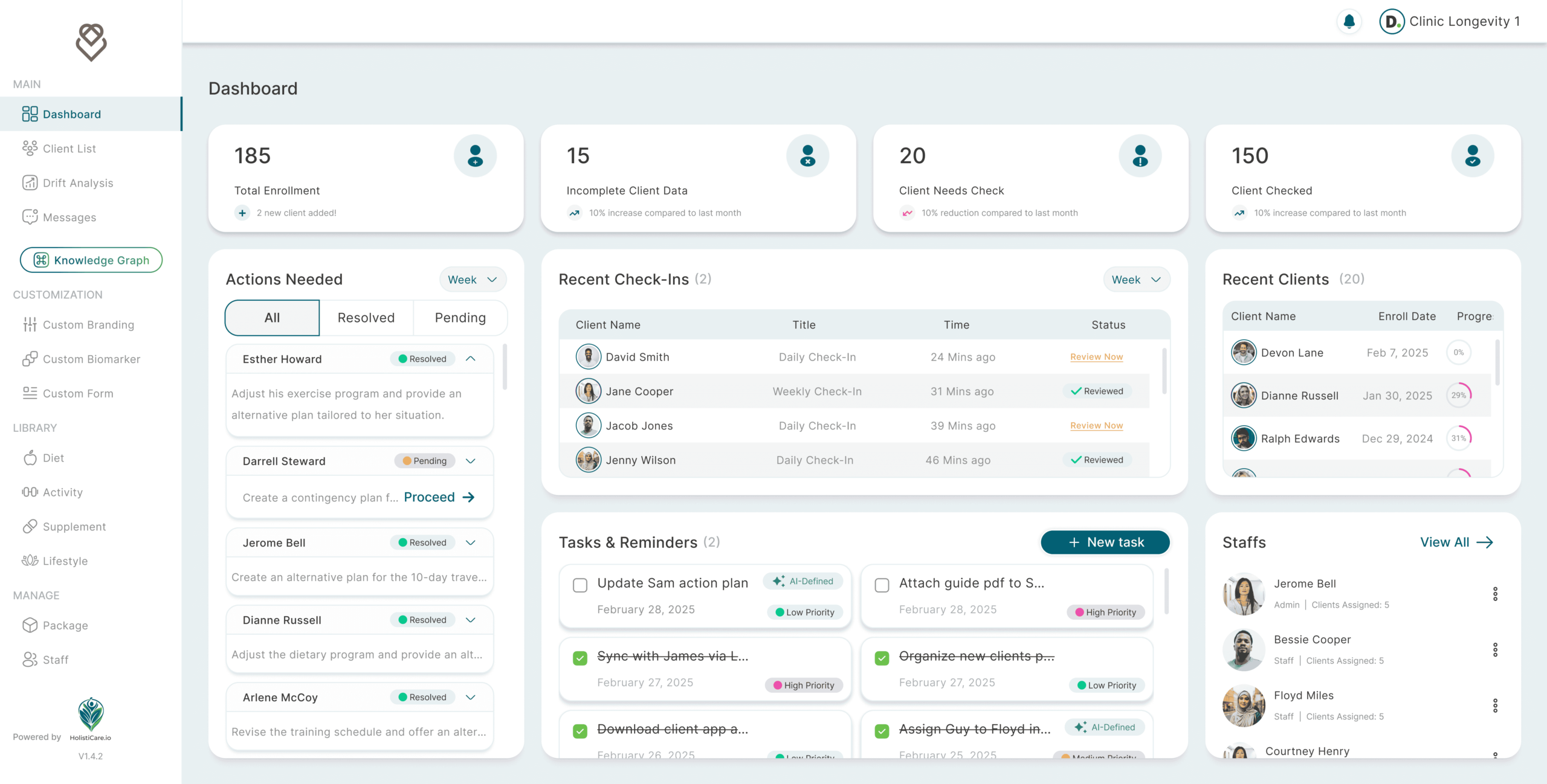
To successfully launch a corporate longevity program without overwhelming your staff, your infrastructure must do more than just store data; it must orchestrate it. HolistiCare provides the three pillars required for B2B scale:
-
Automation of the 50:1 Ratio: By standardizing up to 96.2% of lab records and reducing unit heterogeneity by 81%, HolistiCare removes the manual data-entry burden that typically limits clinic growth.
-
Trust Through Explainable AI: In a corporate setting, medical authority is paramount. HolistiCare ensures your clinicians remain the Chief Health Strategists by displaying a transparent rationale—including linked references to primary literature—for every automated inference.
-
Cohort Signal Detection: HolistiCare is built to identify clinically meaningful patterns across entire executive groups, ranking them by probable impact so you can present the 4.4x ROI to corporate stakeholders with confidence.
Conclusion
As we approach 2026, corporate wellness programs stand at a critical inflection point. The staggering gap between program availability and participation presents an unprecedented opportunity for forward-thinking clinics ready to evolve beyond traditional healthcare models.
First and foremost, repositioning your clinical expertise as “Executive Asset Protection” transforms how corporate decision-makers view wellness investments. This strategic shift helps frame employee health as a valuable business asset rather than merely an expense line.
Additionally, the B2B2C model offers clinics immediate scale without the traditional overhead of direct-to-consumer marketing. This approach generates predictable subscription revenue while creating powerful value for both employers and their workforce. The numbers speak for themselves – a potential 4.4x ROI makes these programs virtually irresistible to CFOs focused on bottom-line impact.
The true game-changer, however, comes through technology integration. Auto-normalization and AI-powered platforms enable the revolutionary 50:1 delivery model, allowing your clinic to scale services exponentially without proportional staffing increases. This efficiency unlocks profitability at scale previously unattainable in traditional clinical settings.
Equally important, cohort signal detection capabilities provide the perfect balance between actionable insights and privacy protection. Your ability to identify health trends across employee populations without exposing individual data will become your strongest selling point to HR executives concerned with both wellness outcomes and confidentiality.
Therefore, successful clinics will thrive by combining medical expertise with strategic business acumen. You now have the blueprint to transform your practice into a corporate wellness powerhouse. The opportunity to position your clinic at the intersection of prevention, personalization, and profitability awaits. Will you seize it?
Book your “Executive Cohort Audit” today and discover how your clinic can become the wellness partner enterprises can’t afford to overlook.
Key Takeaways
Corporate wellness is evolving from reactive sick-care to strategic business investment, creating massive opportunities for clinics to scale through B2B2C models and data-driven solutions.
• Position wellness as “Executive Asset Protection” – Frame your services as strategic business assets rather than healthcare costs to appeal to CFOs and HR leaders
• Leverage the 50:1 delivery model – Use AI automation and white-label testing platforms to generate 50 personalized wellness plans in the time previously needed for one
• Present compelling ROI data – Companies achieve up to 4.4x return on wellness investments, with $6 saved for every $1 spent on comprehensive programs
• Use cohort signal detection for privacy-safe insights – Identify group health trends like “65% of leadership shows chronic inflammation markers” without exposing individual data
• Target the $100 billion market opportunity – Corporate wellness market growth of 9% annually creates unprecedented revenue potential for forward-thinking clinics
The convergence of employer demand, proven ROI, and scalable technology creates perfect conditions for clinics to transform traditional practice models into profitable wellness partnerships that deliver measurable business outcomes.
FAQs
Q1. What are the key benefits of corporate wellness programs for employers? Corporate wellness programs can lead to reduced absenteeism, increased productivity, lower healthcare costs, and improved employee retention. Studies show that for every $1 invested in workplace wellness, organizations can save approximately $6 in other costs.
Q2. How can clinics effectively structure their corporate wellness offerings? Clinics should structure their offerings to include comprehensive health risk assessments, biometric screenings, primary prevention (lifestyle management), secondary prevention (disease management), and personalized coaching. This approach helps identify at-risk employees and provides targeted interventions.
Q3. What role does technology play in scaling corporate wellness programs? Technology, particularly automation and AI tools, enables clinics to scale their wellness programs without proportionally increasing staff. Features like auto-normalization, clinical data analysis software, and cohort signal detection allow for efficient plan generation and insightful reporting while maintaining individual privacy.
Q4. How can clinics effectively sell wellness programs to enterprises? Clinics should frame wellness as “Executive Asset Protection” rather than conventional healthcare. They should use cohort data to demonstrate health trends, benchmark against competitors, and present compelling ROI figures. For instance, companies can achieve up to 4.4x ROI when high-risk employees engage early in wellness programs.
Q5. What is the projected growth of the corporate wellness market? The global corporate wellness market is expected to reach USD 100 billion by 2026, growing at nearly 9% annually. This significant growth reflects the increasing recognition of wellness programs as strategic business investments rather than just employee perks.
References
[1] – https://www.jmp.com/en/software/clinical-data-analysis-software
[2] – https://www.worktango.com/resources/articles/how-you-can-use-data-to-improve-corporate-wellness
[3] – https://www.medidata.com/en/clinical-trial-products/clinical-data-management/
[4] – https://health.calm.com/resources/blog/workforce-well-being-in-2026-5-trends-consultants-cant-afford-to-ignore/
[5] – https://www.careatc.com/blog/data-driven-employee-wellness-how-personalization-improves-workplace-health
[6] – https://www.wellsteps.com/blog/2025/11/05/employee-wellness-trends-2026-for-employers/
[7] – https://medcor.com/occupational-health/design-manage-workplace-wellness-program/
[8] – https://www.dol.gov/sites/dolgov/files/ebsa/researchers/analysis/health-and-welfare/workplace-wellness-programs-study-full-text.pdf
[9] – https://www.wellright.com/designing-a-corporate-wellness-program
[10] – https://www.imaware.health/blog/power-of-white-label-health-testing?srsltid=AfmBOop_jZgWKrKS2P73Eeg0sEI81Rg5oJ0PZCmMHZ1vmVFAFOO7_nHs
[11] – https://siphoxhealth.com/articles/how-can-white-label-testing-expand-your-service-offerings?srsltid=AfmBOoolbbgEQNouxh-JwFh2K3LkbSTH_0jIYRm44B_xoWCONk_Bb7bg
[12] – https://www.aacsb.edu/insights/articles/2025/08/how-ai-can-improve-employee-well-being
[13] – https://www.sciencedirect.com/science/article/pii/S0264410X25008461
[14] – https://www.livtransformed.com/?srsltid=AfmBOor-nHB5CT7uRQv47opnvvMvWH-aThMSetkdiW2-dj3Ztwdrorfs
[15] – https://www.linkedin.com/posts/olasubomi-lasaki_olmettletalks-workplacewellbeing-peoplefirst-activity-7395791153834475520-pbZ9
[16] – https://swordhealth.com/articles/preventive-care-cost-savings
Disclaimer
The information in this article is provided by HolistiCare for general informational purposes only and is not intended to be a substitute for professional medical advice, diagnosis, or treatment. HolistiCare does not warrant or guarantee the accuracy, completeness, or usefulness of any information contained in this article. Reliance on any information provided here is solely at your own risk.
This content does not create a doctor-patient relationship. Clinical decisions should be made by qualified healthcare professionals using clinical judgment and all available patient information. If you have a medical concern, contact your healthcare provider promptly.
HolistiCare may reference biomarker roles, study examples, products, or tools. Mention of specific tests, biomarkers, therapies, or vendors is for illustrative purposes only and does not imply endorsement. HolistiCare is not responsible for the content of third party sites linked from this article, and inclusion of links does not represent an endorsement of those sites.
Use of HolistiCare software, services, or outputs should be in accordance with applicable laws, regulations, and clinical standards. Where required by law or regulation, clinical use of biomarker information should rely on validated laboratory results and regulatory approvals. HolistiCare disclaims all liability for any loss or damage that may arise from reliance on the information contained in this article.
If you are a patient, please consult your healthcare provider for advice tailored to your clinical situation. If you are a clinician considering HolistiCare for clinical use, contact our team for product specifications, regulatory status, and clinical validation documentation.