
Clinical Note: This article discusses the integration of subjective well-being metrics (PROMs) into clinical workflows. HolistiCare.io provides data architecture for these metrics but does not validate metaphysical claims. Compliance with HIPAA and privacy laws regarding sensitive mental health data remains the responsibility of the provider.
The dichotomy between “Western Medicine” (Biological) and “Eastern Medicine” (Energetic/Subjective) is collapsing under the weight of data. Modern longevity medicine increasingly recognizes that Autonomic Stability—influenced by mindset, spiritual practice, and emotional state—is a driver of biological aging. This article addresses the technical challenge of integrating qualitative “spiritual” data into a HIPAA-compliant EHR environment, outlining HolistiCare’s approach to the Bio-Psycho-Spiritual medical record.
The Convergence of Science and Subjectivity
For decades, there was a hard line in medicine. On one side, we had “Hard Data”: blood pressure, cholesterol, glucose. On the other side, we had “Soft Data”: mood, spiritual connection, sense of purpose. The former was recorded in the EHR; the latter was relegated to sticky notes or memory.
In 2026, this distinction is becoming clinically obsolete.
Emerging research into Psychoneuroimmunology and Polyvagal Theory increasingly supports the premise that a patient’s subjective state of “connectedness” or “spiritual alignment” has measurable downstream associations with inflammation (Cytokine activity), Heart Rate Variability (HRV), and Telomere length.
To treat the “Whole Person,” we must track the “Whole Person.” However, this presents a unique challenge for the clinical operator: How do you quantify the unquantifiable? And more importantly, how do you store it legally?
However, these reports are notoriously dense. A single OAT profile can contain over 70 markers regarding mitochondrial function, neurotransmitter metabolites, and fungal toxins.
The operational reality for most clinics is the “Swivel Chair Interface”: The physician swivels between a PDF report on one screen and their EHR on the other, manually typing values into the note. This process is:
- Error-Prone: Transcription errors are a leading cause of preventable documentation discrepancies.
- Time-Intensive: It takes 15-20 minutes to thoroughly analyze and chart a complex panel.
- Data-Destructive: Once the PDF is filed, the data is essentially “dead.” It cannot be easily used for population analytics.
The Data Architecture of Intangible Metrics
Most legacy EHR systems are rigid. They have fields for ICD-10 codes and CPT codes, but they lack the schema for “Subjective Vitality” or “Mindset Shift.”
This forces holistic clinics to operate in the shadows, keeping critical patient data in non-secure notebooks or third-party journaling apps that do not communicate with the medical record—a practice that creates fragmented care and liability risks.
HolistiCare.io solves this via “Flexible Data Objects.”
1. Quantifying the Qualitative: The Rise of Custom PROMs
We enable clinics to build custom Patient-Reported Outcome Measures (PROMs). Just as you track Blood Pressure at every visit, you can configure the system to track subjective indicators using validated scales or custom metrics:
- Subjective Well-Being: (e.g., WHO-5 Index)
- Perceived Stress: (e.g., PSS-10)
- Energetic Alignment: (Custom 1-10 Scale)
By converting these subjective feelings into numerical values, we enable Correlation Analysis without making unsubstantiated medical claims.
2. The Correlation Engine
This is where the utility lies. Once subjective experience is structured as data, it can be visualized alongside biological markers.
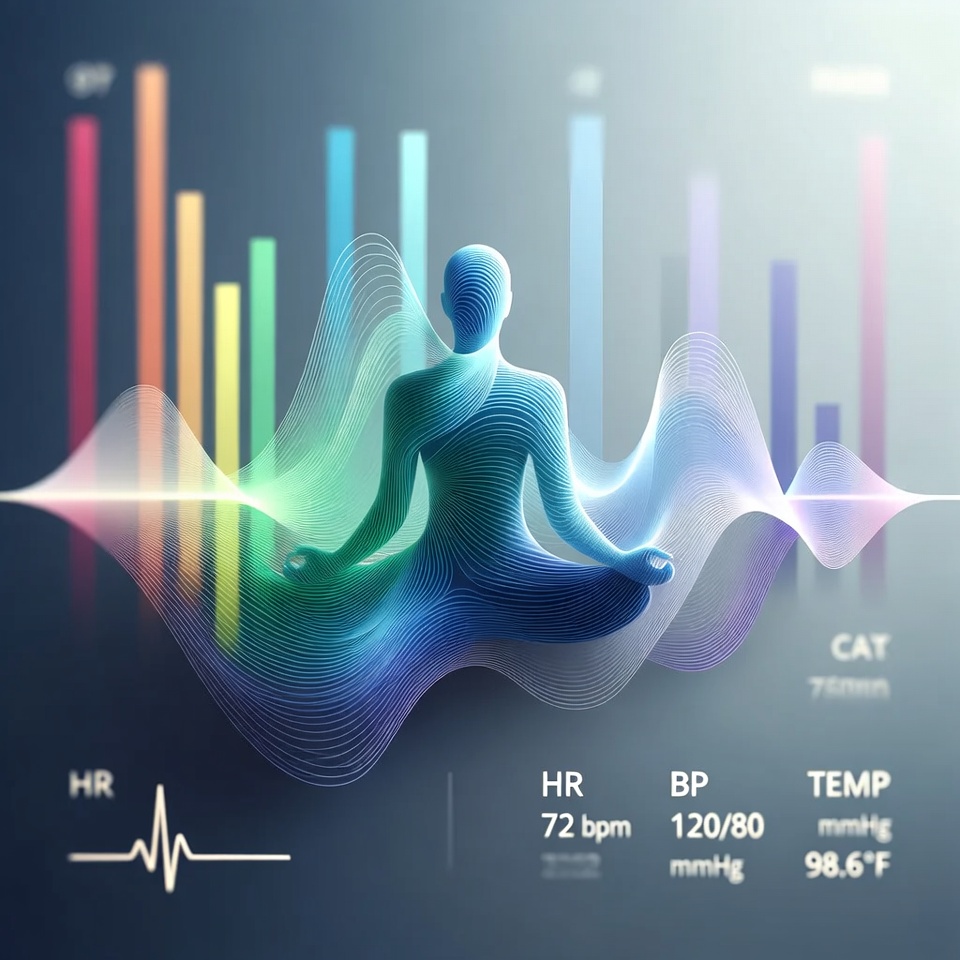
Imagine showing a patient a longitudinal graph that overlays their reported “Meditation Consistency” (Yellow Line) with their “Nocturnal HRV” (Blue Line).
The Insight: “Mr. Smith, observe the trend. During the weeks you reported high spiritual disconnection, your deep sleep recovery metrics dropped by 40% and your fasting glucose rose by 10 points.”
This moves the conversation from abstract advice (“You should meditate”) to data-driven behavioral reinforcement (“Your meditation practice correlates with better glucose control”).
The Compliance Firewall: Managing Sensitive Data
Integrating emotional and spiritual data introduces a heightened tier of regulatory scrutiny under HIPAA (Health Insurance Portability and Accountability Act). It is vital to distinguish between general health data and sensitive mental health documentation.
The “Psychotherapy Note” Distinction (45 CFR § 164.501)
Under federal law, there is a critical distinction between:
- Medical Records: Available to insurers, other providers, and patients upon request. This includes diagnosis, medication prescription and monitoring, counseling session start and stop times, and summary of symptoms.
- Psychotherapy Notes: Private notes recorded by a mental health professional documenting or analyzing the contents of conversation during a private counseling session. These are kept separate from the rest of the individual’s medical record.
The “Partitioned Data Layer” Strategy
HolistiCare.io utilizes a partition strategy designed to support this compliance requirement:
- Layer A (The Clinical Layer): Contains the scores and trends (e.g., “Anxiety Score: 8/10”, “Meditation: 3x/week”). This is part of the medical record, necessary for care coordination and tracking physiological progress.
- Layer B (The Private Note Layer): Contains the narrative details (e.g., specifics about spiritual trauma or private confessions). This layer is encrypted with secondary access controls.
Crucially: This architecture allows the Longevity Physician to track the physiological impact of trauma without necessarily exposing the narrative details of that trauma to general insurance audits or unauthorized staff.
The Consent Framework
Collecting data on “spiritual alignment” or “emotional state” requires transparency. We recommend all clinics utilizing these features implement a Specific Informed Consent module, where patients explicitly opt-in to having these metrics tracked as part of their holistic health profile.
The Business Case: Retention via Deep Understanding
Why should a clinic owner care about tracking spiritual data? Retention.
High-Net-Worth individuals do not leave longevity clinics because the science was bad; they often leave because they didn’t feel “seen.”
By integrating the spiritual and emotional dimensions into the formal record, the patient feels that the clinic understands them as a complete human being, not just a collection of biomarkers. When a physician asks, “I see your Subjective Vitality Score has been down for three weeks, how is that affecting your sleep?”, the bond of trust is cemented. That trust is the foundation of high Life-Time Value (LTV) relationships.
Conclusion
The future of precision medicine is not just about more precise measurement of molecules; it is about the precise measurement of the human experience. By integrating subjective wellness data into the EHR with rigorous privacy safeguards, we are not abandoning science; we are expanding it to encompass the full reality of the patient.
References & Citations
- Porges, S. W. (2011). The Polyvagal Theory: Neurophysiological Foundations of Emotions, Attachment, Communication, and Self-regulation. W. W. Norton & Company.
- Epel, E. S., et al. (2004). “Accelerated telomere shortening in response to life stress.” Proceedings of the National Academy of Sciences, 101(49), 17312-17315.
- U.S. Department of Health & Human Services (HHS). “HIPAA Privacy Rule: 45 CFR § 164.501 – Psychotherapy Notes.” HHS.gov.
- Kiecolt-Glaser, J. K., et al. (2002). “Psychoneuroimmunology: Psychological influences on immune function and health.” Journal of Consulting and Clinical Psychology, 70(3), 537.
- World Health Organization. “WHO-5 Well-Being Index.” Psychiatric Research Unit, 1998.
Disclaimer: The information in this article is for educational and informational purposes only and does not constitute medical or legal advice. HolistiCare.io provides software tools for data organization and security; however, final compliance with HIPAA, GDPR, and state privacy laws is the sole responsibility of the user. The discussion of “spiritual data” refers to user-generated tracking of subjective metrics (PROMs) and does not imply scientific validation of metaphysical concepts. “Psychotherapy Notes” require specific handling under HIPAA; providers should consult legal counsel to ensure their documentation practices meet federal and state requirements.