By HolistiCare | Published 6 July 2026 | Updated 29 July 2026
An EMR can remain valuable while biomarker interpretation, protocol execution, follow-up, and outcomes tracking are distributed across notes, spreadsheets, PDFs, lab portals, and manual team coordination. The operational gap appears when those activities need to function as one longitudinal workflow.
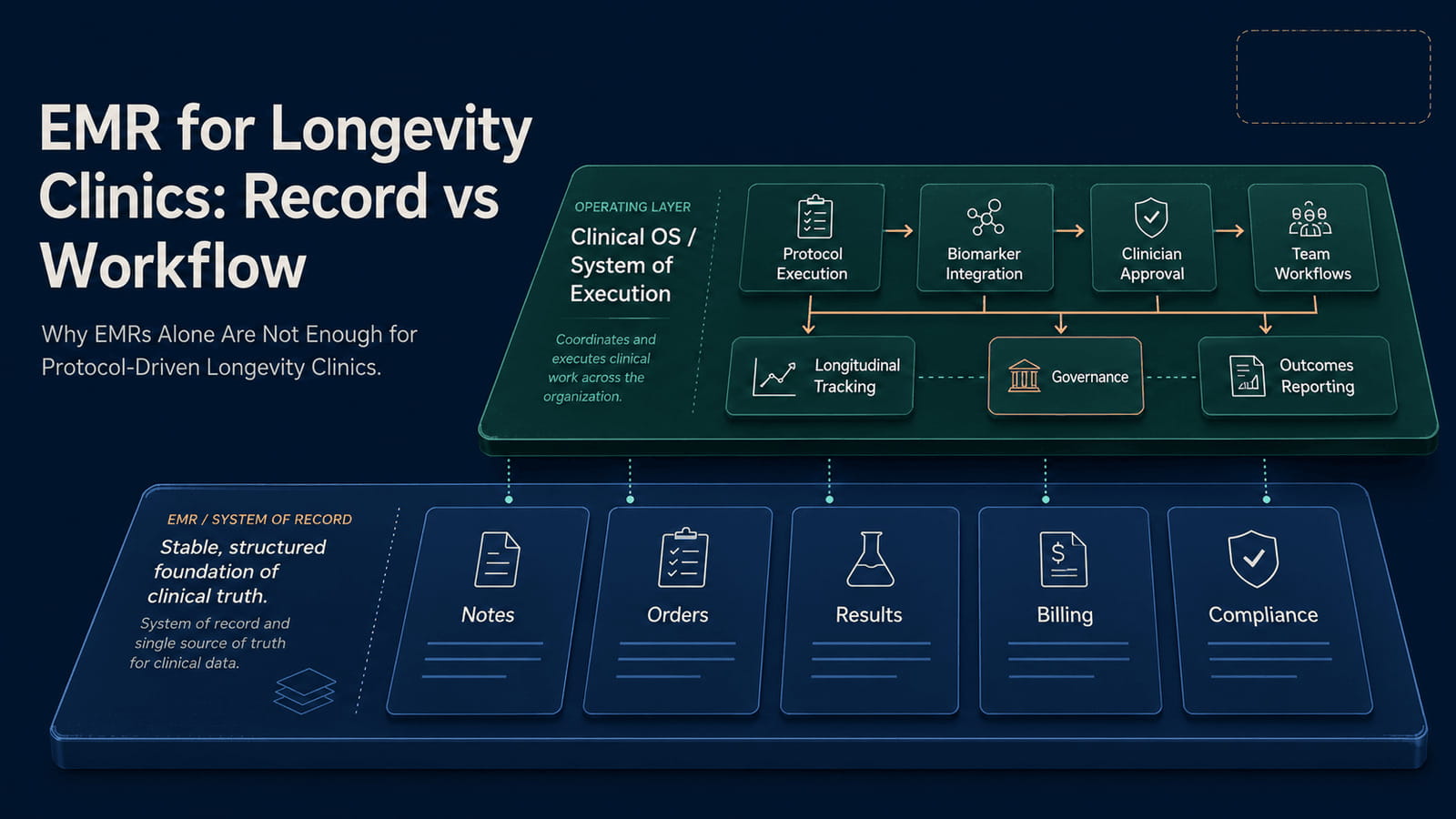
An EMR for longevity clinics is best understood as the system of record for clinical documentation, orders, and compliance; it is not, by itself, the operating layer required to manage biomarker-heavy protocols, team workflows, follow-up, and longitudinal outcomes.
What is the limitation of using only an EMR in a protocol-driven longevity clinic?
Using only an EMR in a protocol-driven longevity clinic means relying on a system designed to document encounters, not to run complex programs. EMRs capture records, orders, and billing well, but they rarely manage time-aware protocol steps, team handoffs, biomarker integration, and longitudinal outcomes reporting. As programs become more structured and biomarker-heavy, clinics need a complementary operating layer that can execute workflows, coordinate teams, and govern protocols on top of the EMR.
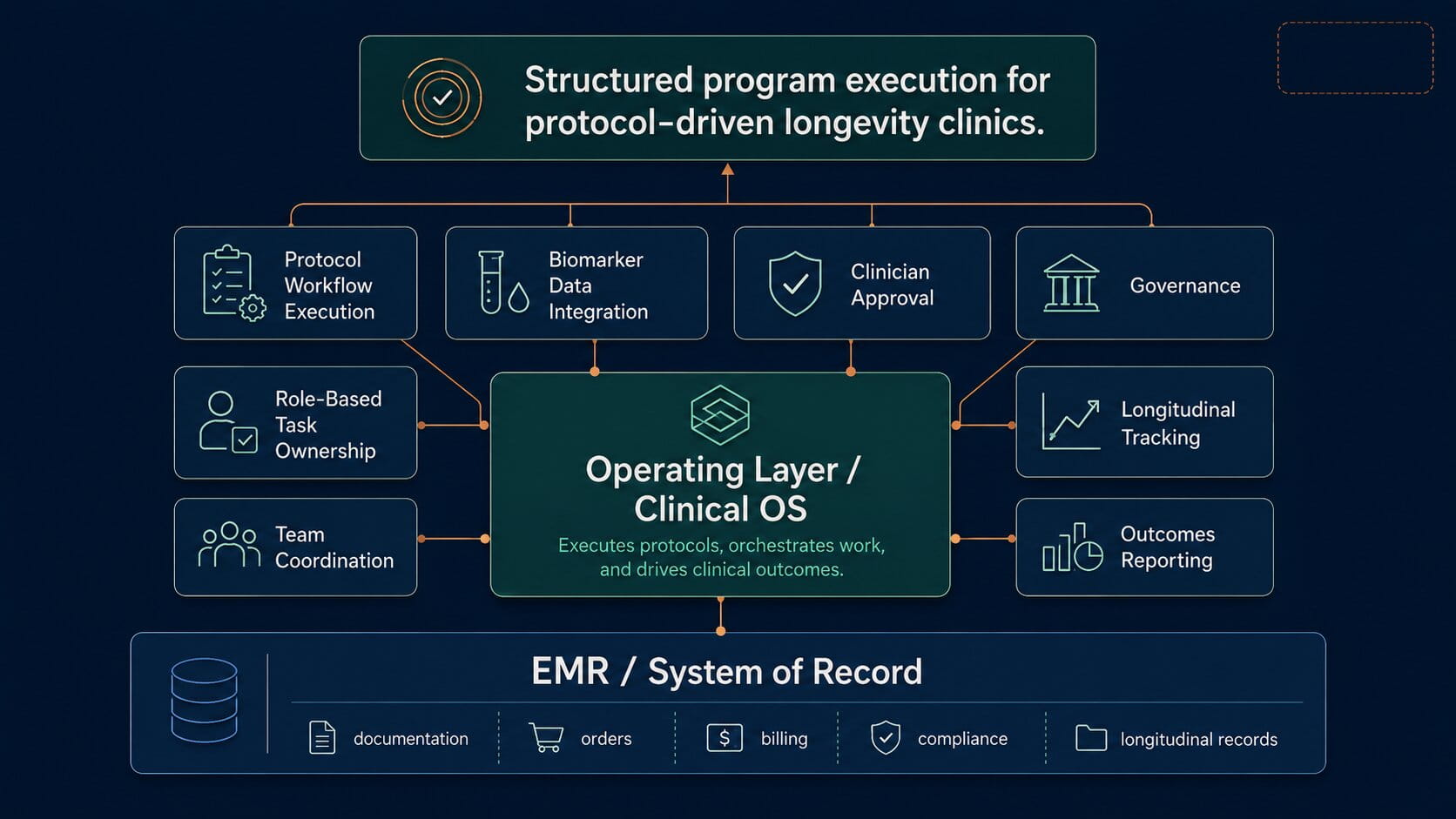
In this context, the operating layer is the workflow infrastructure that sits around the EMR to manage protocol state, team ownership, biomarker context, clinical approval, follow-up, and outcomes visibility. It does not replace the record; it organizes what the record cannot structure on its own.
Key findings
- An EMR provides a system of record for clinical documentation, orders, and compliance, but these functions are distinct from longitudinal protocol execution.
- Protocol-driven longevity programs also require visibility into workflow state, task ownership, clinical approval, retesting, and overdue actions across roles.
- Biomarker-heavy care requires structured, interoperable data for reliable panel-level tracking and outcomes analysis.
- When these requirements exceed the EMR’s workflow scope, clinics should evaluate a complementary operating layer rather than replace the EMR.
Table of Contents
Evidence scope: Direct research on EMR-related operating requirements in private longevity clinics remains limited. This analysis therefore draws on adjacent evidence from primary care, chronic care, hospital pathways, and health information systems. Those sources help explain operational mechanisms, but they do not establish longevity-clinic-specific outcomes or prove that any particular software configuration improves clinical results.
What EMRs Do Well in Longevity Clinics
EMRs remain foundational infrastructure for clinical documentation, orders, billing, and compliance. They provide longitudinal storage of encounters, diagnoses, medications, and orders, and they generate the audit trails that support regulatory and medico-legal requirements. Computerised provider order entry and lab or imaging result integration are standard EMR capabilities, and role-based access controls support the security and audit requirements that clinics must manage across jurisdictions, including frameworks such as HIPAA in the US where applicable. These strengths make EMRs the correct foundation for any clinic’s data architecture — the question is what layer needs to sit on top of that foundation for protocol-driven programs.
Why Protocol-Driven Longevity Clinics Create Different Operating Requirements
Longevity, concierge, functional, preventive, and executive health clinics do not deliver single-visit episodic care. They run multi-step programs with biomarker-heavy protocols, scheduled retesting, and interventions that unfold over months or years across multiple team members. This operating reality stress-tests EMR design, because EMRs are organised around discrete visits and encounters, which makes it difficult to represent where a member sits in a protocol, what is due next, and who owns the next step. Research on why EHRs remain challenging for research and clinical care points to this encounter-centric design as a structural, not incidental, limitation. Programs that depend on structured pathways, coordinated retesting intervals, and multi-domain interventions require a different kind of infrastructure than a system built to log individual visits.
Related reading: why personalized longevity care becomes operationally unscalable.
Documentation Is Not the Same as Workflow Execution
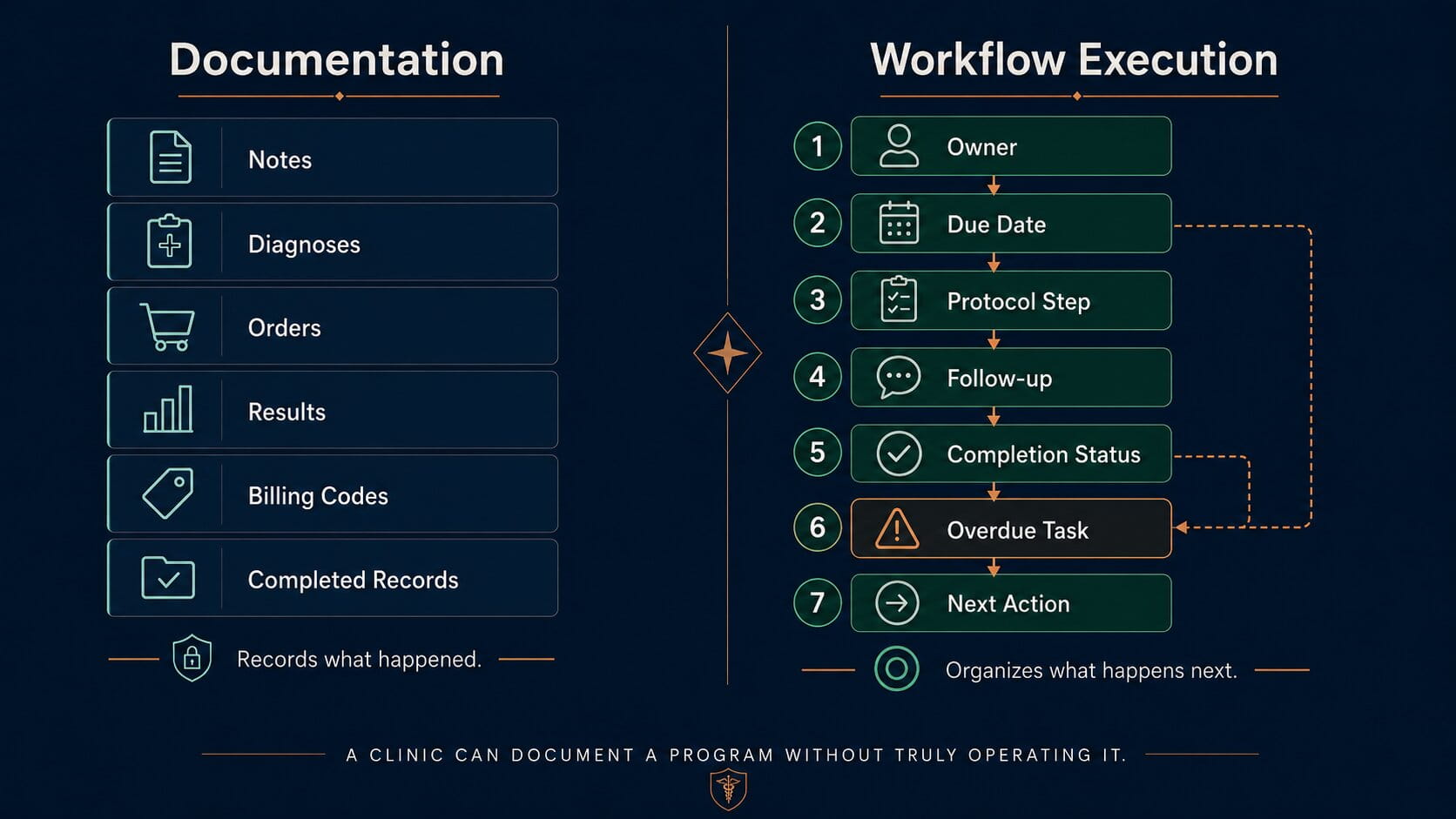
What is the difference between documentation and workflow execution? Documentation records what happened — diagnoses, orders, results, notes, and billing codes. Workflow execution organises what must happen next: who owns it, when it is due, whether it was completed, and how it affects the protocol. An EMR note can show that a lab was ordered; it rarely shows that the lab is due next week, assigned to a specific team member, and not yet completed.
Consider a cardiometabolic protocol. It may require a baseline panel, a clinician-reviewed protocol, a health-coach handoff, a 12-week retest, a protocol adjustment, and an outcomes review. Each step has an owner, a due date, and a dependency on the step before it. When those steps live only as notes, the clinic can document the program without truly operating it.
EMR interfaces and data models are optimised for notes, problem lists, and orders rather than for the state machines that protocol-driven care plans require, and workflow changes in EMRs often demand substantial custom configuration. Operationalising care — moving from recording events to driving them in sequence, with clear ownership — requires time-aware task management, visibility into pending and overdue items, and structured representation of care plan state across roles. A quality-improvement report from a 12-hospital health system found that workflow-embedded COVID-19 pathways were used 21,099 times by 3,474 providers, with 92.4% of uses applying the embedded testing recommendations. This demonstrates broad adoption in a hospital setting, but the study did not examine longevity clinics or compare patient outcomes.
Biomarker-Heavy Data Creates an Interoperability Problem
Protocol execution and outcomes reporting depend on turning multi-source data into structured, usable context — and that data rarely arrives that way. Labs, imaging, wearables, omics, and questionnaires typically exist in separate systems or enter the EMR as semi-structured results, which complicates biomarker tracking and panel-level analysis. Research on precision medicine interoperability readiness describes exponential growth in this kind of multi-modal data alongside persistent challenges in integrating it into coherent analytical frameworks. Incompleteness and variable data quality further limit the reuse of EMR data for analytics, decision support, and population-level reporting. These are not claims that data can be made perfectly complete or error-free; interoperability challenges are structural and ongoing, not a problem any single tool fully resolves.
Related reading: why longevity clinic data stays fragmented.
Protocol Governance Requires More Than Notes
What is the role of governance in personalized clinical protocols? Personalised, protocol-driven care requires formal governance: processes for protocol creation, review, approval, and versioning; defined clinical leads responsible for pathway quality; and regular audits of adherence and off-pathway decisions. Clinics need to know which protocol version a member is following, who approved any deviation, and why the deviation occurred. EMRs contribute generic audit trails and documentation, but they do not by themselves provide the structured, protocol-specific governance frameworks that clinical pathway literature describes as necessary — these are typically designed and implemented at the organisational level. In multi-provider settings, governance also has to extend across organisational boundaries, covering labs, imaging partners, and other external contributors to a member’s protocol.
Team-Based Delivery Creates Coordination Needs the EMR May Not Fully Support
Protocol-driven longevity programs are inherently team-based: physicians and medical directors oversee clinical decisions, health coaches and nutrition experts manage behavioural and lifestyle interventions, operations leads coordinate scheduling, and member-success teams manage engagement and follow-up. Multidisciplinary team research shows that this kind of coordination requires shared visibility into care plans, tasks, and biomarker trajectories, along with clearly defined role-based responsibilities for each protocol step. EMRs typically provide messaging and documentation, but they are not designed as multi-role workflow engines — which is why teams frequently resort to external tools or manual workarounds to know who owns what, and what is overdue.
Follow-Up, Retesting, and Adherence Need Longitudinal Infrastructure
Protocol-driven care does not end at the initial assessment; it depends on scheduled retesting, defined follow-up intervals, adherence visibility, and periodic reassessment. A four-year primary-care study evaluated an EHR-enabled, team-based population-health programme involving 6,768 people with diabetes. The intervention combined decision support, quality reporting, team-based care, patient engagement, and provider education. This adjacent evidence suggests that longitudinal programmes depend on coordinated workflows and reporting around the EHR, not documentation alone, but it does not establish results for longevity clinics. Clinics running protocol-heavy programs need registry-style visibility: which members are enrolled in which protocol, what labs are next due, and what outreach has already occurred. Many EMRs support basic problem lists and simple care plans but lack the richer, goal-oriented, longitudinal tracking that multi-program, multi-year protocols require.
Outcomes Reporting Requires Structured Data, Not Only Encounter Notes
Why is outcomes reporting difficult if data stays inside notes and PDFs? Outcomes reporting depends on defined metrics and consistent data structures; free-text encounter notes and disconnected PDFs cannot easily support population- or panel-level analysis. Research on EHR data incompleteness consistently flags that operational EHR data carries quality caveats that limit its use for rigorous outcomes analysis. Clinics cannot demonstrate longitudinal program value if the evidence remains scattered across notes, lab portals, and spreadsheets rather than organised into structured, comparable records.
Related reading: why longevity clinics struggle to prove clinical outcomes
What Clinics Should Look for Beyond the EMR
Clinics evaluating infrastructure beyond the EMR should assess capabilities rather than any single product’s feature list. A protocol-driven clinic benefits from an operating layer that supports:
Protocol workflow execution with time-aware tasks and dependencies
Biomarker data integration across labs, imaging, wearables, and omics
Clinical governance for protocol approval, versioning, and audit
Clinician approval workflows that keep oversight in the loop
Role-based task ownership across multidisciplinary teams
Longitudinal tracking of protocol state and adherence
Outcomes reporting built on structured, comparable data
Integration with the existing EMR rather than replacement of it
In the industry, this category of infrastructure is sometimes described as a Clinical OS. A Clinical OS is not a replacement for the EMR. It is an operating layer that coordinates protocols, data, teams, governance, and outcomes around the record. The term describes a category, not a specific product, and the underlying capability requirements are what matter when a clinic evaluates its options — not the label attached to any single vendor.
Related reading: longevity clinic operating system.
Conclusion: The EMR Is the Record, Not the Operating Model
The EMR remains foundational — the system of record for encounters, orders, billing, and compliance. But the recurring operational friction in protocol-driven longevity clinics — protocol drift, missed follow-ups, fragmented biomarker data, uneven team coordination, and weak outcomes visibility — typically stems from asking a record-keeping system to do execution work it was never designed for. The more durable framing is architectural: keep the EMR as the documentation foundation, and build or adopt a distinct operating layer that executes protocols, coordinates teams, integrates data, and reports outcomes in coordination with that record.
Frequently Asked Questions
Why are EMRs necessary but insufficient for longevity clinics?
EMRs provide the core system of record — documentation, orders, billing, and compliance — that every clinic needs. They are not designed to execute time-aware protocol steps, coordinate multidisciplinary teams, integrate biomarker data, or generate longitudinal outcomes reports, which is why protocol-driven longevity clinics typically need an additional operating layer alongside the EMR.
What is the difference between documentation and workflow execution?
Documentation records what happened — a diagnosis, an order, a result, a note. Workflow execution organises what must happen next: who owns each task, when it is due, whether it was completed, and how it affects the protocol. A clinic can fully document a program in its EMR while still lacking the infrastructure to actually run it.
What does a protocol-driven longevity clinic need beyond an EMR?
Beyond the EMR, protocol-driven clinics need workflow execution for time-aware tasks, biomarker data integration across labs and wearables, formal protocol governance and versioning, multidisciplinary team coordination, longitudinal follow-up tracking, and structured outcomes reporting.
Is a Clinical OS a replacement for an EMR?
No. A Clinical OS is an operating layer that coordinates protocols, data, teams, governance, and outcomes around the EMR — it does not replace the record. The EMR remains the system of record; the Clinical OS is the system of execution built on top of it.
Why is outcomes reporting difficult in longevity clinics?
Outcomes reporting requires defined metrics and consistent, structured data. When biomarker and program data remain scattered across encounter notes, PDFs, and lab portals, clinics cannot easily assemble the population- or panel-level evidence needed to demonstrate longitudinal program value.
Sources and Further Reading
Meeting the challenges of electronic health record (EHR) optimization — Nature Digital Medicine (nature.com)
Successful Implementation of Workflow-Embedded Clinical Pathways — PMC (pmc.ncbi.nlm.nih.gov)
Obtaining Data From Electronic Health Records — NCBI Bookshelf (ncbi.nlm.nih.gov)
Long-Term Impact of an EHR-Enabled, Team-Based Population Health Strategy Based on the Chronic Care Model — PMC (pmc.ncbi.nlm.nih.gov)
Why Is the Electronic Health Record So Challenging for Research and Clinical Care? — PMC (pmc.ncbi.nlm.nih.gov)
Incompleteness of Electronic Health Records: An Impending Challenge — PMC (pmc.ncbi.nlm.nih.gov)
Multi-modal AI in Precision Medicine: Integrating Genomics, Imaging, and EHR Data — PMC (pmc.ncbi.nlm.nih.gov)
Assessing the Readiness of Precision Medicine Interoperability — PMC (pmc.ncbi.nlm.nih.gov)
Optimizing Multidisciplinary Team Workflow — JICRCR (jicrcr.com)
Implementing a Successful Oncology Pathways Program — Elsevier (elsevier.com)
Chronic Care Management (CCM) Comprehensive Care Plan Template — HSAG (hsag.com)
Challenges and Recommendations for High-Quality Research Using Electronic Health Records — Frontiers in Digital Health (frontiersin.org)
HolistiCare provides clinical decision-support infrastructure; it is not a licensed medical provider or electronic health record. All diagnostics, care protocols, and clinical decisions remain exclusively the responsibility of qualified healthcare professionals. Insights generated by HolistiCare’s AI engine are for clinical and informational use only and do not constitute medical advice, diagnosis, or treatment.