
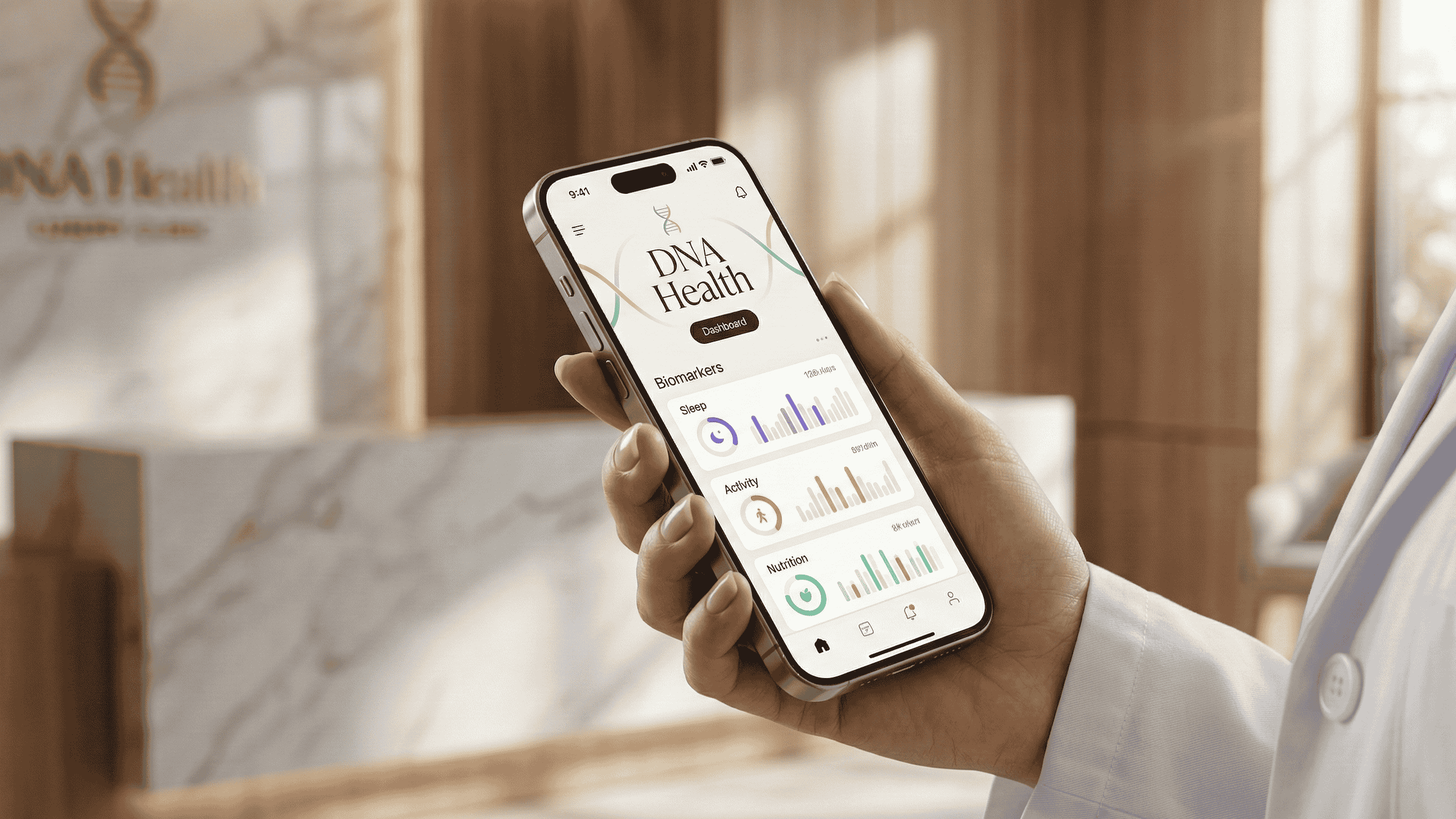
HolistiCare’s white-label wellness software represents a critical competitive advantage in today’s healthcare landscape. Recent industry reports estimate that 15-25% of U.S. telehealth platforms are proprietary software, meaning about 75-85% of healthcare providers rely on vendor platforms rather than developing their own. This shift comes as telehealth visits have risen 50-175x from 2018-2020, with global telemedicine revenue projected to reach $159.4-$431.82 billion by 2028.
When you force high-ticket concierge clients to use third-party apps, you lose valuable brand equity and pricing power. As a result, your clinic misses opportunities to justify premium fees while competing in a rapidly expanding health and wellness market expected to reach $8,945.3 billion by 2032. What your competitors already understand is that branded patient apps create a closed loop of trust and exclusivity that premium clients expect. In fact, research shows fast-growing companies attribute 40% more of their revenue to customized experiences compared to slow-growing competitors, with about 71% of customers expecting some level of personalization.
This article explores how white-label wellness solutions can transform your clinic’s digital presence, enhance patient engagement, and create sustainable competitive advantages through personalized care delivery that scales without sacrificing quality.
The Scaling Paradox: Why Growth Breaks Personalization
The healthcare industry faces a fundamental tension between growth and personalized care. As clinics expand their patient base, the very qualities that initially attracted clients—individualized attention, tailored wellness plans, and high-touch service—become increasingly difficult to maintain.
How scaling wellness protocols creates operational friction
Modern clinics encounter a breaking point when operational demands outpace their team’s capabilities. Initially, this friction appears subtly through delays, miscommunications, or tasks falling through cracks [1]. As your practice grows, providers feel rushed because scheduling workflows become inconsistent, while front desk staff become overwhelmed triaging questions that should be clinical conversations.
This operational strain isn’t due to lack of effort or skill but emerges from blurred boundaries between clinical and operational workflows [1]. Without intentionally designed systems, these micro-gaps create macro consequences: patients arrive unprepared, providers lose time clarifying basic information, and compliance risks increase due to inconsistent documentation.
Furthermore, the traditional healthcare delivery model simply cannot scale efficiently. Studies show service businesses that scale rapidly see customer satisfaction scores drop in the first two years of expansion [2]. Without proper operational infrastructure, the qualities that initially attracted clients deteriorate under growth pressure.
Why personalization becomes harder as patient volume increases
Staffing shortages directly correlate with higher morbidity rates, reduced patient satisfaction, and most significantly, limited ability to personalize care experiences [3]. Yet, personalized approaches remain essential—research confirms they yield better engagement and outcomes in behavioral interventions [3].
The fundamental challenge is straightforward: humans excel at personalization but cannot scale infinitely [3]. As patient volume grows, practitioners struggle to maintain the same level of individualized attention that distinguished their practice initially.
Consider these statistics: fast-growing companies attribute 40% more revenue to customized experiences compared to slow-growing competitors, with approximately 71% of customers expecting some level of personalization.
Nevertheless, according to healthcare data breach reports, security concerns compound these challenges, with healthcare ransomware attacks increasing 278% between 2018-2023 [5]. This forces clinics to balance personalization with robust data protection.
The role of white-label wellness software in solving this paradox
White-label wellness software provides a critical solution to the scaling paradox in healthcare. These platforms utilize AI-powered automation to handle repetitive administrative tasks that typically consume valuable clinical hours. Instead of investing in costly infrastructure, white-label health testing platforms manage all logistics and testing while maintaining client relationships under your brand.
The key advantages become clear:
- Automation and AI dramatically expand capacity without adding staff.
- Cohort signal detection tools identify potential health issues at group levels without compromising individual privacy.
- Security protocols protect sensitive patient data through full encryption.
- Mobile accessibility allows program delivery to anyone with a smartphone.
Essentially, white-label wellness software creates operational muscle—hardening infrastructure, architecting for security, and engineering for scale. This allows you to deliver personalized care that maintains the high-touch experience your premium clients expect, regardless of your growth trajectory.
Clinic-Branded Apps and the Psychology of Trust
Trust forms the cornerstone of healthcare relationships, particularly in digital wellness environments where physical touchpoints are limited. Patients making health decisions online must navigate complex information while facing potential risks—a scenario that elevates trust from a mere preference to an essential requirement.
Why high-net-worth patients prefer branded patient apps
High-net-worth individuals demonstrate distinctive preferences regarding their healthcare technology. These clients, often accustomed to premium experiences across all service categories, view generic health apps as incongruent with the exclusive care they expect. Research indicates that trust spikes in importance particularly when health decisions involve perceived high risk, complex information, hard-to-verify quality, and identity-linked choices [7]—all factors present in premium wellness services.
Moreover, healthcare decisions utilize both emotional and analytical processing. Emotionally, patients ask: “Do I feel safe with this brand?” and “Does this align with who I want to be?” Analytically, they question: “Is this legitimate?” and “Do they have expertise?” [7]. Your clinic’s branded app simultaneously addresses both processing types, creating a cohesive experience that generic apps cannot replicate.
The psychological mechanism at work involves what researchers call “identity-linked” decisions, where clients view their healthcare choices as reflections of personal values [7]. For affluent clients, using your branded app reinforces their self-perception as someone who prioritizes premium, personalized care.
Perceived safety and premium value in private label healthcare platforms
Safety perception directly influences technology adoption in healthcare. Notably, feeling safe refers not only to freedom from physical harm but encompasses emotional safety—a basic human need that affects attitudes toward technological innovation [8]. A white-label wellness app creates this crucial sense of safety through consistent branding that patients already trust.
Patient concerns about healthcare apps are substantiated by evidence showing apps can pose clinical risks to consumers [9]. Consequently, when patients use a branded app from their trusted provider, the perceived safety significantly increases compared to using an unknown third-party application.
The premium value perception stems from four key factors:
-
Consistency – Unified messaging across all patient touchpoints [10]
-
Human connection – Showcasing the real people behind your clinic [10]
-
Evidence-based credibility – Transparent access to qualifications and methods [10]
-
Engaged responsiveness – Demonstrating accountability through direct communication [10]
Moreover, healthcare decisions utilize both emotional and analytical processing. Emotionally, patients ask: “Do I feel safe with this brand?” and “Does this align with who I want to be?” Analytically, they question: “Is this legitimate?” and “Do they have expertise?” [7]. Your clinic’s branded app simultaneously addresses both processing types, creating a cohesive experience that generic apps cannot replicate.
The psychological mechanism at work involves what researchers call “identity-linked” decisions, where clients view their healthcare choices as reflections of personal values [7]. For affluent clients, using your branded app reinforces their self-perception as someone who prioritizes premium, personalized care.
Impact on patient engagement for clinics
The implementation of clinic-branded apps creates measurable improvements in patient engagement metrics. Primarily, this occurs because higher acceptability increases patient adherence, leading to improved clinical outcomes [8]. When patients recognize the relevance of your branded solution, they demonstrate markedly increased engagement compared to generic alternatives.
Digital transformation has become increasingly vital in healthcare, particularly as clinics face challenges related to demographic changes [8]. White-label wellness software enables this transformation while maintaining the trust relationship between provider and patient.
From a business perspective, the engagement advantage translates directly to retention. High acceptability of your branded app increases adherence to wellness protocols, which simultaneously improves outcomes and strengthens patient loyalty. Thus, the investment in white-label technology creates a positive feedback loop—better engagement leads to better results, which further reinforces trust in your clinic’s brand.
Simultaneously, this approach addresses the emerging public health issue of app safety [9] by keeping patients within your clinic’s trusted digital ecosystem rather than sending them to potentially problematic third-party solutions.
AI-Driven Protocols Behind the White-Label Interface
Behind every white-label wellness app lies a sophisticated AI engine that transforms raw patient data into actionable insights. Unlike traditional wellness platforms, these AI-driven systems adapt in real-time to individual health patterns.
How AI generates personalized care plans from biomarker data
Modern white-label wellness software analyzes complex biomarker data—from cortisol levels to heart rate variability—to reveal underlying patterns that human clinicians might miss. These biological signals provide objective insight into internal emotional and cognitive states [2]. The AI engine processes this information alongside genetics, medical history, and lifestyle factors to generate highly individualized treatment protocols.
Studies show that AI-powered personalized health recommendations can dramatically improve patient outcomes. Studies show AI-powered personalized health recommendations can improve outcomes, such as blood pressure management, by up to 50-70% compared to generic advice in specific cases.
The technology works by identifying biological indicators that predict susceptibility to specific health conditions. AI systems can then monitor these biomarkers over time, enabling early intervention before symptoms escalate [2]. This predictive capability represents a significant advancement in preventive wellness care.
Automated scaling of wellness programs across patient cohorts
White-label wellness platforms solve the scaling paradox through what experts call the “AI-powered feedback system.” These systems detect subtle changes in patient data, monitor treatment responses, and automatically adjust protocols accordingly [12].
The real advantage emerges at scale. AI tools identify trends across patient populations, revealing which interventions drive significant health improvements and where additional resources might be needed [11]. Additionally, these systems handle routine inquiries, schedule wellness appointments, and process health information—freeing your clinical team for high-value interactions.
Practically speaking, this means one clinician can effectively manage exponentially more patients without sacrificing care quality. AI systems can generate treatment plans within minutes or seconds, versus the hours traditional providers might require [12].
Clinician override and control in AI-generated plans
Despite AI’s capabilities, human clinical judgment remains paramount. Effective white-label wellness software includes robust override options that maintain clinician authority in all health decisions. This balance is essential—physicians currently override approximately 87% of AI diagnoses in some settings [13].
However, recent innovations have improved this dynamic. When AI systems express confidence levels in their recommendations, override rates drop substantially—to just 33% overall and only 1.7% when AI shows high confidence [13].
Legislators recognize this need for human oversight. Recent legislation requires healthcare AI systems to include override options, ensuring that healthcare workers can prevent incorrect AI decisions [14]. This safeguard maintains the critical human element in wellness care while leveraging AI’s analytical power.
Clinic A vs Clinic B: The Retention and Revenue Gap
To truly understand the impact of white-label wellness software, consider two similar clinics following dramatically different digital strategies, each yielding measurably different business outcomes. These examples are illustrative based on industry trends and not specific case studies.
Clinic A: Using a generic SaaS tool
Clinic A relies on off-the-shelf telehealth and wellness solutions. Their patients juggle multiple logins across disconnected platforms—scheduling in one system, messaging in another, and accessing health records in a third. This fragmentation creates what healthcare technologists call “digital friction,” where each additional step reduces engagement.
Despite offering excellent care, Clinic A’s digital experience undermines their premium positioning. Their patients see third-party logos during critical health interactions, diluting the clinic’s brand equity. Patients often express confusion about which company actually provides their care.
The results speak volumes: Clinic A experiences dropout rates of approximately 40% in its wellness programs [15]. Their generic tools lack cohesive workflows, leading to substantial operational inefficiencies as staff manually connect data between systems.
Clinic B: Using a white-label wellness app
In contrast, Clinic B implemented a comprehensive white-label wellness platform featuring their own branding, colors, and domain. This creates what behavioral economists call “trust continuity”—where every digital interaction reinforces patient confidence in the clinic’s expertise.
The difference is striking: after implementing their branded platform, Clinic B saw:
-
40% fewer program dropoffs
-
2× higher client engagement
-
3× more recurring revenue
-
Double the referrals
-
Stronger retention in subscription programs [15]
Beyond statistics, Clinic B’s patients consistently report feeling “more supported” during treatment [16]. The seamless experience provides automatic appointment reminders, personalized touchpoints, and simple access to support [15].
Patient retention, satisfaction, and pricing power comparison
Patient satisfaction can reach up to 98% with properly implemented telehealth portals, based on industry benchmarks. Yet retention represents just one facet of the business advantage. Clinic B demonstrates significantly stronger pricing power—the ability to command premium fees without resistance.
This pricing advantage stems directly from perception. High-net-worth patients associate proprietary technology with premium care. When they see your branding throughout their digital experience, it reinforces the exclusive nature of your practice.
The ROI difference becomes unmistakable within 60 days of implementation [15]. Clinic B generates substantially higher lifetime patient value through extended relationships and higher fee acceptance. Their white-label approach creates what economists call “service differentiation”—where seemingly similar services command different market prices based on perception alone.
Interested in seeing these results in your practice? Book a 30-minute demo at holisticare.io to explore how white-label wellness software can transform your patient experience and financial outcomes.
Implementation and Customization: What You Can Control
Taking control of your digital health platform begins with understanding the three key customization areas of white-label wellness software.
Custom branding and domain setup
Primarily, white-label wellness platforms allow you to display your clinic’s identity throughout the patient experience. Your logo, brand colors, fonts, and app icon appear at every digital touchpoint [6]. This comprehensive branding extends to splash screens and email templates, creating a cohesive experience that reflects your unique practice culture [6]. This seamless branding delivers a turnkey platform that grows with your practice [6].
Role-based workflows and permissions
Role-based access control creates intelligent security boundaries within your clinic’s digital ecosystem. This structured approach means:
-
Receptionists see only appointment calendars
-
Physicians have access to full patient records
-
Pharmacists view prescriptions and medication history
-
Administrators oversee complete system functions
This precision in permissions safeguards sensitive patient data yet maintains operational flexibility—senior physicians can access more information than interns. Temporary access can be granted for urgent situations without compromising long-term security.
Integration with concierge medicine technology stacks
Subsequently, white-label wellness platforms connect seamlessly with your existing technology infrastructure. Many systems integrate directly with popular EHR platforms like Elation and Athena [18]. Native iOS and Android applications ensure both physicians and patients enjoy frictionless digital experiences [19].
Ready to explore customization options for your clinic? Book a 30-minute demo at holisticare.io to see these features firsthand.
Conclusion
White-label wellness software stands as the defining factor between clinics that merely survive and those that truly thrive in today’s competitive healthcare landscape. Throughout this article, we’ve seen how branded patient apps create that essential closed loop of trust and exclusivity your premium clients expect.
Your high-net-worth patients actively seek personalized experiences that reflect their values and status. Therefore, when you force them to use generic third-party apps, you unwittingly sacrifice both brand equity and pricing power. Fast-growing clinics understand this reality—personalized, branded experiences directly correlate with higher retention rates, stronger patient engagement, and significantly increased revenue.
The contrast remains stark between clinics using off-the-shelf solutions and those implementing white-label wellness platforms. While generic SaaS tools fragment the patient experience across multiple systems, your branded app creates trust continuity at every touchpoint. This difference manifests tangibly through 40% fewer program dropouts, doubled client engagement, and tripled recurring revenue.
AI-driven protocols behind your branded interface solve the fundamental scaling paradox. Despite growing patient volumes, these systems maintain personalization through automated care plans based on biomarker data. Still, clinician override capabilities ensure human judgment remains central to all health decisions.
Custom branding, role-based workflows, and seamless integration with your existing technology infrastructure transform how patients perceive your practice. Book a 30-minute demo at holisticare.io to discover exactly how these features can elevate your clinic’s digital presence while maintaining the high-touch experience your premium clients expect.
As healthcare continues its digital transformation, your clinic faces a clear choice—either blend into the background of generic telehealth platforms or stand out with a branded wellness experience that justifies premium fees. White-label wellness software doesn’t simply improve operational efficiency; it fundamentally strengthens your market position through the power of personalization at scale.
Key Takeaways
White-label wellness software transforms clinics from generic service providers into premium healthcare brands that command higher fees and deeper patient loyalty.
• Brand equity drives pricing power: High-net-worth patients expect branded apps that reflect their premium care investment, not generic third-party platforms that dilute your clinic’s exclusivity.
• AI solves the scaling paradox: White-label platforms use AI to generate personalized care plans from biomarker data, enabling one clinician to manage 50× more patients without sacrificing quality.
• Retention rates double with branded experiences: Clinics using white-label apps see 40% fewer dropouts, 2× higher engagement, and 3× more recurring revenue compared to generic SaaS tools.
• Trust continuity creates competitive advantage: Seamless branded experiences from scheduling to treatment reinforce patient confidence at every touchpoint, justifying premium fees.
• Implementation is turnkey: Custom branding, role-based workflows, and EHR integration create a professional platform that grows with your practice while maintaining clinical oversight.
The healthcare market is rapidly digitizing, and clinics must choose between blending into generic telehealth platforms or standing out with branded wellness experiences that justify premium positioning. White-label wellness software doesn’t just improve efficiency—it fundamentally strengthens your market position through personalization at scale.
FAQs
Q1. What are the main benefits of using white-label wellness software for clinics? White-label wellness software offers clinics branded patient apps, AI-driven personalized care plans, improved patient retention, higher engagement rates, and increased recurring revenue. It also helps solve the scaling paradox by allowing clinics to manage more patients without sacrificing personalized care.
Q2. How does white-label wellness software impact patient trust and engagement? White-label wellness software creates a cohesive, branded experience that reinforces patient trust in the clinic. This leads to higher engagement rates, with some clinics reporting doubled client engagement and 40% fewer program dropouts compared to generic solutions.
Q3. Can white-label wellness software integrate with existing clinic systems? Yes, many white-label wellness platforms can seamlessly integrate with popular EHR systems and existing clinic technology stacks. They also offer native iOS and Android applications for both physicians and patients, ensuring a smooth digital experience.
Q4. How does AI contribute to personalized care in white-label wellness software? AI in white-label wellness software analyzes complex biomarker data, medical history, and lifestyle factors to generate highly individualized treatment protocols. It can monitor biomarkers over time, enabling early intervention and adjusting protocols automatically based on patient responses.
Q5. What customization options are available with white-label wellness software? White-label wellness software offers extensive customization options, including custom branding with your clinic’s logo, colors, and domain. It also provides role-based workflows and permissions to ensure appropriate access to patient data for different staff members.
References
[1] – https://docuhealth.com/clinical-operations-vs-healthcare-operations-simple-explanation/
[2] – https://abpp.org/newsletter-post/artificial-intelligence-biomarkers-in-mental-health-care-moving-towards-a-new-era-of-personalized-treatment/
[3] – https://pmc.ncbi.nlm.nih.gov/articles/PMC10084530/
[4] – https://healthray.com/blog/clinic-management-systems/role-based-access-in-clinic-software-protecting-data-the-smart-way/
[5] – https://www.redpointglobal.com/blog/2025-healthcare-trends-how-personalization-is-reshaping-the-patient-experience/
[6] – https://www.wellness360.co/white-label-wellness-program/
[7] – https://www.thecoupetcollective.com/blog/the-psychology-behind-wellness-brand-trust
[8] – https://link.springer.com/article/10.1186/s13643-024-02465-9
[9] – https://academic.oup.com/jamia/article/27/2/330/5585394
[10] – https://www.interdependence.com/trust-is-currency-how-health-and-wellness-brands-can-build-credibility-in-an-ever-skeptical-consumer-base/
[11] – https://www.glean.com/perspectives/what-is-the-role-of-ai-in-employee-wellness-programs
[12] – https://pmc.ncbi.nlm.nih.gov/articles/PMC10930608/
[13] – https://www.linkedin.com/posts/zytertrucare_aiinhealthcare-caremanagement-clinicaldecisionsupport-activity-7383895049065054210-xmu2
[14] – https://www.meritalk.com/articles/senate-proposal-aims-to-establish-ai-override-button-in-healthcare/
[15] – https://oladigital.health/boosting-wellness-program-roi-with-ola-digital-health-solutions/
[16] – https://ac-health.com/white-label-branded-app-pricing-page/
[17] – https://www.qualifacts.com/resources/how-to-increase-patient-satisfaction-with-a-white-label-telehealth-portal/
[18] – https://headsuphealth.com/concierge-medicine-platform/
[19] – https://mdintegrations.com/
Disclaimer
The information in this article is provided by HolistiCare for general informational purposes only and is not intended to be a substitute for professional medical advice, diagnosis, or treatment. HolistiCare does not warrant or guarantee the accuracy, completeness, or usefulness of any information contained in this article. Reliance on any information provided here is solely at your own risk.
This content does not create a doctor-patient relationship. Clinical decisions should be made by qualified healthcare professionals using clinical judgment and all available patient information. If you have a medical concern, contact your healthcare provider promptly.
HolistiCare may reference biomarker roles, study examples, products, or tools. Mention of specific tests, biomarkers, therapies, or vendors is for illustrative purposes only and does not imply endorsement. HolistiCare is not responsible for the content of third party sites linked from this article, and inclusion of links does not represent an endorsement of those sites.
Use of HolistiCare software, services, or outputs should be in accordance with applicable laws, regulations, and clinical standards. Where required by law or regulation, clinical use of biomarker information should rely on validated laboratory results and regulatory approvals. HolistiCare disclaims all liability for any loss or damage that may arise from reliance on the information contained in this article.
If you are a patient, please consult your healthcare provider for advice tailored to your clinical situation. If you are a clinician considering HolistiCare for clinical use, contact our team for product specifications, regulatory status, and clinical validation documentation.
All claims and statistics are based on cited studies and industry reports as of 2026. Individual results may vary; consult healthcare professionals for personalized advice. HolistiCare features are designed to support evidence-based holistic care.